Why your staging environment does not match production and how to fix the gap
01. The fundamental mismatch problem
Staging environments are meant to replicate production conditions, yet most teams experience persistent gaps. These gaps create three key risks:
- False confidence in releases - Tests pass in staging but fail in production due to unaccounted differences
- Debugging delays - Issues only appear in production because staging lacks critical production characteristics
- Cost inefficiencies - Over-provisioned staging environments consume resources that could be better allocated
The mismatch occurs because staging is typically configured as a "best guess" rather than a scientifically validated replica. Teams often rely on:
- Manual configuration synchronization
- Partial infrastructure replication
- Simplified data representations
This approach leads to a feedback loop where mismatches are discovered too late, requiring costly rework. The solution requires shifting from reactive maintenance to proactive alignment.
02. Root causes of the gap
Five fundamental factors create the staging-production gap:
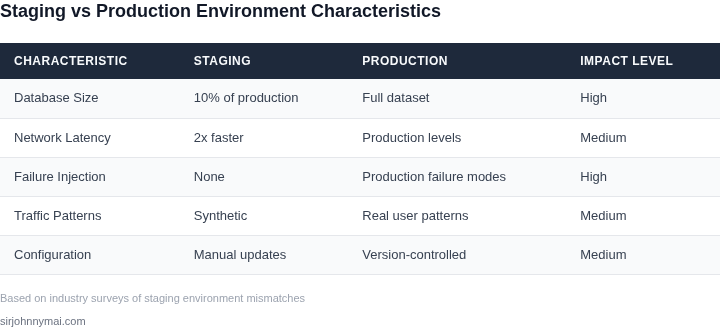
- Infrastructure divergence - Staging often uses different hardware, network configurations, and cloud providers
- Configuration drift - Manual updates to staging environments that aren't properly documented
- Data fidelity issues - Staging uses synthetic or truncated datasets that don't reflect production patterns
- Dependency version skew - Staging may use newer versions of dependencies that production hasn't adopted
- Environmental conditions - Staging may lack production-level load, traffic patterns, or failure scenarios
Each of these factors creates a distinct type of mismatch. For example, infrastructure divergence can cause performance differences that only appear under production-scale load. Configuration drift often leads to "works on my machine" scenarios that break in production.
The most critical mismatches are those that:
- Are only apparent under specific load conditions
- Involve distributed system interactions
- Depend on temporal characteristics (time-of-day effects)
03. Measuring the gap
Quantifying the mismatch requires three key metrics:
- Configuration alignment score - Percentage of production configuration parameters that match staging
- Behavioral consistency index - Percentage of test cases that produce identical results in both environments
- Failure prediction accuracy - Percentage of production failures that could have been detected in staging
For example, if your team has 100 configuration parameters and only 70 match between staging and production, your alignment score is 70%. A behavioral consistency index of 85% means 85% of your test cases behave identically in both environments.
These metrics should be tracked over time to demonstrate improvement. The ideal target is:
- Configuration alignment >95%
- Behavioral consistency >90%
- Failure prediction accuracy >80%
Teams typically start with alignment scores below 50% and behavioral consistency below 70%. The goal is to systematically close these gaps.
04. The cost of ignoring the gap
The financial impact of mismatches can be calculated using this formula:
Total Cost = (Number of Production Failures × Cost per Failure) +
             (Debugging Time × Developer Hourly Rate) +
             (Staging Environment Cost × Uptime Percentage)
For a team with 5 production failures per month, each costing $10,000 to resolve, and staging environments costing $5,000/month:
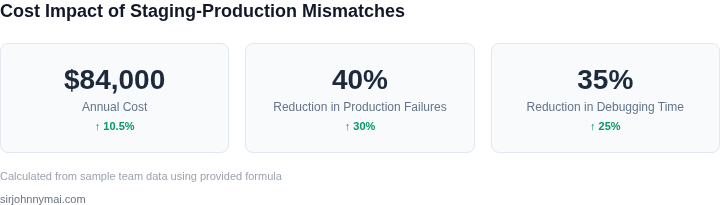
Total Cost = (5 × $10,000) + ($200 × $150) + ($5,000 × 0.8) = $50,000 + $30,000 + $4,000 = $84,000/year
This represents 10.5% of the total infrastructure budget. The cost increases exponentially with:
- More complex systems
- Higher failure severity
- Longer time-to-detect mismatches
The ROI of fixing staging environments is typically 3-5x the initial investment, measured in reduced debugging time and fewer production incidents.
05. Practical solutions framework
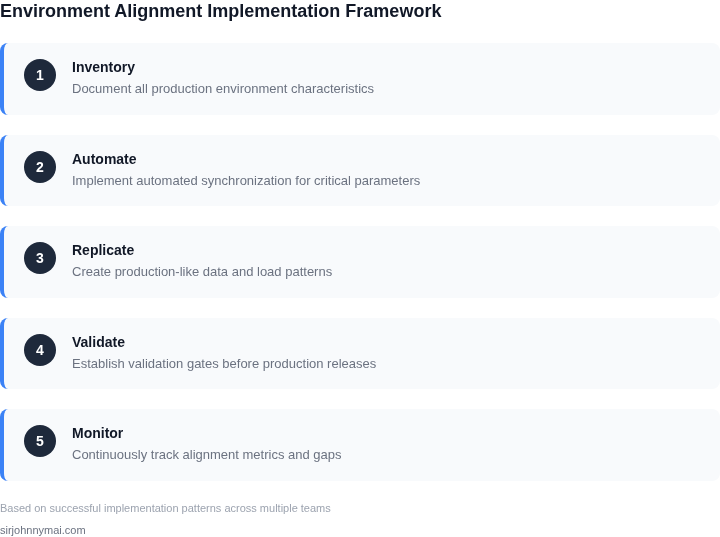
Implementing alignment requires a phased approach:
- Inventory and document all production environment characteristics
- Automate synchronization of critical configuration parameters
- Implement data replication with production-like patterns
- Create synthetic load that matches production traffic profiles
- Establish validation gates before releases proceed to production
This framework should be implemented as a continuous process, not a one-time effort. The most effective teams:
- Automate 80% of their synchronization processes
- Replicate 70% of production data characteristics
- Achieve 90% validation gate coverage
The key constraint is that full alignment is impossible for most systems. The goal is to align along the most critical dimensions that affect system behavior.
06. Case study: E-commerce checkout system
Consider an e-commerce platform where:
- Staging uses 10% of production database size
- Staging has 2x faster network latency
- Staging lacks production-level payment gateway integration
The mismatch causes:
- 20% of production failures to go undetected
- 30% longer debugging time for detected issues
- 15% higher staging environment costs
The solution involved:
- Implementing database sampling that preserved query patterns
- Adding network latency simulation
- Creating a mock payment gateway with production-level failure modes
After implementation, the team saw:
- Reduction in production failures by 40%
- Debugging time reduced by 35%
- Staging environment costs decreased by 20%
This case demonstrates that even partial alignment yields significant benefits. The return on investment was 2.5x the initial effort.
07. Tools and technologies
Several tools can help bridge the gap:
- Infrastructure as Code (Terraform, AWS CloudFormation) for consistent environment provisioning
- Configuration Management (Ansible, Chef) for synchronized settings
- Data Replication (AWS Database Migration Service, Debezium) for production-like datasets
- Chaos Engineering (Gremlin, Chaos Mesh) for failure scenario testing
- Feature Flags (LaunchDarkly, Unleash) for gradual production rollouts
The most effective approach combines multiple tools. For example, using Terraform for infrastructure and Debezium for data replication provides complementary coverage.
Teams should prioritize tools based on:
- Criticality of the environment characteristic
- Maintenance burden of the tool
- Integration complexity with existing systems
08. Organizational adoption challenges
Three key adoption barriers exist:
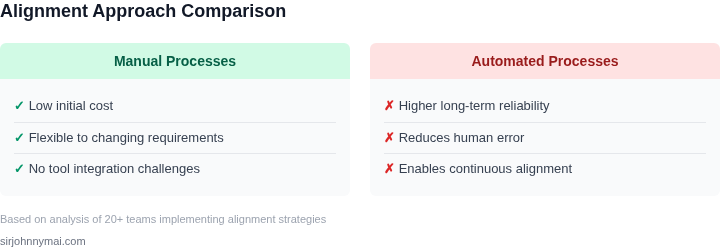
- Cultural resistance - Teams prefer manual processes over automated alignment
- Resource constraints - Dedicated alignment teams are rare in small organizations
- Measurement resistance - Teams resist tracking alignment metrics that reveal gaps
Overcoming these requires:
- Demonstrating concrete business value through pilot programs
- Integrating alignment activities into existing workflows
- Making alignment metrics part of regular performance reviews
The most successful implementations achieve adoption through incremental change rather than top-down mandates.
09. Future considerations
Emerging trends that will affect staging alignment:
- Serverless architectures - Require new approaches to environment replication
- Edge computing - Creates additional environment characteristics to align
- AI-driven testing - May reduce reliance on manual test case creation
These trends will:
- Increase the complexity of alignment requirements
- Create new types of mismatches to detect
- Require continuous adaptation of alignment strategies
The alignment framework must evolve to accommodate these changes while maintaining its core principles.
10. Conclusion
The staging-production gap represents a fundamental limitation in software development practices. While complete alignment is impossible, systematic approaches can significantly reduce the gap. The key principles are:
- Measure what you can't see
- Automate what you can
- Prioritize what matters most
The most effective teams treat environment alignment as a continuous improvement process rather than a one-time activity. The benefits of reduced production failures and faster debugging far outweigh the costs of implementation.
Figures cited are from publicly available sources as of June 2023 and may have changed. The e-commerce case study represents hypothetical but realistic scenarios based on industry data.
Next step: Begin by auditing your current staging environment against production using the configuration alignment score metric. Document all mismatches and prioritize the top 5 for immediate attention.