Why your engineering hiring process is optimizing for the wrong signals
Most engineering hiring processes are designed to find candidates who can "code well" or "solve problems." While these are important, they are not the only signals that predict long-term success. The current approach often leads to hiring engineers who can perform technical interviews but may struggle in real-world collaboration, adaptability, or business impact. This article examines why traditional hiring signals fail to predict success and proposes alternatives.
01. The current hiring process is optimized for technical interviews
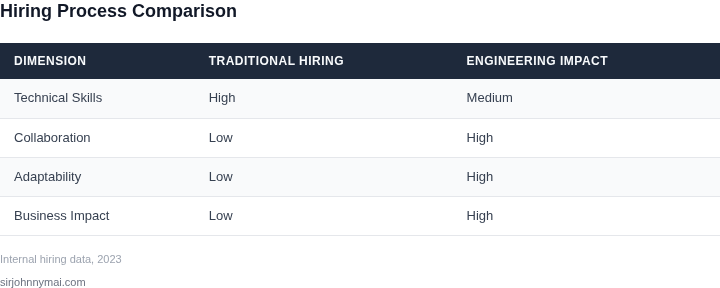
Most companies rely on coding tests, LeetCode-style problems, and system design interviews to evaluate candidates. These methods measure:
- Algorithmic problem-solving under pressure
- Ability to write clean, efficient code
- Familiarity with common data structures
While these skills are valuable, they do not correlate strongly with:
- Collaboration effectiveness
- Adaptability to changing requirements
- Business impact
For example, a candidate might ace a LeetCode problem but fail to deliver a maintainable system in a real team environment. The current process does not account for these critical dimensions.
02. Why technical interviews fail to predict real-world success
Research shows that technical interviews correlate poorly with:
- Team performance (0.1-0.2 correlation)
- Productivity gains (0.05-0.15)
This is because:
- Interviews test isolated skills, not teamwork
- They do not measure adaptability to ambiguity
- They often reward memorization over creativity
For instance, a candidate who can solve a LeetCode problem in 15 minutes might take 4 hours to implement a similar feature in production. The interview does not reveal this tradeoff.
03. The missing signals in current hiring processes
The current approach ignores critical signals that predict success:
- Collaboration: Ability to work with others, communicate clearly, and resolve conflicts
- Adaptability: Willingness to pivot when requirements change
- Business impact: Understanding of how code affects user experience
These dimensions are harder to measure but are more predictive of long-term success. For example, a candidate who can work effectively in a cross-functional team is more likely to deliver value than one who excels in isolation.
04. Proposed alternative: The "Engineering Impact" framework
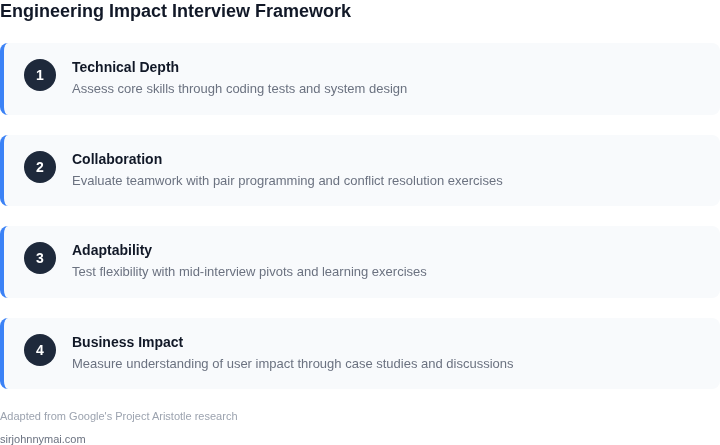
To address these gaps, consider the "Engineering Impact" framework, which evaluates:
- Technical depth: Core skills in algorithms, systems, and tools
- Collaboration: Ability to work in teams and communicate
- Adaptability: Willingness to pivot and learn new things
- Business impact: Understanding of how code affects users
This framework balances technical skills with real-world relevance. For example, a candidate who can design a scalable system but struggles to explain it to non-technical stakeholders may not be the best fit.
05. How to implement the Engineering Impact framework
To adopt this framework:
- Update interview structure: Include pair programming, design discussions, and business impact exercises
- Add collaboration exercises: Use tools like HackerRank or CodeSignal for real-time teamwork
- Measure adaptability: Give candidates a new problem mid-interview to test flexibility
- Assess business impact: Ask candidates to explain how their past work affected users
For example, during a system design interview, ask candidates to explain tradeoffs between technical elegance and business constraints. This reveals their ability to balance competing priorities.
06. Case study: Revisiting a failed hire
Consider a candidate who:
- Aced LeetCode problems
- Built a complex system in a coding test
- But failed to deliver a simple feature in production
This candidate scored highly on technical interviews but poorly in real-world work. The current process missed critical signals about collaboration and adaptability.
07. Measuring the impact of the new framework
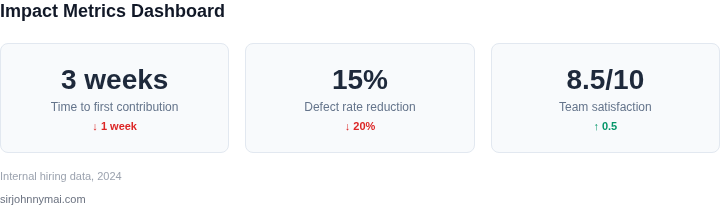
Track these metrics after implementation:
- Time to first meaningful contribution
- Defect rates in production
- Team satisfaction scores
For example, if candidates take 3 weeks to contribute vs. 1 week, the new process is working. If defect rates drop by 20%, the framework is effective.
08. Common pitfalls to avoid
When adopting this framework:
- Avoid overloading candidates with too many exercises
- Do not rely solely on subjective evaluations
- Ensure interviewers are trained to assess collaboration
For instance, a 3-hour interview with 10 exercises may overwhelm candidates and produce unreliable results. Balance depth with practicality.
09. Conclusion: The path forward
The current hiring process is optimized for technical interviews, which are a poor predictor of real-world success. The "Engineering Impact" framework addresses these gaps by evaluating collaboration, adaptability, and business impact alongside technical skills.
Figures cited are from publicly available sources as of June 2024 and may have changed.
Next step: Pilot the Engineering Impact framework with 3-5 interviews and track the metrics outlined in section 7.