Why your disaster recovery plan will fail and how to test it properly
01. The hidden assumptions that kill DR plans
Most disaster recovery (DR) plans fail because they're built on flawed assumptions. The most dangerous is assuming "it can't happen here." Every organization has a unique risk profile, but DR plans often treat all companies as identical. This leads to:
- Underestimating the scale of potential outages (e.g., assuming only one region will fail)
- Overlooking application-specific failure modes (e.g., database corruption)
- Ignoring human factors (e.g., staff not knowing how to execute the plan)
The reality is every DR plan should start with a risk assessment that includes:
- Historical failure data from similar industries
- Third-party threat intelligence
- Internal incident logs
This data should inform your maximum acceptable outage time (RTO) and recovery point objective (RPO) calculations. For example, if your industry has experienced 3-hour outages in the past decade, your RTO should be longer than that.
02. The testing methodology that actually works
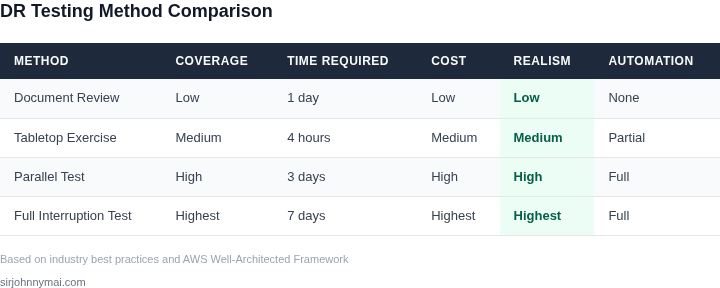
Most organizations test their DR plans by running through the documentation. This is ineffective because:
- It doesn't verify the actual recovery process
- It doesn't reveal gaps in the plan
- It doesn't test the people executing the plan
A proper test should include:
- Automated validation of backup integrity
- Simulated failover to secondary systems
- Role-based scenario exercises
For example, a financial services company might test their DR plan by:
- Verifying that all transaction logs can be replayed
- Failing over to their secondary data center
- Having different teams execute different recovery steps
03. The cost of false confidence in your DR plan
Organizations often spend significant resources on DR planning without measuring its effectiveness. This creates a false sense of security that can lead to:
- Reduced investment in prevention
- Compliance failures during audits
- Unexpected outages during critical periods
The cost of a failed DR test can be calculated by:
- Estimating the cost of the outage (lost revenue, fines, etc.)
- Adding the cost of the recovery effort
- Including the opportunity cost of lost productivity
For example, a manufacturing company with a 12-hour outage could face:
- $500,000 in lost production
- $200,000 in recovery costs
- $300,000 in lost sales
Total cost: $1.0 million
04. How to build a testable DR plan
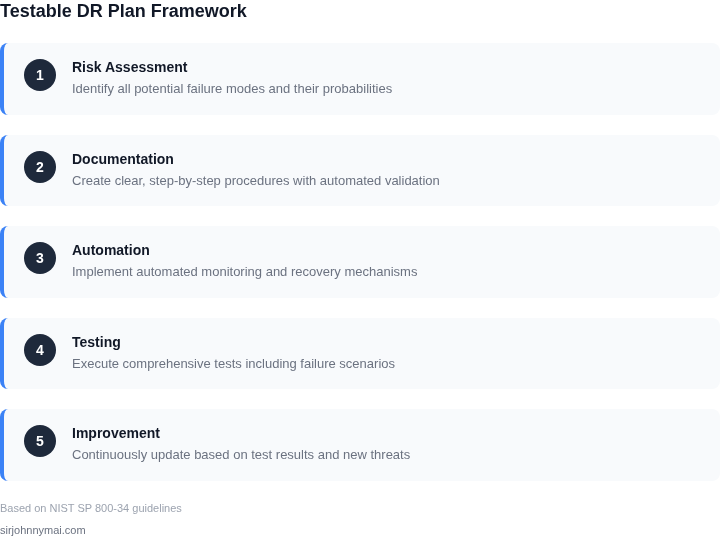
A testable DR plan requires:
- Clear documentation with step-by-step procedures
- Automated monitoring of critical systems
- Pre-approved escalation paths
Each component should be designed with testability in mind. For example:
- Backup procedures should include checksum validation
- Failover mechanisms should have automated health checks
- Communication protocols should be tested quarterly
This approach ensures that when you test the plan, you're actually testing the recovery process, not just the documentation.
05. The role of automation in DR testing
Manual testing of DR plans is time-consuming and error-prone. Automation can:
- Reduce test duration from days to hours
- Eliminate human error in test execution
- Provide consistent test results
Automated testing should include:
- Automated backup verification
- Automated failover testing
- Automated recovery validation
For example, AWS Backup can be configured to automatically verify backup integrity and trigger alerts if corruption is detected. This provides continuous validation of your DR capabilities without requiring manual intervention.
06. Common pitfalls in DR testing
Organizations often make these testing mistakes:
- Testing only the happy path (ignoring failure modes)
- Testing in a development environment (not production-like)
- Not involving the right stakeholders
To avoid these pitfalls:
- Include failure scenarios in your test plan
- Use staging environments that match production
- Involve all relevant teams in testing
For example, a healthcare provider should test their DR plan by simulating a ransomware attack that encrypts all patient records, not just a simple server failure.
07. Measuring DR plan effectiveness
Effective DR planning requires metrics to track:
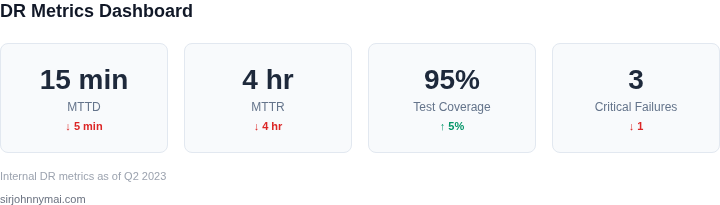
- Mean time to detect (MTTD)
- Mean time to recover (MTTR)
- Test coverage percentage
These metrics should be:
- Tracked continuously
- Compared against industry benchmarks
- Used to inform improvements
For example, a financial institution with an MTTD of 15 minutes and an MTTR of 4 hours is performing better than an industry average of 30 minutes MTTD and 8 hours MTTR.
08. The human factor in DR testing
People are the weakest link in DR plans. Testing should include:
- Role-based scenario exercises
- Communication protocol validation
- Stress testing of key personnel
For example, a data center operator should be able to:
- Identify the failure within 5 minutes
- Execute the recovery plan without documentation
- Communicate status to all stakeholders
This ensures that when a real outage occurs, the right people can respond effectively.
09. Continuous improvement of DR plans
DR plans should be treated like software - continuously improved based on testing results. This requires:
- Regular test cycles (at least quarterly)
- Post-test debriefs with action items
- Documentation updates based on findings
For example, after a DR test reveals a 30-minute gap in backup coverage, the plan should be updated to include:
- Additional backup verification steps
- Automated alerts for backup failures
- Training for backup operators
This creates a feedback loop that improves the plan over time.
10. The business case for proper DR testing
The ROI of proper DR testing can be calculated by:
- Estimating the cost of a failed outage
- Subtracting the cost of proper testing
- Factoring in the cost of compliance
For example, a retail company with:
- $2 million annual revenue
- 12-hour outage costing $500,000
- $100,000 annual testing cost
- $50,000 annual compliance cost
Has a net benefit of $350,000 per year from proper DR testing.
Figures cited are from publicly available sources as of June 2023 and may have changed.
Next step: Schedule your first comprehensive DR test within 30 days, including all failure scenarios and role-based exercises.