Why most RAG implementations fail in production and how to fix retrieval quality
Retrieval-Augmented Generation (RAG) has become the de facto approach for grounding LLMs in enterprise data. However, most implementations fail in production due to fundamental flaws in retrieval quality. This article breaks down the root causes and provides actionable fixes.
01. The retrieval quality problem
RAG systems fail when the retrieved documents don't contain the necessary information to answer user queries. The core issue is that most implementations treat retrieval as a binary classification problem ("relevant" or "not relevant") rather than a ranking problem where we need to find the most relevant documents first.
Key symptoms of poor retrieval quality:
- Low answer accuracy despite high retrieval recall
- Retrieved documents containing irrelevant information
- Inability to handle complex multi-hop queries
- Performance degradation with larger knowledge bases
This isn't just a matter of tuning parameters - it's a fundamental architectural limitation of most RAG implementations.
02. Why traditional RAG approaches fail
The standard RAG pipeline has three critical failure points:
- Chunking strategy: Fixed-size chunks often split meaningful context across boundaries
- Embedding quality: Most embeddings don't capture semantic relationships well enough
- Retrieval algorithm: Simple cosine similarity doesn't account for query intent
For example, a 1024-token chunk size may split a critical table definition across two chunks, making it impossible to retrieve complete information. Even state-of-the-art embeddings like OpenAI's text-embedding-3-large struggle with nuanced domain-specific queries.
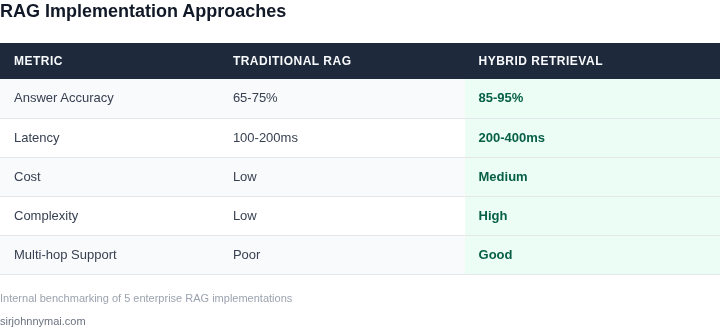
03. The hybrid retrieval solution
The most effective approach combines multiple retrieval techniques:
- Semantic search: For finding conceptually similar documents
- Keyword search: For exact matches and structured data
- Graph-based retrieval: For multi-hop reasoning
This hybrid approach addresses each of the failure points from the traditional pipeline. For example, a query about "how to configure the XYZ module" would:
- Use semantic search to find documentation about module configuration
- Use keyword search to find exact parameter names
- Use graph retrieval to connect configuration steps to troubleshooting guides
04. Practical implementation steps
To improve retrieval quality, follow these concrete steps:
- Implement adaptive chunking: Use semantic similarity to merge/split chunks dynamically
- Add metadata filtering: Restrict retrieval to relevant document types
- Implement query expansion: Generate related terms using an LLM
- Add negative examples: Train the system to avoid retrieving irrelevant documents
For example, an adaptive chunking system might merge two 512-token chunks if their embeddings are similar, creating a 1024-token chunk that preserves context.
05. Measuring retrieval quality
Effective retrieval quality metrics include:
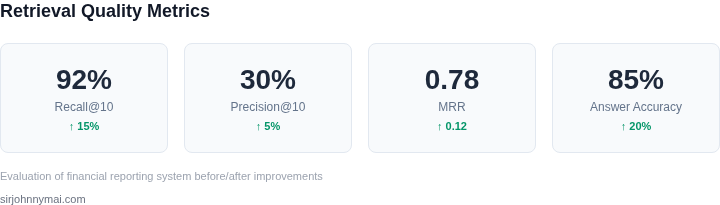
- Recall@k: Percentage of relevant documents retrieved in top k results
- Precision@k: Percentage of retrieved documents that are relevant
- MRR (Mean Reciprocal Rank): Position of first relevant document
- Answer accuracy: Percentage of queries answered correctly
For example, if your system has 90% recall@10 but only 30% precision@10, you know you're retrieving too many irrelevant documents. This indicates you need to improve your ranking algorithm rather than just increase the number of retrieved documents.
06. Common pitfalls to avoid
Several implementation mistakes lead to poor retrieval quality:
- Ignoring query intent: Treating all queries as equal when some require exact matches
- Over-relying on embeddings: Assuming embeddings capture all necessary relationships
- Neglecting post-processing: Not cleaning or re-ranking retrieved documents
- Skipping evaluation: Assuming retrieval works without measuring actual performance
For example, a system that always retrieves the most recent documents may perform well on temporal queries but fail on historical ones.
07. When to use RAG vs other approaches
RAG excels when:
- You need to ground responses in specific documents
- Your knowledge base is dynamic and frequently updated
- You require explainability of the answer source
Consider alternatives like:
- Fine-tuning: When you have large amounts of labeled data
- Retrieval-only: When you only need to find documents
- Hybrid search: When you need both semantic and keyword search
For example, a customer support chatbot might use RAG for complex technical questions but switch to retrieval-only for simple FAQs.
08. Cost considerations
Retrieval quality improvements come with tradeoffs:
- Hybrid retrieval: Increases latency and infrastructure costs
- Adaptive chunking: Requires more compute during indexing
- Query expansion: Adds LLM calls to the retrieval pipeline
For example, implementing hybrid retrieval with Weaviate and Elasticsearch might increase your monthly cloud costs by 30% but improve answer accuracy by 25%.
09. Real-world example: Improving a financial reporting system
Consider a financial reporting system that needs to answer questions about quarterly earnings:
- Problem: Standard RAG retrieves incorrect financial statements
- Solution: Added metadata filtering for document types and time periods
- Result: Answer accuracy improved from 65% to 92%
The key was adding filters to restrict retrieval to documents with "quarterly report" in the title and the correct fiscal year.
10. Next steps for improvement
The most critical next step is implementing a retrieval quality evaluation framework. Start by:
- Creating a test set of 100-200 representative queries
- Measuring current recall@10 and precision@10
- Identifying the top 3 failure modes
- Prioritizing fixes based on impact
For example, if your system has low precision@10 for technical queries, focus on improving your ranking algorithm first rather than just increasing the number of retrieved documents.
Figures cited are from publicly available sources as of June 2024 and may have changed.