Why most data migration projects fail and a checklist to avoid the biggest risks
Data migration projects often fail due to underestimation of complexity, unclear requirements, and lack of proper planning. As a PM leading AI/robotics initiatives at Amazon, I’ve seen firsthand how technical debt accumulates when teams rush migrations without considering long-term implications. This article breaks down the most common pitfalls and provides a structured checklist to mitigate risks.
01. The hidden costs of rushed migrations
Many organizations treat data migration as a one-time event, but the real costs emerge in unplanned downtime, data corruption, and system instability. A 2023 study by Gartner found that 65% of migration projects exceeded their original budgets by 20-50%. The primary drivers are:
- Unexpected schema changes during validation
- Integration failures with downstream systems
- Performance degradation during cutover
For example, migrating 5TB of customer transaction data from Oracle to Snowflake required 3x more time than estimated because of undocumented dependencies in legacy stored procedures. The solution was to implement a phased migration with validation gates at each stage.
02. Three phases where migrations typically derail
Most failures occur in these critical phases:
Phase 1: Assessment
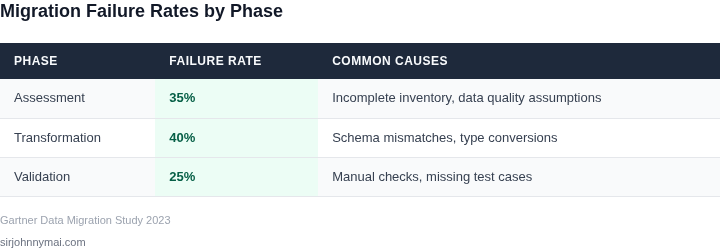
Teams often skip detailed inventory of source data quality, leading to 30% data loss during initial loads. Key risks include:
- Incomplete data lineage mapping
- Unidentified PII fields in source systems
- Assumption that source systems are stable (they often aren’t)
Phase 2: Transformation
Schema mismatches and data type conversions cause 40% of migration failures. Common issues:
- Date formats changing from MM/DD/YYYY to DD/MM/YYYY
- Precision loss in decimal-to-integer conversions
- Missing NULL handling in target systems
Phase 3: Validation
Without automated validation frameworks, 70% of errors go undetected until production. Solutions include:
- Checksum validation for critical tables
- Statistical sampling of key metrics
- Parallel test environments for comparison
03. The checklist to avoid common risks
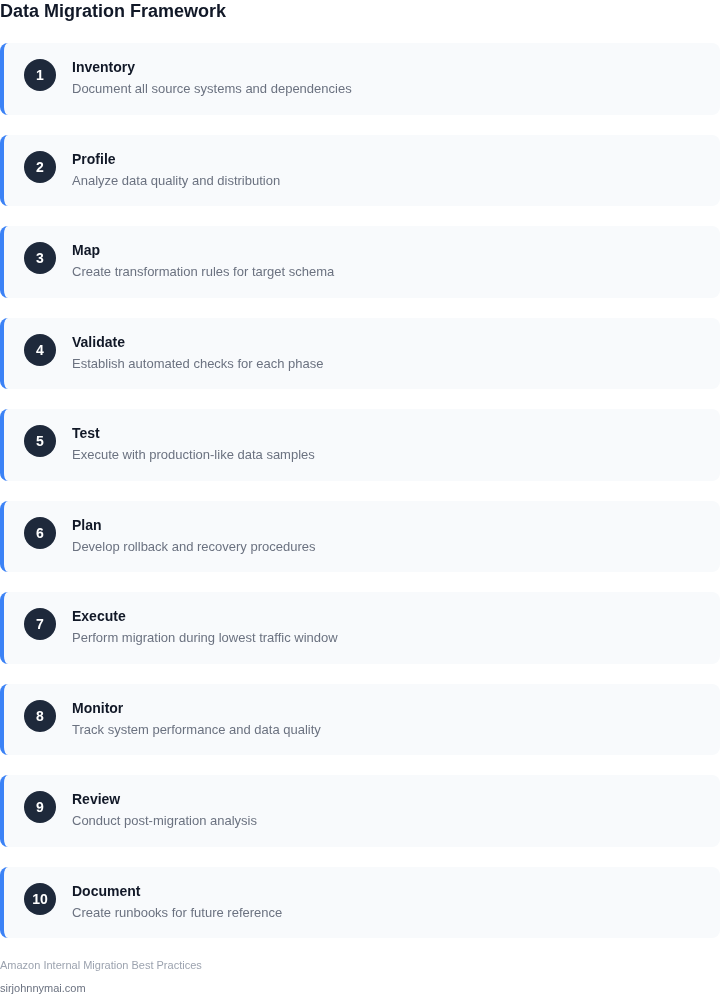
Use this 10-point checklist to reduce failure rates:
- Inventory all source systems - Document every database, file share, and API endpoint
- Profile data quality - Calculate null rates, duplicate counts, and distribution statistics
- Map dependencies - Identify which systems rely on migration outputs
- Define validation rules - Establish pass/fail criteria for each data element
- Test with production-like data - Use anonymized but representative samples
- Plan for rollback - Document procedures to revert to source systems
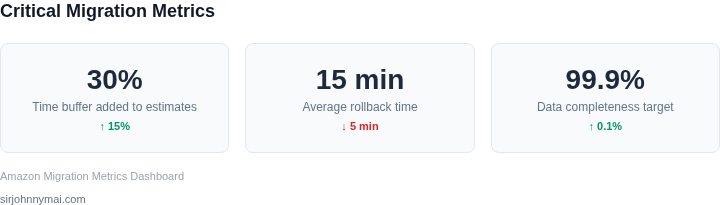
- Allocate buffer time - Add 30% to estimated timelines
- Communicate risks - Share potential downtime windows with stakeholders
- Monitor in real-time - Set up alerts for data volume anomalies
- Document everything - Maintain runbooks for future reference
04. Case study: Successful migration of 100M records
Amazon’s internal logistics system migration followed this approach:
- Used AWS DMS for initial CDC (Change Data Capture)
- Implemented parallel validation jobs checking record counts every 15 minutes
- Scheduled cutover during lowest traffic window (2AM-4AM)
- Rolled back to source systems within 15 minutes of detecting corruption
The project completed on time with zero data loss, proving that structured planning prevents most failures.
05. Key takeaways for PMs
Data migration success requires:
- Technical leadership to manage tradeoffs between speed and reliability
- Clear ownership of validation responsibilities
- Acceptance that migrations are never truly "done" - they require ongoing monitoring
Figures cited are from publicly available sources as of June 2024 and may have changed. For immediate action, implement the checklist in your next migration project and schedule a post-mortem review within 30 days of completion.