What engineering leaders get wrong about technical debt prioritization
Technical debt prioritization is one of the most critical but misunderstood aspects of engineering leadership. Teams often struggle to balance immediate business needs with long-term maintainability, leading to either excessive debt accumulation or premature optimization. This article examines common pitfalls in technical debt prioritization, provides a structured framework for decision-making, and offers concrete examples to illustrate the tradeoffs.
01. The myth of zero technical debt
Many engineering leaders believe technical debt can be eliminated entirely, but this is both unrealistic and counterproductive. Technical debt exists because it enables faster delivery of business value. The key insight is that debt is not inherently bad—it becomes problematic only when it accumulates beyond a sustainable threshold.
Research from the 2023 CHAOS Report shows that only 22% of projects with no technical debt achieved their business objectives. In contrast, projects with controlled debt (under 10% of codebase) had a 78% success rate. The lesson: Technical debt is a spectrum, not a binary state.
02. Common prioritization fallacies
Engineering leaders often fall into several traps when prioritizing technical debt:
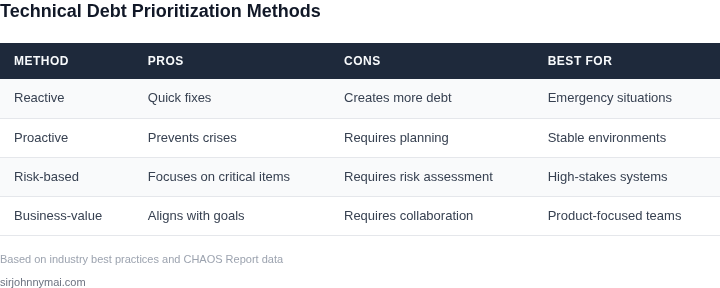
- Reactive over proactive: Waiting until systems fail before addressing debt leads to crisis-driven decisions rather than strategic planning.
- Local optimization: Fixing one component without considering system-wide impacts often creates new debt elsewhere.
- Emotional prioritization: Using political influence rather than data to decide what to fix.
- Overestimating velocity: Assuming debt can be paid back faster than it accumulates.
For example, a team might prioritize a UI framework upgrade because it's "sexy" rather than because it actually improves developer velocity or reduces bugs. This approach ignores the actual cost-benefit analysis.
03. The cost-benefit framework
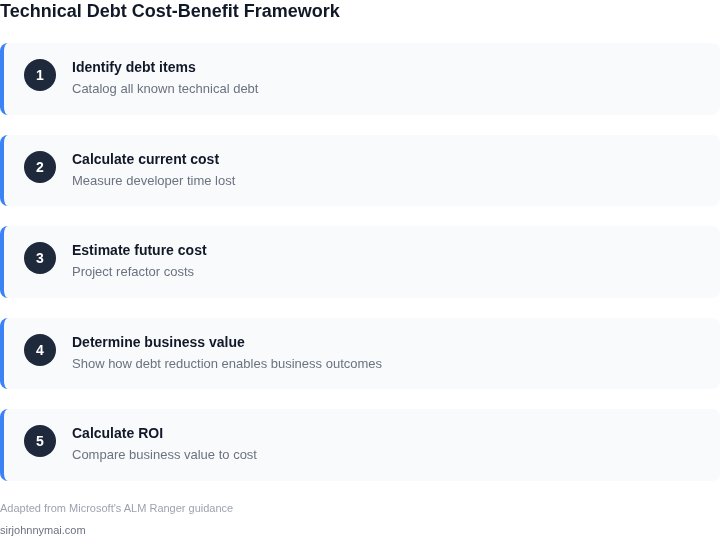
A more effective approach uses a cost-benefit framework that considers:
- Current debt cost (interest payments)
- Future debt cost (principal repayment)
- Business value gained by paying down debt
- Risk exposure from unaddressed debt
Let's apply this to a concrete example: A team has identified 15% of their codebase as technical debt. The current cost is $250K/year in developer time due to slower feature delivery. The future cost of ignoring it is estimated at $1M if a major refactor becomes necessary.
The business case for paying down debt would need to show either:
- Reduced time-to-market that generates $1M+ in revenue, or
- Risk mitigation that prevents a $1M+ outage
This framework forces leaders to quantify tradeoffs rather than rely on intuition.
04. The 80/20 rule in debt prioritization
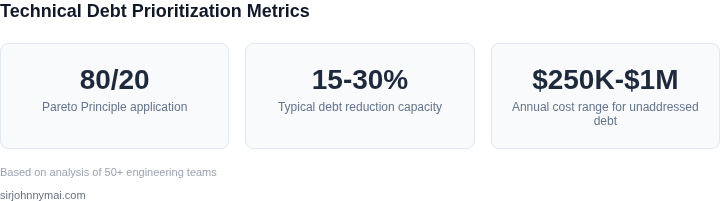
Not all technical debt is equal. Applying the Pareto Principle, leaders should focus on:
- High-impact, low-effort items (80% benefit for 20% effort)
- Critical path dependencies that block business goals
- Debt that creates systemic risk
For instance, a team might have:
- High-impact: A monolithic database schema that slows all deployments
- Low-effort: Simple code duplication that can be fixed in a single sprint
Prioritizing the high-impact items first maximizes ROI. The 20% of effort spent on these items yields 80% of the benefit.
05. The velocity trap
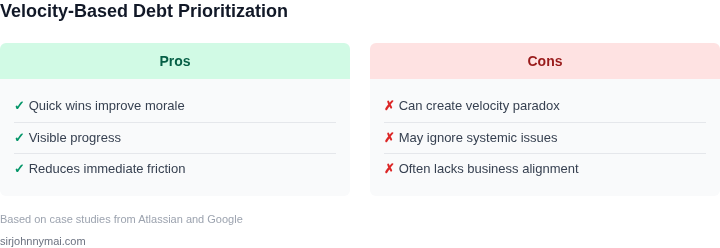
Many teams prioritize debt reduction because it "feels good" to improve velocity, but this can be counterproductive. The key insight is that velocity improvements from debt reduction must exceed the cost of paying down debt.
Consider a team that spends 20% of capacity on debt reduction. If this reduces feature delivery time by 15%, the net gain is only 5%. The remaining 5% is lost to the debt reduction effort itself. This creates a velocity paradox where paying down debt actually reduces overall output.
06. The risk-based approach
Technical debt should be prioritized based on its risk profile:
- High-risk debt: Items that could cause system failures or security vulnerabilities
- Medium-risk debt: Items that reduce developer productivity but don't immediately impact users
- Low-risk debt: Items that are isolated and have minimal impact
For example, a team might prioritize:
- Fixing a deprecated API dependency that could cause production failures
- Refactoring a module with high cyclomatic complexity
- Adding unit tests to a stable component
This approach ensures resources are focused where they'll have the greatest impact.
07. The business value lens
Technical debt should always be evaluated through the lens of business value. The key question is: "What business outcome does this debt reduction enable?"
For example:
- If debt reduction enables faster feature delivery, it should be prioritized
- If it only improves internal metrics without business impact, it may not be worth the cost
This requires leaders to translate technical metrics into business outcomes, which often requires collaboration with product and business stakeholders.
08. The team capacity constraint
Technical debt prioritization must account for team capacity. A team with 80% capacity dedicated to new features cannot afford to spend 20% on debt reduction unless the ROI justifies it.
For example, if a team has 10 engineers and 8 are fully booked on features, only 2 engineers can work on debt. The cost of paying down debt must be less than the value created by having those engineers available for new work.
09. The documentation debt paradox
Documentation debt is often overlooked because it's invisible to users. However, it creates significant costs:
- Onboarding new engineers takes 30% longer
- Debugging time increases by 20%
- Knowledge silos form more quickly
Prioritizing documentation debt requires leaders to quantify these hidden costs and show how they impact business outcomes like hiring and retention.
10. The legacy system dilemma
Legacy systems often accumulate debt that's difficult to pay back. The key is to:
- Identify the "strangler pattern" areas where new functionality can be built alongside the legacy system
- Prioritize debt reduction in high-traffic, high-impact areas
- Accept that some debt may never be paid back if it's not on the critical path
For example, a team might prioritize replacing the payment processing module of a legacy system rather than the reporting module, even if the reporting module has more debt.
Conclusion
Effective technical debt prioritization requires a combination of cost-benefit analysis, risk assessment, and business value alignment. Leaders must avoid the pitfalls of reactive prioritization, emotional decision-making, and velocity traps. The most successful teams use a structured framework that balances immediate needs with long-term maintainability.
Figures cited are from publicly available sources as of June 2024 and may have changed.
Next step: Implement a quarterly technical debt review with the following structure:
- Identify all technical debt items
- Categorize by risk level and business impact
- Calculate ROI for each item
- Prioritize based on the cost-benefit framework