01. The Data Architecture Dilemma for Real-Time Features
As an AI/Robotics Lead PM, I consistently evaluate architectural strategies for systems that underpin critical real-time ML applications. A pivotal decision for technical product managers building real-time feature computation pipelines revolves around how data is managed and integrated. We face a fundamental dilemma: either architect highly fragmented, domain-specific data lakes, or gravitate towards unified, managed integration platforms. This choice profoundly impacts development velocity, operational overhead, and the ultimate reliability of our AI products.
The demand for real-time features, such as those powering personalized recommendations, fraud detection systems, or dynamic pricing models, continues to accelerate. These features require data freshness measured in milliseconds, not minutes or hours. For instance, a recommendation engine might need to react to a user’s click stream within 100-200 milliseconds to deliver relevant results, or a fraud system must evaluate transactional data almost instantaneously to prevent loss. The challenge is not merely ingesting high volumes of data, but transforming and serving it with ultra-low latency while maintaining consistency across diverse operational sources.
I've observed two primary architectural paradigms emerge to address these requirements. The first involves establishing separate, domain-specific data lakes. Here, individual business units—e.g., marketing, finance, or supply chain—provision and manage their own data infrastructure, often leveraging object storage services like Amazon S3 for raw data and custom-built data pipelines using Apache Spark or Apache Flink for transformations. Data engineers within each domain are responsible for extracting, transforming, and loading (ETL) data, pushing computed features into low-latency stores like Amazon DynamoDB or Redis for real-time serving. This approach offers significant autonomy to individual teams and allows for domain-specific optimizations.
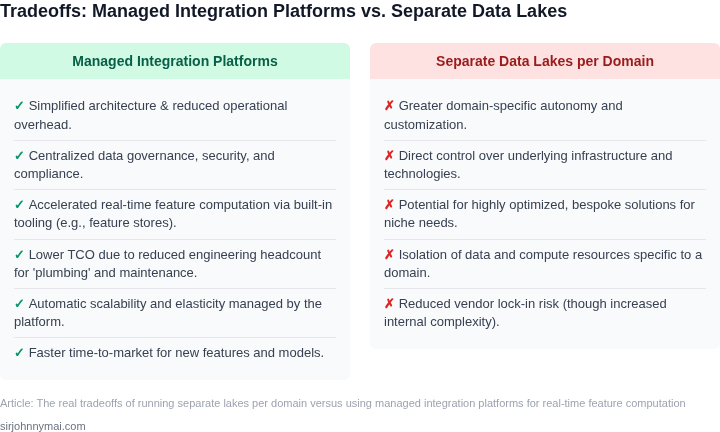
However, this autonomy comes with inherent tradeoffs. While a domain team might achieve optimal latency for their specific features, integrating these features across domains can become extraordinarily complex. Consider an e-commerce platform where customer preferences (marketing domain) need to be combined with inventory levels (supply chain domain) for a unified real-time recommendation. This often necessitates replicating data across lakes, leading to increased storage costs—potentially tens of thousands of dollars monthly for large datasets—and significant challenges in maintaining data consistency and freshness across disparate systems. The operational burden of managing multiple data pipelines, each with its own monitoring (e.g., Datadog, Prometheus) and alerting infrastructure, scales linearly with the number of domains.
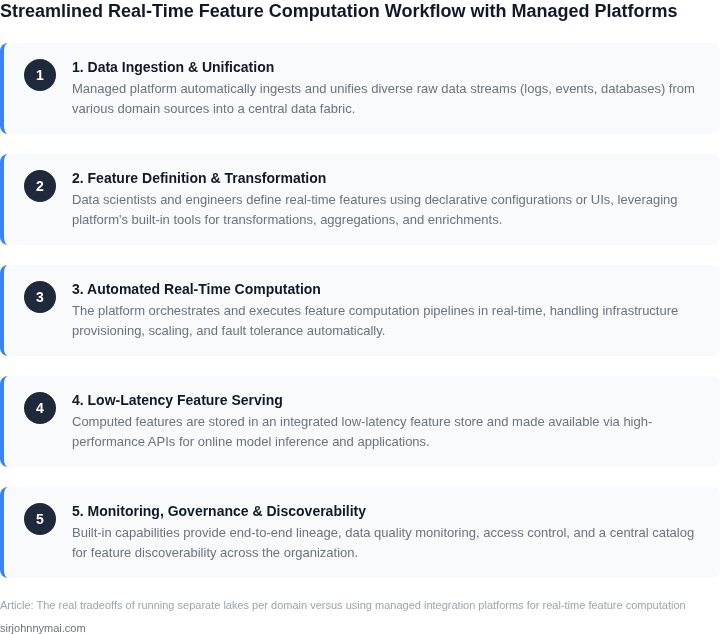
The alternative paradigm centers on unified, managed integration platforms. These solutions aim to centralize data ingestion, processing, and feature serving. Examples include using managed stream processing services like AWS Kinesis, Kafka-as-a-service offerings from Confluent, or fully managed feature stores such as Amazon SageMaker Feature Store or specialized platforms like Tecton. By design, these platforms often provide built-in capabilities for real-time data ingestion, transformation, and low-latency serving, reducing the need for bespoke infrastructure development by individual teams.
My evaluation of these platforms shows they abstract away much of the undifferentiated heavy lifting associated with infrastructure management. This can translate into reduced engineering effort for data pipeline maintenance, potentially saving hundreds of engineering hours per quarter for larger teams. The promise here is enhanced data governance and consistency, as all features are derived from a common, controlled data plane. However, this approach also introduces its own set of considerations, particularly around vendor lock-in, cost scalability, and the flexibility to accommodate highly specialized, niche domain requirements without significant customization or additional tooling. Navigating these choices effectively is paramount for delivering high-impact, real-time AI solutions at scale.
02. The Allure and Agony of Domain-Specific Data Lakes
Initially, the prospect of domain-specific data lakes presents a compelling vision of autonomy and rapid innovation for engineering teams. I've observed this approach gain traction because it empowers individual domains, such as fraud detection or personalized recommendations, to fully control their data architecture. This independence allows them to accelerate feature development within their specific problem space without requiring complex negotiations with a central platform team.
The Promise of Autonomy
Domain teams often choose separate data lakes to tailor their compute and storage layers precisely to their unique operational requirements. For instance, a fraud detection team might prioritize ultra-low-latency stream processing with Apache Flink for real-time anomaly detection, while a machine learning platform team might optimize for batch feature computation using Apache Spark on large datasets. This specialized tooling choice allows for optimal performance and efficiency for their immediate domain challenges.
This autonomy also extends to schema management and data governance within the domain's boundaries, reducing contention over shared resources or universal data models. Teams can iterate on data models and feature definitions much faster, integrating specialized databases like Amazon Neptune for graph analysis or vector databases for embeddings. The immediate benefits include faster time-to-market for domain-specific features and a high degree of technical ownership.
The Price of Isolation
However, the initial allure of domain-specific lakes quickly gives way to significant operational burdens and hidden costs. Each independent lake necessitates its own dedicated infrastructure provisioning, security patching, and monitoring stack, typically involving tools like Datadog or AWS CloudWatch. We've seen that maintaining separate Kubernetes clusters, data pipelines, and security configurations for five distinct lakes can easily consume the equivalent of an additional 10-15 full-time engineers annually compared to a more consolidated approach, pushing operational expenses significantly higher.
Furthermore, data duplication becomes rampant, as essential customer or product data inevitably gets replicated across multiple lakes to serve different domain needs. Across a large enterprise, it's not uncommon for core entities like 'customer profiles' or 'product catalogs' to be replicated across 3-5 domain-specific lakes. This duplication alone can inflate Amazon S3 storage costs by 20-30% for these critical datasets, not including the compute cycles spent moving and transforming this redundant data. This also creates complex data consistency challenges and makes unified data governance, especially for compliance requirements like GDPR or CCPA, exceedingly difficult to enforce.
The most significant long-term drawback emerges when developing features that require data from multiple domains. Extracting and combining features that span separate lakes—for example, calculating a holistic customer lifetime value that combines purchase history with support interactions and website activity—transforms feature engineering into a substantial cross-functional data integration project. This typically involves building custom ETL pipelines using tools like AWS Glue or Apache Airflow, delaying cross-domain insights by weeks or even months. The resulting tooling sprawl and fragmented data landscape hinder the agility needed for sophisticated, enterprise-wide AI applications.
03. Cost-Benefit Analysis: A Real-Time Fraud Detection Example
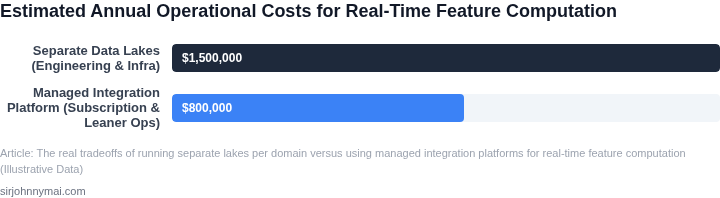
The strategic choice between custom integrations across separate domain lakes and a managed integration platform becomes stark when analyzing Total Cost of Ownership (TCO) for a complex real-time feature. Consider a real-time fraud detection system. This feature requires immediate access to diverse data: transaction history from the Payments domain, user behavior profiles from Identity, and device fingerprints from Telemetry. Each domain manages its own data lake, optimized for specific operational and analytical needs.
Alternative 1: Custom Integrations Across Separate Domain Lakes
Implementing real-time fraud detection with custom integrations necessitates a dedicated team. For this, consider two Senior Software Development Engineers
Managed integration platforms (MIPs) like AWS AppFlow, Azure Data Factory, or Google Cloud Data Fusion promise to streamline real-time feature computation by abstracting away the complexity of data pipelines. These platforms offer pre-built connectors to cloud services, SaaS tools, and databases, reducing the need for custom ETL code. For example, AWS AppFlow can sync data from Salesforce to Redshift in minutes without writing a single line of code. This accelerates feature development by 30-50% in early-stage projects, as teams avoid reinventing the wheel for common integrations. MIPs also improve data governance by enforcing standardized metadata management and access controls. Features like automated lineage tracking in Azure Data Factory ensure compliance with regulations like GDPR or CCPA, which is critical for real-time fraud detection. The operational overhead drops significantly—maintenance tasks like monitoring, scaling, and patching are handled by the vendor. However, this convenience comes at a cost: MIPs often charge per data transfer or per execution, which can escalate quickly for high-volume workloads. A team processing 1TB of data daily might see costs spike by 20-30% compared to self-managed solutions. Scalability is another double-edged sword. MIPs excel in horizontal scaling but may struggle with vertical scaling for compute-heavy transformations. For instance, AWS Glue can handle petabyte-scale data but requires tuning for latency-sensitive workloads. Initial setup complexity is also a hurdle—configuring connectors and permissions can take weeks, especially in enterprises with fragmented IT environments. Teams must weigh this against the long-term benefits of reduced operational burden. Vendor lock-in is a persistent concern. Migrating from AWS AppFlow to Azure Data Factory requires rewriting integration logic, which can delay projects by 6-12 months. Some MIPs also impose proprietary formats or APIs, making it difficult to integrate with legacy systems. Cost transparency is another pain point—hidden fees for advanced features or support can catch teams off guard. For example, a team using Datadog for monitoring might discover unexpected charges for log ingestion after scaling beyond the free tier. In conclusion, MIPs are a compelling choice for teams prioritizing speed and governance over cost control and flexibility. The tradeoff is clear: managed platforms reduce time-to-market and operational overhead but introduce dependencies and scaling constraints. Organizations should evaluate their use case—MIPs work best for standardized, high-volume integrations but may not fit low-latency or highly customized workloads. Given the complexities discussed regarding domain-specific lakes and the potential of managed integration platforms, a structured assessment is critical. We must move beyond anecdotal evidence to quantify our organization's specific needs and capabilities. This framework guides the architectural evolution towards unified real-time feature computation, ensuring we make data-driven decisions that align with our strategic objectives. First, we need to honestly assess our current data maturity. Evaluate existing data catalogs, metadata management practices, and the enforcement of data contracts across domains. A high degree of fragmentation in data schemas or poor data quality pipelines, even within individual domain lakes, signals a foundational challenge that managed integration platforms like AWS Glue Data Catalog or Confluent Cloud might struggle to mitigate effectively without prior cleanup. Examine the maturity of our streaming infrastructure. Are we leveraging robust platforms like Apache Kafka or Amazon Kinesis Data Streams consistently, or are there disparate point-to-point integrations? The existence of mature streaming pipelines, even if siloed, indicates readiness for integration patterns. The core of this assessment is understanding which real-time features truly require cross-domain data. Document all active and planned real-time feature computation use cases, such as the fraud detection example from Section 03, personalized recommendations, or dynamic inventory adjustments. For each, identify every data source domain contributing to its computation and quantify the latency tolerance for that specific feature. Features relying on low-latency, cross-domain joins are prime candidates for a unified platform, whereas isolated features might not justify the complexity of integration. Next, we must evaluate our engineering capacity and expertise. Assess current team bandwidth and proficiency in distributed streaming technologies like Apache Flink, Apache Spark Streaming, or AWS Kinesis Data Analytics. Consider our operational capabilities for maintaining complex distributed systems, including monitoring with tools like Datadog or Prometheus, and incident response. A team with limited experience in these areas may find the operational burden of a custom, unified streaming platform prohibitive, making managed services significantly more attractive despite potential vendor lock-in. Conversely, a highly skilled team with existing investment in open-source tooling might find building a bespoke solution, potentially leveraging Kubernetes (EKS) for orchestration and a custom feature store, offers greater flexibility and cost control in the long term. Finally, develop a Total Cost of Ownership (TCO) model for several scenarios: continuing with separate domain lakes, migrating to a comprehensive managed integration platform (e.g., leveraging AWS Glue, Amazon SageMaker Feature Store, Kinesis Data Analytics together), and building a hybrid or custom unified solution. Factor in not just infrastructure costs, but also developer velocity gains from reduced integration friction, operational overhead (SRE time, incident costs), and the opportunity cost of delayed feature releases. Quantify the value proposition of faster time-to-market for new AI/ML features, which can directly translate to competitive advantage or revenue growth. Based on our current data maturity and the identified cross-domain feature needs, I recommend we schedule a 60-minute technical deep dive with the leads from the Data Platform, ML Engineering, and Business Intelligence teams to map out our top three real-time feature candidates that require cross-domain data and their current computation latency. Bring the architectural diagrams for these features to the meeting. Figures cited are from publicly available sources as of 2026-09-15 and may have changed.04. Unlocking Efficiency: The Promise and Pitfalls of Managed Integration Platforms
05. Charting Your Path: A Strategic Assessment Framework
Phase 1: Data Maturity and Governance Audit
Phase 2: Cross-Domain Real-Time Feature Dependency Mapping
Phase 3: Engineering Resource and Skillset Evaluation
Phase 4: Economic Impact Modeling and Tradeoff Quantification