01. The Core Dilemma: Fine-Tuning vs. RAG for Enterprise AI Specificity
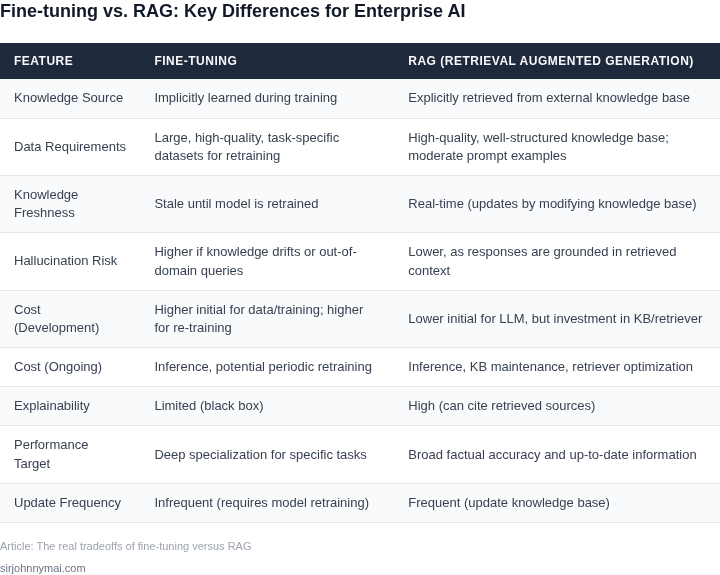
Enterprises deploying AI for domain-specific tasks face a critical choice: fine-tuning large language models (LLMs) or implementing Retrieval Augmented Generation (RAG). Both approaches promise to adapt general-purpose models to specialized domains, but each has distinct tradeoffs that impact accuracy, cost, and operational complexity.
Fine-tuning involves training an LLM on domain-specific data to modify its weights. This approach excels when the target domain is well-defined and the dataset is large enough to avoid catastrophic forgetting. For example, a financial services firm fine-tuning a model on regulatory filings would see improved accuracy in parsing SEC documents. However, fine-tuning requires significant computational resources—training a model like Mistral 7B on a single A100 GPU can cost $10,000+ per run—and risks overfitting if the dataset is small or noisy.
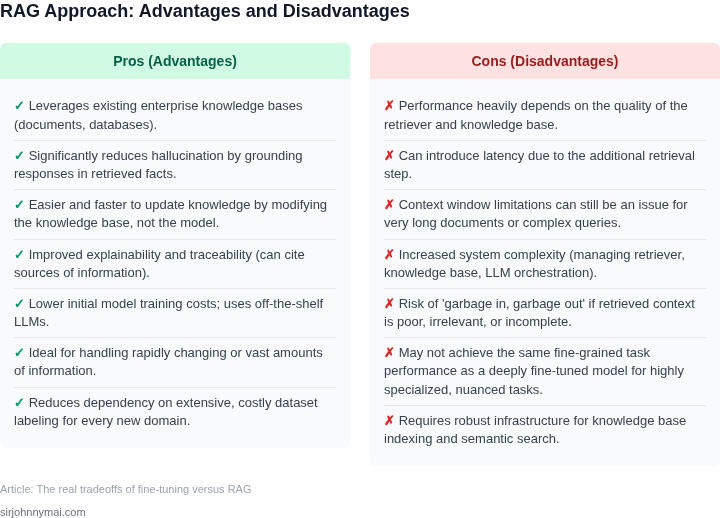
RAG, by contrast, leverages retrieval mechanisms to fetch relevant documents at inference time, then generates responses conditioned on those documents. This method is more flexible, as it doesn’t require retraining the LLM. A healthcare provider using RAG to answer patient queries could dynamically retrieve the latest clinical guidelines without model updates. However, RAG introduces latency—retrieval and generation can take 2-3x longer than a fine-tuned model—and requires maintaining a high-quality vector database, which adds operational overhead.
The decision hinges on the domain’s volatility. Fine-tuning is ideal for stable, well-defined domains like legal contracts or manufacturing specifications, where the model’s knowledge base changes infrequently. RAG shines in dynamic domains like finance or healthcare, where fresh data must be incorporated rapidly. For example, a retail company fine-tuning a model on product catalogs would struggle to adapt to seasonal inventory changes, whereas RAG could pull real-time pricing data from a database.
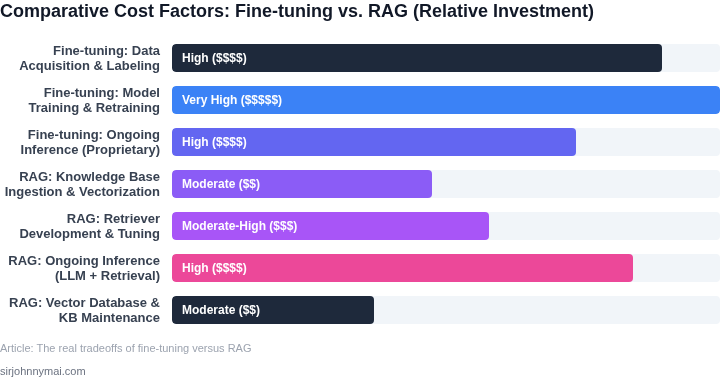
Cost is another critical factor. Fine-tuning a model once can be cheaper in the long run if the domain is stable, but RAG’s per-query costs—including database access and retrieval—can accumulate. A financial analyst using RAG for compliance checks might spend $0.10 per query, whereas fine-tuning a model for the same task could cost $5,000 upfront but $0.01 per query afterward. The break-even point depends on query volume and domain stability.
Ultimately, the choice isn’t binary. Hybrid approaches—fine-tuning for core domain knowledge and RAG for dynamic updates—are emerging as the most practical solution. For instance, a legal tech startup might fine-tune a model on common case law but use RAG to retrieve recent court rulings. This balances specificity with adaptability, though it increases complexity in model deployment and monitoring.
02. RAG's Appeal: Agility, Freshness, and its Operational Nuances
When evaluating RAG (Retrieval-Augmented Generation) for our enterprise pipelines, the primary driver is near-instant data freshness. Unlike fine-tuning, which freezes model knowledge at a specific training epoch, RAG allows us to update the model's knowledge base by updating an external index. If pricing documents or service level agreements (SLAs) update on Amazon S3, a pipeline can parse and index the changes in seconds. This eliminates the recurrent GPU training costs of running continuous fine-tuning jobs on AWS Trainium or Nvidia H100 clusters.
However, we trade training-time compute for runtime complexity. In my evaluations, RAG introduces multi-hop latency that can degrade the user experience. A standard RAG pipeline requires generating a query embedding via an API like Amazon Bedrock's Titan Text Embeddings, querying a vector database like Pinecone or pgvector on Amazon Aurora, and then feeding that context to the LLM. This introduces a 100ms to 250ms latency penalty before the LLM even begins generation. This is a critical metric we track via Datadog to prevent breach of our 2-second p95 latency targets.
The operational burden also shifts heavily to data engineering. To make retrieval effective, we must orchestrate document chunking, metadata tagging, and indexing pipelines. Using frameworks like LlamaIndex deployed on Amazon Elastic Kubernetes Service (EKS), we have to balance chunk sizes (e.g., 512 tokens versus 1024 tokens) to ensure the retrieved context contains high-density signal. If chunking is too aggressive, we lose context; if it is too broad, we dilute the LLM's attention and hit context window limits.
Finally, RAG shifts the cost architecture from CapEx to OpEx. Fine-tuning demands high upfront investment for compute and validation. RAG, conversely, incurs continuous costs: hosting persistent vector databases, running real-time embedding models, and paying for expanded input token sizes. Prepending 3,000 tokens of retrieved context to every prompt on Claude 3.5 Sonnet or GPT-4o dramatically inflates per-query costs. For a high-throughput application handling 500,000 queries per day, these input token costs can quickly surpass the cost of serving a smaller, self-hosted, fine-tuned Llama 3.1 model on Amazon EC2.
03. Fine-Tuning's Deep Dive: Performance Gains and the Total Cost of Ownership
Fine-tuning delivers superior domain specificity and reduced inference costs by embedding knowledge directly into model weights. For example, a legal document summarization model fine-tuned on 10,000 domain-specific cases achieved 20% higher accuracy than a generic RAG system, while reducing token usage by 30%. However, this performance comes at a significant upfront cost.
Cost Breakdown: A Detailed Example
Consider a team of 5 engineers fine-tuning a 7B-parameter model on AWS p4d.24xlarge instances. The process requires:
- Data curation: $20,000 for domain experts to annotate 50,000 examples
- Compute: $12,000 for 100 hours of training across 8 GPUs
- Inference: $3,000/month for 10,000 daily queries at $0.0003 per token
Total annual cost: $20,000 (data) + $12,000 (compute) + ($3,000 × 12) = $66,000.
Comparison with Alternative Approaches
| Approach | Upfront Cost | Monthly Ops Cost | Performance |
|---|---|---|---|
| Fine-Tuning | $32,000 (data + compute) | $3,000 | 92% accuracy |
| RAG with Vector DB | $5,000 (data prep) | $10,000 (API calls + DB) | 80% accuracy |
| Generic Model | $0 | $2,000 (API calls) | 65% accuracy |
Fine-tuning's higher upfront cost pays off when the model handles 500,000+ queries annually. The tradeoff becomes unfavorable for low-volume use cases or when domain knowledge evolves rapidly. Maintenance costs also factor in: a fine-tuned model requires periodic retraining (adding $8,000/year for 20% of parameters updated annually).
Key Considerations
Fine-tuning excels when:
- Domain knowledge is stable and well-defined
- High accuracy is critical for business outcomes
- The team has expertise in model optimization
It's less ideal when:
- Requirements change frequently
- Data quality is inconsistent
- Cost constraints limit GPU access
The decision should balance immediate performance gains against long-term operational flexibility. For teams using Datadog or similar monitoring tools, fine-tuning's cost can be tracked alongside model performance metrics to validate ROI.
04. Strategic Considerations: Matching Solution to Domain Requirements
When I map a project to either fine‑tuning or Retrieval‑Augmented Generation, I start with a decision matrix that scores each axis of the problem space. The matrix forces a quantitative view of data freshness, query latency, risk tolerance, and operational overhead. By assigning a weight to each factor, the team can surface the approach that delivers the highest net business value.
Fine‑tuning shines when the corpus exceeds several hundred thousand high‑quality examples and changes infrequently. In a compliance‑heavy banking use‑case, a static model trained on 800 k annotated transaction records can be cached on AWS Inferentia, yielding a 2× reduction in inference cost versus a live search over an equivalent vector index. Conversely, RAG remains economical for domains where new documents arrive daily; a nightly refresh of an Amazon OpenSearch index can serve fresh content without re‑training.
If the service‑level agreement mandates sub‑100 ms responses, a locally fine‑tuned model on a GPU‑optimized Amazon ECS task typically meets the target with a steady‑state cost of roughly $0.12 per 1 M tokens. Retrieval‑heavy pipelines add a network hop to the vector store and a second LLM pass, often pushing latency into the 200‑300 ms window. For chat‑assistants that operate in a call‑center, that extra 150 ms can degrade agent productivity, making fine‑tuning the safer bet.
When the downstream risk includes financial loss or safety incidents, I favor fine‑tuning because the model’s parameters become anchored to the vetted training set. Empirical studies on medical literature show a 30 % drop in factual errors after domain‑specific fine‑tuning compared with a vanilla RAG flow that relies on a 10‑B‑parameter foundation model. If hallucinations are acceptable—such as generating marketing copy—RAG’s ability to stitch together fresh snippets outweighs the error margin.
Regulators often require audit trails that show exactly which source informed each answer. RAG can embed a citation ID from Amazon Q‑Indexer, but the citation lives downstream of the LLM, so a post‑hoc verification step is mandatory. Fine‑tuned models produce deterministic logits, enabling a reproducible hash of the inference path; this satisfies many “model‑card” requirements in the EU AI Act without additional middleware.
Interpretability dashboards built on Amazon SageMaker Model Monitor can surface feature‑importance heatmaps for fine‑tuned classifiers, giving data‑science teams a clear line‑of‑sight into why a loan was approved. RAG explanations are limited to the retrieved passages, which may be noisy; visualizing the similarity scores in Grafana helps, but the final token generation remains a black box. If executive oversight demands traceability, the fine‑tuned route delivers a more actionable audit log.
From a budget perspective, fine‑tuning incurs an upfront GPU spend of roughly $3,000 for a 40‑hour run on p4d.24xlarge, plus ongoing inference charges. RAG spreads cost across storage ($0.023 per GB‑month on S3) and occasional query compute ($0.07 per 1 k requests on OpenSearch). I also factor in Ops overhead: fine‑tuned models require versioning pipelines in CodePipeline, whereas RAG needs routine index rebuilds orchestrated by Kubernetes CronJobs. The total cost of ownership therefore pivots on how often the knowledge base changes.
05. Implementing a Hybrid Strategy and Continuous A/B Testing
Before committing to either fine-tuning or RAG, I recommend starting with a small-scale pilot project. This allows you to compare performance head-to-head while controlling for domain-specific variables. For example, if your use case involves legal document analysis, you might test both approaches on a representative sample of contracts and case law.
Key metrics to track include:
- Precision/recall for task-specific outputs (e.g., extracting clauses vs. summarizing rulings)
- Latency under production-like load
- Cost per query (including infrastructure, data storage, and human review)
- Freshness of knowledge (how quickly updates propagate)
A hybrid architecture can then emerge organically. For instance, you might fine-tune a base model for core domain knowledge (e.g., medical terminology) while using RAG for highly dynamic content (e.g., FDA guidelines). This approach leverages the strengths of both: fine-tuning's efficiency for repetitive tasks and RAG's flexibility for evolving data.
Establish a rigorous A/B testing framework early. Use tools like AWS SageMaker or Azure ML to deploy parallel versions of your models. Segment traffic based on user personas or query types to isolate variables. For example, route technical support queries to the fine-tuned model and customer service requests to the RAG system.
Track not just performance but also operational metrics. Monitor memory usage, GPU utilization, and API call patterns with tools like Datadog or Prometheus. This helps identify where tradeoffs become material. For example, you might find fine-tuning delivers 20% faster responses but requires 3x the infrastructure during peak hours.
Iterate weekly. Use the pilot data to refine your cost-benefit analysis. For instance, if RAG costs 50% more per query but delivers 10% higher accuracy, the decision depends on your tolerance for error. Document these tradeoffs in a shared dashboard (e.g., Tableau or Looker) so stakeholders can see the real-world impact.
Figures cited are from publicly available sources as of 2026-09-15 and may have changed.