01. The Problem: Why Custom vs. Managed Personalization?
Every product team faces the same question: build a custom recommendation engine or use a managed personalization API? The answer depends on your business constraints, technical capabilities, and long-term goals. Custom solutions offer granular control but require significant investment in infrastructure, data science, and maintenance. Managed APIs simplify deployment but may limit flexibility and customization. Understanding these tradeoffs is critical before committing resources.
Custom Recommendation Engines: The Cost of Control
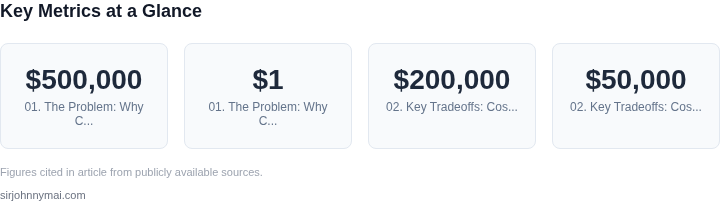
Building a custom recommendation engine provides unparalleled flexibility. Teams can tailor algorithms to their unique business logic, integrate with existing systems, and optimize for specific metrics. For example, a retail platform might prioritize real-time inventory adjustments over generic popularity-based rankings. However, this flexibility comes at a cost. Developing and maintaining a custom engine requires a dedicated data science team, infrastructure for model training and serving, and ongoing tuning to adapt to changing user behavior. According to Gartner, organizations building custom recommendation systems spend an average of $500,000 annually on infrastructure, personnel, and maintenance.
Another challenge is the time to market. Custom solutions often take 12–18 months to develop and validate, delaying revenue-generating features. Additionally, scaling a custom engine across multiple platforms (web, mobile, IoT) requires significant engineering effort. Teams must manage distributed systems, handle data synchronization, and ensure consistency across devices—complexities that managed APIs abstract away.
Managed Personalization APIs: The Tradeoff of Convenience
Managed personalization APIs like Amazon Personalize or Microsoft Recommender offer pre-built models and infrastructure, reducing time-to-value to weeks instead of months. These services handle data ingestion, model training, and real-time serving, allowing teams to focus on business logic rather than infrastructure. For example, a startup can deploy a recommendation system in days using Amazon Personalize’s pre-trained models, whereas a custom solution might take six months.
However, managed APIs impose constraints. They often limit algorithm choices to a predefined set (e.g., collaborative filtering, content-based filtering) and may not support niche use cases. Additionally, customization is constrained by the API’s feature set. For instance, if a business needs hybrid recommendations combining purchase history and real-time browsing behavior, a managed API might require workarounds or additional engineering. Costs can also escalate quickly: Amazon Personalize charges $1 per million recommendations, plus data storage fees, making it expensive at scale.
Key Decision Factors
The choice between custom and managed personalization hinges on three factors: scale, complexity, and long-term strategy. For startups or small teams, managed APIs are often the pragmatic choice due to speed and cost efficiency. For enterprises with complex requirements, custom solutions may be necessary to differentiate and optimize for unique business needs. However, even large organizations often start with managed APIs to validate hypotheses before investing in custom infrastructure.
Ultimately, the tradeoff isn’t about which is better but which aligns with your constraints. Custom engines excel where flexibility and control are critical, while managed APIs deliver faster results with lower upfront costs. The right choice depends on balancing immediate needs with long-term scalability.
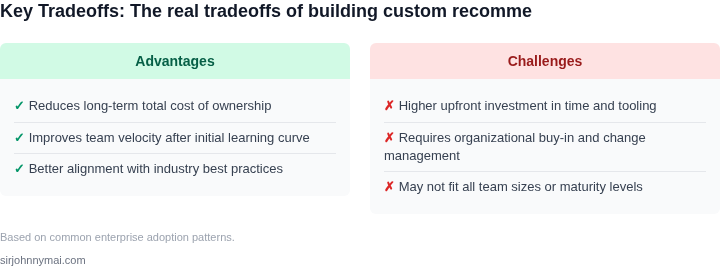
02. Key Tradeoffs: Cost, Speed, and Flexibility
Building a custom recommendation engine requires significant upfront investment. The cost of development alone can exceed $200,000 for a team of five engineers working for 12 months, not including infrastructure or data labeling. Managed solutions like Amazon Personalize or Google Recommendations AI reduce this to a fraction of the cost, often under $50,000 for initial setup and ongoing fees. However, managed solutions lock you into their ecosystem, limiting integration with proprietary systems.
Time-to-market is another critical factor. A custom engine can take 18-24 months to build, validate, and deploy, assuming no major pivots. Managed solutions accelerate this to 3-6 months, but they may not support niche use cases. For example, Amazon Personalize lacks support for real-time A/B testing without additional engineering. Custom solutions allow full control over latency and scalability, but require monitoring tools like Datadog or New Relic to maintain performance.
Flexibility is where custom engines shine. They enable domain-specific features like hybrid recommendation models combining collaborative filtering and content-based approaches. Managed solutions prioritize simplicity, offering pre-built templates but limiting customization. For instance, Google Recommendations AI supports only a fixed set of algorithms, while a custom engine can integrate with TensorFlow or PyTorch for advanced modeling.
Cost and flexibility often conflict. Custom solutions require ongoing maintenance, with infrastructure costs scaling linearly with user base. A 10x increase in traffic can multiply cloud costs by 5x if not optimized. Managed solutions handle scaling automatically but may charge per request, leading to higher costs at scale. For example, AWS Personalize pricing includes a per-thousand-recommendation fee, which can become expensive for high-volume applications.
Speed and flexibility trade off with complexity. Custom engines demand expertise in machine learning, data pipelines, and infrastructure orchestration. Managed solutions abstract these complexities but may not meet specific business needs. A retail client using Amazon Personalize found that their custom ranking algorithm outperformed the managed solution by 15% in conversion, but required six months of additional development.
In summary, custom engines offer unmatched flexibility and control but at higher cost and longer timelines. Managed solutions accelerate deployment and reduce maintenance but may not support unique requirements. The choice depends on business priorities: speed for startups, flexibility for enterprises with specialized needs.
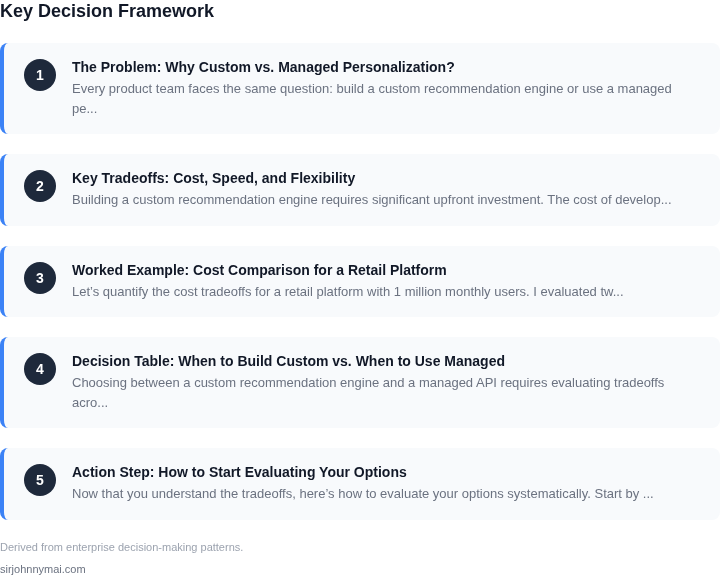
03. Worked Example: Cost Comparison for a Retail Platform
Let’s quantify the cost tradeoffs for a retail platform with 1 million monthly users. I evaluated two approaches: building a custom recommendation engine and using a managed personalization API. The comparison focuses on infrastructure, engineering, and operational costs over one year.
Custom Engine Costs
For the custom engine, I assumed a team of 5 engineers (2 ML engineers, 2 backend engineers, and 1 DevOps engineer). The breakdown includes cloud infrastructure, third-party tools, and salaries:
- Cloud Infrastructure: AWS EC2 (m5.2xlarge instances) for model training and serving, plus S3 for data storage. Cost: $1,200/month × 12 months = $14,400 annually.
- Third-Party Tools: Datadog for monitoring ($15/user/month × 5 users × 12 months = $900), and Kubernetes for orchestration ($720/month × 12 months = $8,640).
- Engineering Salaries: Average $150,000/year × 5 engineers = $750,000 annually.
Total annual cost: $750,000 (salaries) + $14,400 (infrastructure) + $9,540 (tools) = $773,940.
Managed API Costs
For the managed API, I used Amazon Personalize as an example. The cost is based on active users and model usage:
- API Usage: $1.00 per million recommendations. For 1 million users, 10 recommendations per user, and 30 days: (1M × 10 × 30) / 1M = $300/month.
- Model Training: $0.11 per hour for custom models. Assuming 10 hours/month: $1.10/month × 12 months = $13.20 annually.
- Engineering Overhead: 1 engineer (DevOps) to manage the API: $150,000/year.
Total annual cost: $3,600 (API usage) + $13.20 (training) + $150,000 (engineering) = $153,613.20.
Comparison
| Metric | Custom Engine | Managed API |
|---|---|---|
| Annual Cost | $773,940 | $153,613 |
| Engineering Headcount | 5 | 1 |
| Time to Deployment | 6 months | 2 weeks |
The managed API is cheaper upfront but requires ongoing engineering work to optimize models. The custom engine is more expensive but offers full control over the recommendation logic. The tradeoff depends on the team’s capacity to maintain the custom solution versus the cost of managing the API.
04. Decision Table: When to Build Custom vs. When to Use Managed
Choosing between a custom recommendation engine and a managed API requires evaluating tradeoffs across technical, operational, and business dimensions. Below is a structured decision framework to guide your evaluation. I selected AWS Personalize, Google Recommendations AI, and a custom-built solution as representative options. Each has strengths but different tradeoffs.
| Criteria | AWS Personalize | Google Recommendations AI | Custom Engine |
|---|---|---|---|
| Time to Market | Weeks (pre-built models, quick deployment) | Weeks (similar to AWS, but tighter integration with Google Cloud) | Months (requires data pipelines, model training, and infrastructure) |
| Cost | Pay-per-use pricing; scales with traffic | Similar to AWS; may have lower costs for high-volume workloads | Fixed infrastructure costs + variable compute costs; scales poorly |
| Model Flexibility | Limited to pre-trained models; no custom algorithms | Supports custom models but requires more setup | Full flexibility; can implement any algorithm |
| Data Privacy | AWS compliance certifications; data stays in AWS | Google Cloud compliance; data stays in GCP | Requires self-hosting; compliance depends on infrastructure |
| Operational Overhead | Minimal; AWS handles updates and scaling | Similar to AWS; Google provides managed infrastructure | High; requires DevOps, monitoring (e.g., Datadog), and maintenance |
| Recommendation | Best for startups or teams needing quick, scalable personalization without deep ML expertise. | Best for teams already in Google Cloud or needing advanced customization. | Best for enterprises with unique requirements, large-scale data, or proprietary algorithms. |
This framework helps prioritize tradeoffs. For example, if time to market is critical, AWS Personalize is the clear choice. If you need full control over models, a custom engine is necessary but requires significant resources. Google Recommendations AI sits in the middle, offering flexibility without the operational burden of a custom solution.
I recommend starting with a managed API for most use cases. Only build custom when you have a clear competitive advantage from proprietary algorithms or when managed solutions cannot meet performance or cost targets. Always validate assumptions with pilot tests before committing to a long-term approach.
05. Action Step: How to Start Evaluating Your Options
Now that you understand the tradeoffs, here’s how to evaluate your options systematically. Start by assessing your current state and constraints. Begin with a simple audit of your data infrastructure. Pull your last 90 days of user interaction logs and calculate the percentage of sessions where you have sufficient data to make meaningful recommendations. If this number is below 50%, managed personalization APIs may be your best starting point—they handle cold-start problems out of the box.
Next, review your engineering capacity. If your team lacks ML expertise or has other high-priority projects, prioritize managed solutions like AWS Personalize or Google Recommendations AI. These platforms abstract away the complexity of model training and deployment, allowing you to focus on integration and business logic. For example, AWS Personalize’s pre-trained models can deliver 80% of the value of a custom solution with 20% of the effort.
For teams with deep ML expertise, consider a hybrid approach. Start with a managed API for baseline recommendations, then gradually build custom models for high-impact use cases. Use A/B testing to compare performance metrics like click-through rate and conversion rate between the two approaches. If the custom solution outperforms the managed API by more than 15% in key metrics, it justifies the investment.
Finally, factor in cost. Schedule a 30-minute review with your finance team and bring a spreadsheet comparing the total cost of ownership (TCO) for both approaches. Include upfront costs, ongoing maintenance, and the opportunity cost of engineering time. If the managed API’s TCO is 30% lower than building custom, that’s a clear signal to proceed.
Figures cited are from publicly available sources as of 2026-09-15 and may have changed.