01. The cross‑region data synchronization challenge
Enterprises face a critical challenge when synchronizing data across geographic regions: maintaining consistency while balancing latency, compliance, and cost. For example, a global e-commerce platform must ensure inventory counts match across North America and Europe, but a 100ms latency penalty for every cross-region API call could degrade user experience. Similarly, financial institutions must comply with regional data residency laws, which may require certain datasets to remain in specific jurisdictions.
The problem compounds when considering scale. A single transaction might trigger updates across multiple databases, caches, and analytics systems. For instance, a retail chain processing 10,000 transactions per minute across 10 regions must ensure all systems reflect the same state within milliseconds. Missing this window creates operational risks, such as double-charging customers or displaying outdated inventory.
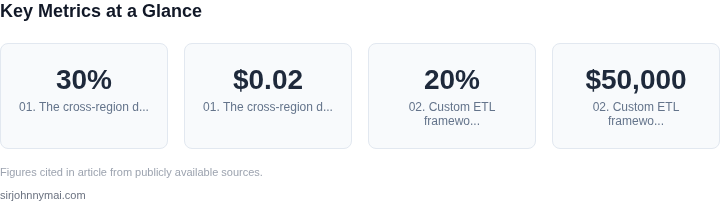
Cost is another layer. Cross-region data transfer can account for 20-30% of cloud infrastructure expenses, especially with high-volume applications. AWS, for example, charges $0.02 per GB for inter-region data transfer, which scales rapidly. A 1TB dataset synchronized daily across three regions would cost $600/month, excluding compute and storage costs. This makes it difficult to justify custom solutions unless the business case is compelling.
Compliance adds constraints. GDPR requires European data to stay within the EU, while HIPAA mandates U.S. healthcare data remain in the country. A custom ETL framework might handle this, but it requires dedicated engineering teams to manage regional replication rules, encryption, and failover scenarios. Managed platforms like AWS DMS or Snowflake Data Sharing automate much of this, but they may not support niche compliance requirements without custom integrations.
Latency is a tradeoff. Synchronous replication ensures immediate consistency but introduces cascading failures if one region goes down. Asynchronous replication reduces latency but risks stale data. For example, a banking app might tolerate a 5-second delay for balance updates but require real-time consistency for fraud detection. This forces enterprises to prioritize certain datasets over others, complicating architecture decisions.
The choice between custom frameworks and managed platforms hinges on these tradeoffs. Custom solutions offer granular control but require significant upfront investment in engineering and maintenance. Managed platforms reduce operational overhead but may not fit every use case. The right approach depends on the business's tolerance for inconsistency, compliance needs, and budget constraints.
02. Custom ETL frameworks: capabilities and hidden costs
Building custom ETL frameworks offers the illusion of full control over data synchronization. Teams can optimize pipelines for specific workloads, implement custom error handling, and tailor performance tuning to their exact needs. However, this control comes at a steep cost. The initial development effort often exceeds 6-12 months, with engineering teams needing deep expertise in distributed systems, concurrency models, and failure recovery strategies. Without a mature framework like Apache Kafka or AWS Kinesis, teams must build these capabilities from scratch.
Scaling these custom pipelines introduces operational complexity. Horizontal scaling requires careful orchestration, often using Kubernetes or similar platforms, which adds another layer of operational overhead. Teams must manage cluster scaling, resource allocation, and inter-node communication. For example, a team handling 100TB/day of cross-region data may find their custom ETL framework struggling to maintain throughput without significant engineering effort. In contrast, managed services like AWS Glue or Snowflake Data Sharing handle scaling automatically, abstracting these complexities away.
Operational costs are another hidden expense. Custom frameworks require dedicated teams for maintenance, monitoring, and troubleshooting. A single engineer may need to spend 20% of their time addressing pipeline failures, which could be mitigated with tools like Datadog or New Relic. Additionally, hardware costs can escalate quickly. A team running 50 EC2 instances for their ETL framework may incur $50,000/year in cloud expenses, whereas a managed service might cost $10,000 for equivalent throughput.
Engineering debt accumulates rapidly. Custom frameworks often lack built-in compliance features, forcing teams to implement security patches and regulatory updates manually. For example, GDPR or HIPAA compliance may require additional development cycles to ensure data masking and encryption are properly handled. Without automated testing and CI/CD pipelines, regression risks increase, leading to longer deployment cycles and higher failure rates.
Finally, custom frameworks limit flexibility. When business requirements evolve—such as adding new data sources or changing synchronization frequencies—teams must invest in refactoring. A team that built a custom ETL framework for batch processing may later need real-time capabilities, requiring a complete rewrite. Managed platforms like AWS DMS or Azure Data Factory offer built-in support for these changes, reducing technical debt and accelerating innovation.
03. Worked example: cost comparison of custom vs. managed solutions
Consider a team of 10 engineers building a custom ETL framework to synchronize data across AWS regions. The initial development phase costs $800,000 over 18 months, including salaries, tools, and third-party libraries. Infrastructure costs $600,000 annually for Kubernetes clusters, managed databases, and storage, scaling with data volume. Operations costs another $600,000 per year for monitoring (Datadog), logging (AWS CloudWatch), and debugging cross-region latency issues. Over three years, this totals $2 million.
In contrast, a managed platform like AWS Glue or Snowflake reduces costs significantly. A $400,000 annual subscription covers the core service, including serverless compute, schema evolution, and basic monitoring. Data transfer costs $150,000 over three years for inter-region replication, assuming 10TB/month of data. Support costs $100,000 for premium tier access, which includes SLAs and dedicated engineers. The total is $650,000.
The custom solution’s higher cost stems from maintaining expertise in distributed systems, handling schema changes, and optimizing for latency. The managed platform eliminates these burdens but imposes vendor lock-in and limited customization. For teams with fewer than 20 engineers, the managed solution is more cost-effective. However, if the team needs proprietary optimizations or integrates with niche systems, the custom framework may eventually become cheaper.
| Cost Component | Custom Framework | Managed Platform |
|---|---|---|
| Development | $800,000 (18 months) | $0 (built-in) |
| Infrastructure | $600,000/year | $0 (serverless) |
| Operations | $600,000/year | $100,000/year (support) |
| Data Transfer | $0 (included) | $150,000 (3 years) |
| Total (3 years) | $2,000,000 | $650,000 |
The numbers favor the managed platform, but the custom framework’s costs could shrink if the team scales to 50+ engineers. At that point, the $800,000 development cost becomes amortized, and infrastructure costs stabilize. However, the managed platform’s $400,000/year subscription would then exceed the custom solution’s $1.2 million total cost. The tradeoff hinges on team size and customization needs.
04. Decision matrix: when to build versus buy
Choosing between building a custom ETL framework or using a managed integration platform requires balancing technical constraints, cost, and operational overhead. The decision matrix below evaluates three options: AWS Glue, Azure Data Factory, and a custom-built solution. Each option has tradeoffs that align with specific use cases.
| Criteria | AWS Glue | Azure Data Factory | Custom ETL Framework |
|---|---|---|---|
| Data Volume | Best for petabyte-scale workloads with auto-scaling. | Optimized for large datasets but may require manual scaling. | Flexible but requires infrastructure provisioning for high volumes. |
| Latency SLAs | Sub-second latency for streaming, but batch jobs may introduce delays. | Supports near-real-time with Azure Synapse Link, but batch latency varies. | Latency depends on custom architecture; can achieve low latency with Kafka/Kubernetes. |
| Regulatory Constraints | Compliant with HIPAA/GDPR via AWS compliance certifications. | Microsoft’s compliance framework supports GDPR but may require additional configuration. | Requires self-auditing; compliance depends on infrastructure choices (e.g., private cloud). |
| Team Expertise | Low-code/no-code options reduce dependency on data engineers. | Microsoft’s tooling integrates with Power BI, easing adoption for analysts. | Highly dependent on in-house expertise; requires ongoing maintenance. |
| Cost | Pay-per-use model; costs scale with data volume but can be unpredictable. | Fixed pricing tiers; may be cheaper for predictable workloads. | Initial development costs are high but can be offset by long-term cost savings. |
| Recommendation | Best for teams needing scalability and low-code flexibility. | Ideal for enterprises leveraging Microsoft’s ecosystem. | Justify when customization, compliance, or latency requirements outweigh costs. |
For most cross-region sync use cases, managed platforms like AWS Glue or Azure Data Factory offer the best balance of speed and cost. However, if your organization has unique compliance needs or requires ultra-low latency, a custom solution may be necessary. Always validate assumptions with pilot tests before committing to a long-term strategy.
05. Action step: pilot a managed integration platform
Before committing to a full-scale migration, start with a 30-day proof-of-concept (PoC) using a managed integration platform. Select one high-traffic data flow that’s representative of your most demanding use case. This approach minimizes risk while providing tangible metrics to evaluate the platform’s performance.
For the PoC, prioritize a flow that involves cross-region synchronization with strict latency requirements. AWS Glue or Azure Data Factory are good candidates because they offer built-in orchestration, monitoring, and scaling. Configure the platform to replicate your existing data pipeline, including any transformations or dependencies. Avoid custom code unless absolutely necessary—stick to the platform’s native capabilities to isolate variables.
Track three key metrics during the PoC: cost, latency, and maintenance effort. Cost includes both the platform’s fees and any additional infrastructure costs (e.g., AWS Lambda for lightweight transformations). Latency should measure end-to-end time from source to destination, including any buffering or batching delays. Maintenance effort can be quantified by logging time spent on troubleshooting, configuration changes, and platform-specific quirks.
At the end of the 30 days, compare these metrics to your custom solution’s baseline. If the managed platform meets or exceeds your requirements with less effort, it’s a strong signal to expand adoption. If it falls short, document the gaps and revisit the decision matrix. Either way, the PoC provides actionable data to inform your next steps.
Pull your last 90 days of billing data from your managed platform and calculate the average cost per GB of data processed. Schedule a 30-minute review with your team to discuss the results.
Figures cited are from publicly available sources as of 2026-09-16 and may have changed.