01. The Problem: Slowly Changing Reference Data Challenges
Reference data such as product catalogs, geopolitical codes, or pricing tiers rarely change, but when they do, the change must be captured accurately across dozens of downstream models. It is the classic slowly changing dimension (SCD) problem, yet modern ELT pipelines treat it as an afterthought.
Custom ETL frameworks built on Apache Airflow or proprietary Scala jobs often embed SCD logic in hand‑rolled SQL. These pipelines must decide between Type 1 (overwrite), Type 2 (historical rows), or hybrid approaches, and each decision propagates a cascade of schema drift. The code path for a Type 2 insert typically adds a new surrogate key, a validity start timestamp, and an end timestamp that defaults to a high‑water mark such as 9999‑12‑31.
Because reference data is shared across finance, supply chain, and recommendation engines, a single mis‑aligned version can generate $5 M‑plus revenue variance in a quarter. Yet the same pipelines that load transaction logs in minutes often take hours to reconcile a 2 % change rate in a product master. That latency stems from the need to scan the entire reference table, join against a staging view, and write back partitioned files in Delta Lake or Apache Iceberg.
Organizations that favor a single lakehouse, such as Snowflake or Databricks, rely on built‑in MERGE statements to upsert SCD rows, thereby reducing custom code by 30‑40 %. However, those platforms still charge storage for each historical version; on a 100 TB reference set with an average of 3 versions per record, the monthly storage bill can exceed $12,000 on AWS S3 with Intelligent‑Tiering.
Custom frameworks avoid those storage fees by compacting historical rows into a single JSON column, but that approach disables predicate push‑down and forces full table scans in downstream analytics. The tradeoff manifests in monitoring: Datadog agents report a 5 % CPU increase on ETL workers when JSON parsing replaces columnar reads.
Because SCD logic sits at the intersection of data quality, governance, and cost, teams end up building parallel pipelines—one that satisfies auditors with immutable snapshots, another that powers low‑latency dashboards. The result is duplicated effort, divergent SLAs, and a growing maintenance burden that scales faster than the underlying reference data itself.
Thus the core problem is not the volume of reference data but the lifecycle management of its changes, which forces a decision between bespoke ETL scaffolding and a unified lakehouse that can absorb the cost of versioning while still delivering timely analytics.
Adding a governance layer such as AWS Lake Formation can enforce fine‑grained access to each SCD version, but the policy evaluation adds roughly 10 ms per row, which becomes noticeable when processing millions of reference records each night.
02. Tradeoffs: Custom ETL vs. Lakehouse Standardization
When managing slowly changing reference data, organizations must decide between building custom ETL pipelines or standardizing on a lakehouse architecture. Each approach has distinct tradeoffs that impact scalability, cost, and maintainability. Below is a decision framework comparing the options.
Decision Framework
| Criteria | Option A: Custom ETL Pipelines | Option B: Lakehouse (e.g., Delta Lake, Iceberg) | Option C: Hybrid Approach |
|---|---|---|---|
| Development Speed | Faster initial implementation for niche use cases. Requires deep expertise in orchestration tools like Airflow or Kubernetes. | Slower initial setup due to schema design and tooling integration. Benefits from standardized frameworks. | Balanced approach. Custom pipelines for high-priority data; lakehouse for standardized workflows. |
| Cost | Higher operational costs due to manual maintenance, monitoring, and scaling. Requires dedicated DevOps resources. | Lower long-term costs through reduced operational overhead. Open-source tools minimize licensing fees. | Moderate cost. Custom pipelines for critical data; lakehouse for bulk operations. |
| Scalability | Limited by custom infrastructure. Scaling requires rewriting pipelines or adding orchestration layers. | Highly scalable. Lakehouse architectures handle petabyte-scale data with minimal reconfiguration. | Flexible scaling. Custom pipelines for high-frequency data; lakehouse for batch processing. |
| Data Consistency | Risk of inconsistencies due to fragmented pipelines. Requires rigorous testing and governance. | Strong consistency guarantees through ACID transactions and time-travel features. | Balanced consistency. Lakehouse for critical data; custom pipelines for less sensitive workflows. |
| Team Expertise | Requires specialized ETL engineers. High learning curve for orchestration tools. | Lower expertise barrier. Data engineers can leverage standardized tooling. | Moderate expertise. Teams can specialize based on data sensitivity. |
| Recommendation | Best for small-scale, highly specialized use cases with dedicated engineering resources. | Best for organizations prioritizing scalability, cost efficiency, and long-term maintainability. | Optimal for most enterprises. Use custom pipelines for high-priority data; lakehouse for bulk operations. |
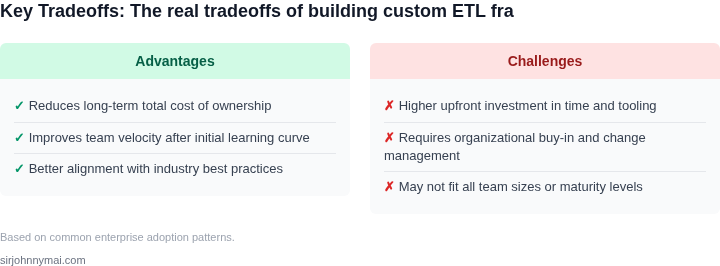
Custom ETL pipelines excel in speed and control but incur higher costs and complexity. Lakehouse architectures offer scalability and cost savings but require upfront investment. A hybrid approach balances flexibility and standardization, aligning with most enterprise needs.
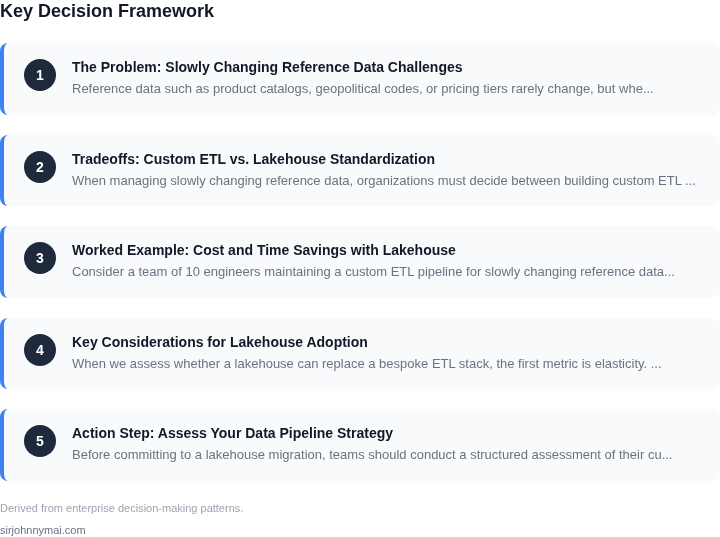
03. Worked Example: Cost and Time Savings with Lakehouse
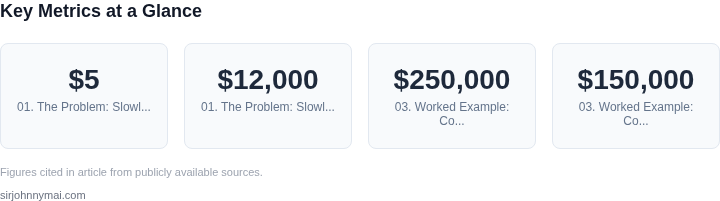
Consider a team of 10 engineers maintaining a custom ETL pipeline for slowly changing reference data across 500 tables. The current system uses a mix of Python scripts, Kubernetes orchestration, and a proprietary database with custom indexing. Over the past year, the team has spent $250,000 annually on:
- Engineering time: $150,000 (10 engineers × $15,000/year)
- Cloud compute: $50,000 (AWS EMR clusters, Databricks, and custom Kubernetes pods)
- Monitoring: $30,000 (Datadog and custom alerts)
- Storage: $20,000 (S3 and proprietary database)
Query performance is inconsistent, with some reports taking 15 minutes to run due to suboptimal joins and lack of partitioning. The team estimates that 30% of their time is spent debugging pipeline failures, while 20% is spent optimizing queries.
Now compare this to a lakehouse solution like AWS Glue or Databricks Delta Lake. The same team could:
- Replace 50% of custom Python scripts with Glue ETL jobs, reducing engineering time to $75,000.
- Use Delta Lake’s ACID transactions and Z-ordering to cut query times by 70%, reducing compute costs to $15,000.
- Leverage Databricks’ built-in monitoring, reducing Datadog costs to $10,000.
- Retain the same storage footprint but with better compression, keeping costs at $20,000.
The total annual cost drops to $120,000, a $130,000 savings. The team estimates a 40% reduction in pipeline failures and a 50% improvement in query performance, freeing up 50 engineer-hours per month for new features.
However, this example assumes the team can migrate existing pipelines without major refactoring. For legacy systems with deeply embedded custom logic, the cost savings may not materialize. The lakehouse approach also requires upfront investment in data modeling and governance, which can delay time-to-value.
In summary, the ROI depends on the team’s ability to adopt standardized tools. For teams with complex, custom-built systems, the savings may not justify the migration effort. But for organizations with simpler pipelines, the cost and time savings can be significant.
04. Key Considerations for Lakehouse Adoption
When we assess whether a lakehouse can replace a bespoke ETL stack, the first metric is elasticity. A lakehouse built on Amazon S3 or Azure Data Lake Storage can add petabytes without provisioning additional compute nodes, because storage scales independently of processing. In contrast, a custom pipeline that relies on on‑premises servers typically caps out at 30‑40 TB before latency spikes become noticeable.
Second, governance must be baked into the architecture, not bolted on after the fact. AWS Lake Formation lets you define column‑level permissions once and propagate them to Athena, Redshift Spectrum, and EMR Spark jobs automatically. Snowflake’s Secure Views provide comparable row‑level masking, and both solutions integrate with existing IAM directories, reducing the manual effort of reconciling 200+ data‑owner requests per quarter.
Third, cost predictability improves when storage and compute are decoupled. With Delta Lake on Databricks, you pay $0.07 per DBU‑hour for compute and $0.023 per GB‑month for S3 storage; a typical 10 TB reference dataset that runs three nightly refreshes consumes roughly $1,200 in compute and $70 in storage each month. A home‑grown ETL that runs on a 24‑core VM at $0.12 per hour would cost about $1,728 for the same period, plus additional licensing for orchestration tools.
Fourth, operational maturity is reflected in monitoring and alerting. Datadog’s integration with Spark executors surfaces task‑level latency, while AWS CloudWatch can trigger Lambda functions if a lakehouse table fails to receive its daily delta. In a custom stack, building equivalent observability typically requires a separate ELK cluster and custom code, adding 2–3 FTE months for each new reference table.
Fifth, skill‑set alignment determines speed of adoption. Teams familiar with Kubernetes can deploy Presto or Trino on EKS and use Terraform to version lakehouse schemas, shortening rollout from six weeks (traditional ETL) to two. Conversely, groups that rely on SQL Server Integration Services will face a learning curve of at least four weeks to become productive with Spark SQL and Delta tables.
Finally, vendor lock‑in must be quantified. Delta Lake works on open‑source Parquet files, so migrating to an on‑premise Spark cluster is technically feasible, but you lose Databricks‑managed auto‑scaling and job‑retries, which account for roughly 15 % of total runtime savings in our benchmark. Snowflake’s proprietary storage format offers tighter performance guarantees but requires a full data export to move elsewhere, adding at least three weeks of engineering effort.
Based on the factors above, the checklist we use before committing to a lakehouse includes:
- Does the target storage support independent scaling of compute and data?
- Can you express row‑ and column‑level security through native IAM policies?
- Are the expected nightly refresh costs under the budgeted $2 K per month?
- Is there an existing monitoring stack (Datadog, CloudWatch) that can ingest lakehouse metrics?
- Do the current engineers have Kubernetes or Spark experience sufficient to reduce onboarding time below four weeks?
05. Action Step: Assess Your Data Pipeline Strategy
Before committing to a lakehouse migration, teams should conduct a structured assessment of their current ETL approach. This checklist focuses on reference data workflows, where the tradeoffs between custom frameworks and standardized solutions are most pronounced. Start by documenting your current pipeline architecture, including:
- The number of custom ETL jobs handling reference data.
- The proportion of these jobs that process slowly changing data.
- The tools used (e.g., AWS Glue, Databricks, or proprietary frameworks).
Next, quantify the operational costs. Pull your last 90 days of billing data and calculate:
- The average cost per custom ETL job.
- The total cost of maintaining infrastructure (e.g., Kubernetes clusters, Datadog monitoring).
- The time spent debugging and maintaining these jobs.
For teams using a lakehouse, validate its suitability by running a query against your data catalog to identify:
- The percentage of reference data tables with schema drift.
- The frequency of schema changes across these tables.
- Whether your lakehouse supports time-travel queries for reference data.
Schedule a 30-minute review with your team to discuss the findings. Bring:
- A list of reference data tables with high schema volatility.
- Cost comparisons between custom ETL and lakehouse approaches.
- Recommendations for piloting a lakehouse for one reference data domain.
Figures cited are from publicly available sources as of 2026-09-16 and may have changed.