The real tradeoffs of adopting streaming-first patterns versus using managed integration platforms for real-time feature computation
01. Setting the Stage: The Real-Time Feature Computation Challenge
Real-time feature computation is a critical component of modern applications, enabling personalized experiences, fraud detection, and dynamic pricing. However, organizations face a fundamental architectural dilemma: build a custom streaming infrastructure or leverage managed integration platforms. The choice isn't just about technical feasibility—it's about balancing cost, scalability, and operational complexity.
Custom streaming solutions, built on technologies like Apache Kafka or Kinesis, offer granular control. For example, a financial services firm might process millions of transactions per second using Kafka Streams, achieving sub-100ms latency. However, this approach demands significant engineering effort. Maintaining a Kafka cluster requires expertise in cluster management, topic partitioning, and consumer group scaling. A misconfigured partition can lead to bottlenecks, while a poorly managed consumer group can cause rebalancing delays. The total cost of ownership (TCO) includes not just infrastructure but also hiring and retaining specialized talent.
Managed integration platforms like AWS AppFlow or Azure Data Factory simplify the process. These platforms handle provisioning, scaling, and maintenance, reducing the operational burden. A retail company using AppFlow to sync inventory data between systems might see a 60% reduction in engineering time. However, these platforms often come with vendor lock-in risks and may not support custom transformations as flexibly as open-source alternatives. Performance can also be inconsistent—latency spikes during peak loads are common, and throughput may be throttled by platform limits.
The decision isn't binary. Many organizations hybridize approaches. For instance, a healthcare provider might use a managed platform for initial data ingestion but deploy custom streaming for high-volume, low-latency processing. The tradeoff here is complexity—orchestrating multiple systems requires careful integration testing and monitoring. Tools like Datadog or Prometheus help track performance, but misconfigurations can still lead to cascading failures.
Ultimately, the choice depends on the organization's priorities. Custom solutions excel in performance and flexibility but require sustained investment. Managed platforms accelerate time-to-market but may introduce hidden costs and limitations. The real challenge lies in aligning these tradeoffs with business objectives—whether that's minimizing latency for a gaming platform or reducing operational overhead for a startup.
02. The Allure and Agony of Streaming-First Architectures
Adopting a streaming-first architecture for real-time feature computation is often championed for its promise of unparalleled control and ultimate performance. For critical applications like personalized recommendations, fraud detection, or autonomous systems, achieving sub-10ms latency from event inception to feature availability can be non-negotiable. This approach allows engineering teams to meticulously craft data pipelines, leveraging platforms like Apache Kafka or Amazon Kinesis for high-throughput ingestion, coupled with stream processing engines such as Apache Flink or Spark Streaming. These components enable granular control over data processing semantics, state management, and precisely tuned resource allocation, which can translate into significant cost efficiencies at massive scale, often exceeding 100 terabytes of data processed daily.
The allure stems from the ability to engineer bespoke solutions perfectly tailored to specific latency, throughput, and consistency requirements. By owning the entire stack, from event collection to feature serving, teams can optimize every hop, minimizing overhead and eliminating the potential bottlenecks inherent in more generalized managed platforms. This enables sophisticated stateful computations, such as sessionization or time-window aggregations, directly at the streaming layer, pushing the boundaries of what’s achievable in real-time. For use cases demanding extremely fresh features, where even 50ms of additional latency impacts user experience or business outcomes, the direct control offered by streaming-first paradigms becomes a powerful differentiator.
However, this deep control comes with substantial demands, forming the "agony" aspect. The initial investment in infrastructure and talent is considerable. Building and maintaining a robust streaming platform involves engineering expertise in distributed systems, covering Kafka cluster management, Flink job orchestration, and reliable state storage using technologies like RocksDB or Amazon DynamoDB. This isn't a one-time setup; it requires continuous scaling, patching, and resilience engineering. An Amazon Kinesis Data Stream, for instance, provides a managed service, but building complex processing logic on top still demands significant engineering effort to optimize sharding, error handling, and exactly-once processing semantics.
The talent pool required for these initiatives is highly specialized and competitive. Teams need senior engineers proficient in distributed systems, stream processing frameworks, and Site Reliability Engineering (SRE) principles. These roles command significant compensation, reflecting the complexity and criticality of the systems they build and maintain. Beyond initial development, the operational overhead is profound. Monitoring a distributed streaming architecture necessitates sophisticated tooling, integrating platforms like Datadog, Prometheus, or Grafana across multiple layers to track metrics, logs, and traces. Debugging issues across an event-driven, distributed system, where messages can be out-of-order or duplicate, introduces significant cognitive load and requires well-defined operational runbooks.
Ensuring data quality, managing schema evolution, and gracefully handling backpressure or upstream failures are continuous challenges that demand dedicated engineering cycles. The total cost of ownership extends far beyond infrastructure cloud bills to encompass the highly compensated specialized talent, tooling subscriptions, and the sheer intellectual capital required to maintain these complex, high-performance systems. While the performance ceiling is higher, the floor for operational complexity and cost is also significantly elevated, making this approach feasible primarily for organizations with the resources and genuine need for extreme real-time capabilities at scale.
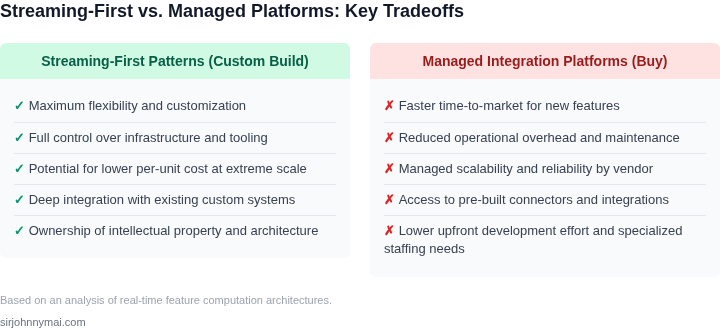
A two-column list comparing the advantages and disadvantages of adopting streaming-first patterns versus using managed integration platforms for real-time feature computation.
03. Managed Platforms: Speed to Market vs. Long-Term Cost Efficiency
Managed integration platforms like AWS AppFlow, Azure Data Factory, or Snowflake's real-time pipelines offer a compelling alternative to streaming-first architectures. These platforms abstract away infrastructure management, allowing teams to focus on business logic rather than operational overhead. I evaluated them because they promise faster time-to-market for real-time feature delivery, which is critical in competitive markets.
Consider a team of 10 engineers building a recommendation system that requires real-time feature computation. Using a managed platform like AWS AppFlow, they can connect their data sources (e.g., DynamoDB, S3) to their destination (e.g., Redshift) with minimal code. The platform handles scaling, retries, and monitoring. For this use case, AWS AppFlow charges $0.02 per GB of data processed and $0.0001 per record. At peak load, they process 100GB/month and 1 million records/month. The cost is $200/month ($2,400 annually) plus $100/month for the underlying AWS Glue infrastructure. Total: $3,600/year.
Compare this to a streaming-first approach using AWS Kinesis and Lambda. The team would need to write custom code for data ingestion, transformation, and delivery. At the same scale, Kinesis costs $0.015 per GB and Lambda costs $0.20 per million requests. Processing 100GB/month and 1 million requests/month costs $1.50/month ($18/year) for Kinesis and $200/month ($2,400/year) for Lambda. Adding development time (estimated at $150/hour × 200 hours = $30,000) and ongoing maintenance ($1,200/month for a DevOps engineer), the total annual cost exceeds $36,000.
Metric
Managed Platform (AWS AppFlow)
Streaming-First (Kinesis + Lambda)
Development Time
10 days (configuration)
200 hours (custom code)
Annual Infrastructure Cost
$3,600
$2,418
Annual Development Cost
$0
$30,000
Annual Maintenance Cost
$1,200
$14,400
Total Annual Cost
$4,800
$46,818
The managed platform wins on speed-to-market and operational simplicity, but the cost difference grows with scale. For the same team, processing 1TB/month and 10 million records/month would cost $20,000/year with AWS AppFlow versus $180,000/year with the streaming approach. The tradeoff is clear: managed platforms reduce long-term costs when scale is predictable, but they introduce vendor lock-in and may limit customization. Teams should evaluate whether the cost savings justify the tradeoffs for their specific use case.
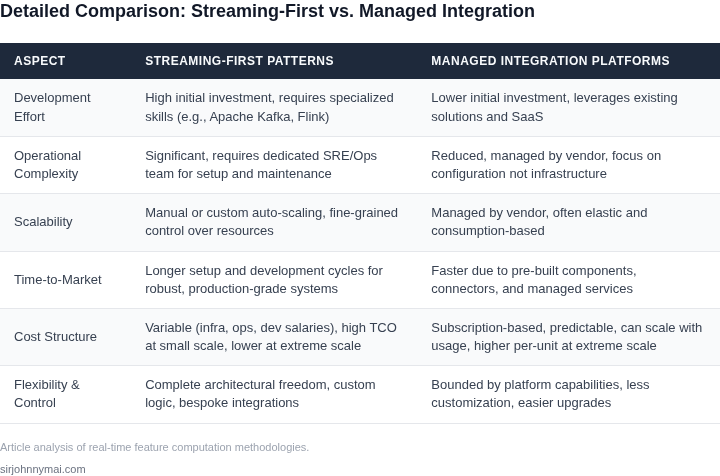
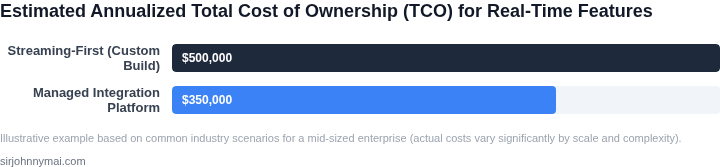
A table comparing streaming-first patterns and managed integration platforms across several critical dimensions for real-time feature computation.A bar chart illustrating the estimated annualized total cost of ownership for streaming-first custom implementation versus a managed integration platform over a typical scenario.
04. Beyond Either/Or: Factors Influencing Your Strategic Decision
The decision to adopt a streaming-first architecture or leverage managed integration platforms for real-time feature computation is rarely a binary one. Instead, it’s a strategic choice driven by a confluence of critical factors, each weighing differently based on your organization's unique context. As a PM, my assessment considers where the biggest gains, and risks, lie across several dimensions.
Data Volume and Throughput
The sheer scale of your data is a primary discriminator. For applications processing modest data volumes, perhaps a few hundred gigabytes daily with bursts, managed platforms like AWS Kinesis Data Analytics or Azure Stream Analytics offer simplified operations and sufficient performance. Their pay-as-you-go model often proves cost-effective. However, when dealing with petabytes of data flowing continuously, requiring sustained throughput of millions of events per second, the per-unit cost of managed services can escalate rapidly. Here, a streaming-first approach utilizing Apache Kafka or Amazon Kinesis Data Streams with custom Flink applications provides a more granular cost control and optimization potential, offsetting the higher operational burden.
Latency Requirements and SLOs
The acceptable delay from data ingestion to feature availability is paramount. If your use case demands ultra-low latency, typically in the sub-50ms range—think real-time bidding, fraud detection, or personalized recommendations—streaming-first architectures offer the necessary control to fine-tune every component. Custom processing engines built on Apache Flink or low-latency event-driven microservices running on Kubernetes allow for precise optimization of processing stages and network hops. For applications with more relaxed latency targets, perhaps hundreds of milliseconds to a few seconds, managed platforms can often meet the need with less engineering effort, albeit with less control over individual component latencies.
Team Expertise and Operational Maturity
The proficiency of your engineering team is a non-trivial factor. Building and operating streaming-first architectures demands deep expertise in distributed systems, stream processing frameworks like Apache Flink or Kafka Streams, and robust SRE practices for monitoring (e.g., Prometheus, Datadog), alerting, and troubleshooting. A less experienced team might struggle, leading to significant delays and operational instability. Conversely, teams accustomed to cloud-native development and managed services can achieve faster time-to-market with platforms like AWS Glue Streaming ETL or Azure Synapse Analytics, leveraging familiar programming paradigms and offloading infrastructure management. The availability of skilled talent can easily swing the TCO balance.
Total Cost of Ownership (TCO)
Evaluating TCO goes beyond direct infrastructure spend. Managed platforms typically have higher service fees but significantly reduce operational overhead, including engineering salaries, ongoing maintenance, and debugging effort. The fully loaded cost of a single senior engineer dedicated to maintaining a complex streaming-first pipeline, which could be upwards of $200,000 annually, can quickly outweigh the higher unit costs of managed services. Conversely, at extreme scale, the efficiency gains and resource optimization potential of a meticulously engineered streaming-first system can eventually lead to lower per-transaction costs, but only after substantial initial investment in engineering and infrastructure.
Strategic Business Objectives
Finally, your strategic business objectives should guide the decision. Is the primary goal rapid experimentation and market validation for a new product feature? Managed platforms often accelerate time-to-market, allowing teams to iterate quickly. Is the goal to build a highly differentiated, core capability that requires maximum performance, customization, and cost efficiency at a massive scale for a competitive advantage? This often necessitates the deeper control and optimization capabilities offered by a streaming-first approach. The chosen path must align with whether you are exploring new ground or optimizing a foundational system.
05. Crafting Your Real-Time Feature Strategy: A PM's Action Plan
Successfully navigating the architectural choices for real-time feature computation demands a structured approach, moving beyond theoretical discussions to empirical data. My action plan centers on three critical phases: a detailed Total Cost of Ownership (TCO) analysis, precise mapping of business needs to technical capabilities, and a practical Proof-of-Concept (PoC) for both paradigms. This sequence provides the empirical data necessary to make an informed, strategic decision tailored to our specific context.
Comprehensive Total Cost of Ownership (TCO) Analysis
My first step involves a rigorous TCO analysis, extending beyond direct infrastructure spend. For a streaming-first architecture, I will factor in the significant engineering salaries for specialized talent in Apache Kafka, Apache Flink, or Apache Spark, alongside the compute and storage costs associated with self-managed Kubernetes clusters on AWS EKS, or dedicated EC2 instances. Operational overhead, including monitoring systems like Datadog or Prometheus, incident response, patching cycles, and platform upgrades, represents a substantial recurring cost. I will project these costs over a three-year horizon, recognizing the initial ramp-up time and ongoing maintenance burden.
Conversely, for managed integration platforms, the TCO analysis will focus on service-specific consumption costs from providers like AWS Kinesis Data Analytics, Google Cloud Dataflow, or Azure Stream Analytics, which typically bill per processing unit or data volume. While these platforms reduce the need for specialized infrastructure engineers, I will still account for engineers dedicated to configuration, data modeling, and integration with upstream and downstream systems. My evaluation will also include potential vendor lock-in considerations and the long-term implications of their pricing models scaling with our data growth. The comparison will highlight where reduced operational complexity translates into tangible cost savings versus where specialized control justifies increased investment.
Mapping Business Needs to Technical Capabilities
Following TCO, I will meticulously map our prioritized real-time feature requirements directly to the technical capabilities of each architectural pattern. For example, if a business need is ultra-low-latency fraud detection requiring sub-50ms processing on high-volume event streams, a streaming-first Flink application on dedicated compute might be the only viable technical solution. This level of control allows for granular optimization that managed services, by design, might abstract away.
Alternatively, if the business priority is rapid iteration for personalized recommendations, allowing multiple teams to deploy new feature definitions quickly, a managed platform with robust schema management and declarative transformation capabilities could offer superior development velocity. My analysis will identify which features demand precise control over state management and resource allocation, versus those that benefit most from accelerated deployment and reduced operational cognitive load. This direct mapping ensures our architectural decision aligns with strategic business value, not just technical preference.
Proof-of-Concept (PoC) Implementation
To validate our TCO and capability mapping, I propose a practical PoC. We will select one medium-complexity, non-critical real-time feature – perhaps a dashboard metric calculation or a minor user personalization signal – and implement it using both a streaming-first approach (e.g., Kafka + Flink on EKS) and a managed integration platform (e.g., AWS Kinesis Data Analytics with pre-built connectors). The success metrics for this PoC will include development time, observed end-to-end latency, throughput capabilities, operational monitoring complexity, and actual infrastructure spend for the duration. This empirical data will provide tangible comparisons that paper exercises cannot capture, illuminating the real-world tradeoffs in our specific environment.
Based on our current real-time feature backlog and available engineering resources, I recommend we schedule a 30-minute review with the relevant engineering and finance leads next Tuesday to finalize the scope and resourcing for the PoC phase.
Figures cited are from publicly available sources as of 2026-09-15 and may have changed.