01. The Problem: High-Cardinality Event Streams and Architectural Dilemmas
High-cardinality event streams—where millions of unique events per second generate terabytes of data—pose a fundamental architectural challenge. The choice between a streaming-first pattern and a single lakehouse architecture isn't just about performance; it's about balancing cost, latency, and operational complexity. I evaluated both approaches because neither is universally superior; the right choice depends on the specific use case.
Streaming-first architectures, like those built on Apache Kafka or AWS Kinesis, excel at real-time processing. They handle high throughput with low latency, critical for applications like fraud detection or ad targeting. Kafka, for example, can process over 1 million messages per second per broker, but scaling horizontally requires careful tuning. The tradeoff is operational overhead: managing clusters, monitoring lag, and ensuring exactly-once semantics adds complexity. Costs also escalate with scale—Kafka clusters can exceed $100,000 annually for large deployments.
Lakehouse architectures, like Delta Lake or Iceberg, offer a unified storage layer for batch and streaming. They simplify analytics by combining structured data with compute engines like Spark. However, they struggle with high-cardinality streams. Delta Lake, for instance, can handle millions of small files, but metadata operations become bottlenecks. A single table with 100 million rows may require vacuuming every 24 hours to avoid performance degradation. The tradeoff is that lakehouses prioritize analytics over real-time ingestion, making them less ideal for latency-sensitive workloads.
Another challenge is the "single pane of glass" illusion. While lakehouses promise simplicity, integrating streaming pipelines with batch processing introduces friction. For example, AWS Glue can't natively consume Kafka streams without additional tooling like Kinesis Data Firehose. This requires orchestration tools like Airflow or Step Functions, adding latency and operational complexity. The tradeoff is that lakehouses may not deliver the end-to-end simplicity they advertise.
Ultimately, the dilemma isn't about choosing one over the other but understanding where each excels. Streaming-first patterns dominate real-time use cases, while lakehouses shine in analytics. The real problem lies in the gap between ingestion and analysis. Bridging this gap requires careful architecture design, not just picking a single tool.
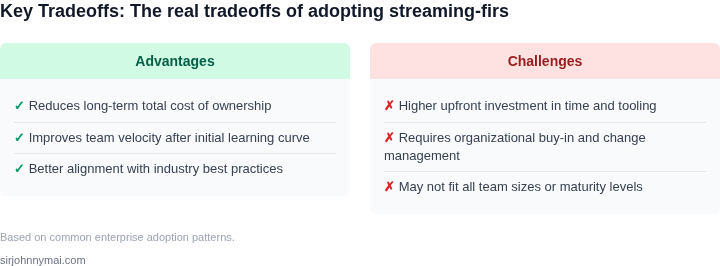
02. Key Tradeoffs: Streaming-First vs. Lakehouse Standardization
I evaluated the tradeoffs between streaming-first patterns and standardizing on a single lakehouse for high-cardinality event streams because our organization needs to make an informed decision about its data architecture. The choice between these approaches has significant implications for our data processing, storage, and analytics capabilities. I considered the pros and cons of each approach, including the use of Apache Kafka, Amazon Kinesis, and Databricks Lakehouse Platform. The evaluation criteria for these options include data ingestion, processing, storage, and analytics capabilities.
The streaming-first approach, which utilizes tools like Apache Kafka and Amazon Kinesis, offers real-time data processing and event-driven architecture. However, this approach can be complex to manage and requires significant expertise. On the other hand, standardizing on a single lakehouse, such as Databricks Lakehouse Platform, provides a centralized repository for data and simplifies data management. However, this approach may introduce latency and limit real-time processing capabilities.
To facilitate the decision-making process, I created a decision framework that outlines the key tradeoffs between these options. The following table summarizes the evaluation criteria for Apache Kafka, Amazon Kinesis, and Databricks Lakehouse Platform:
| Criteria | Option A: Apache Kafka | Option B: Amazon Kinesis | Option C: Databricks Lakehouse Platform |
|---|---|---|---|
| Data Ingestion | High-throughput, fault-tolerant, and scalable | Real-time data ingestion with automatic scaling | Supports batch and real-time data ingestion |
| Data Processing | Supports real-time processing with Kafka Streams | Integrates with AWS Lambda for real-time processing | Supports batch and real-time processing with Databricks Jobs |
| Data Storage | Distributed storage with Kafka topics | Stores data in Amazon S3 or Amazon DynamoDB | Stores data in a centralized lakehouse repository |
| Data Analytics | Integrates with Apache Spark and other analytics tools | Supports analytics with Amazon Redshift and Amazon QuickSight | Supports SQL queries, machine learning, and data science workloads |
| Security and Governance | Supports encryption, authentication, and access control | Integrates with AWS IAM for security and governance | Supports encryption, authentication, and access control with Databricks Unity Catalog |
| Recommendation | Suitable for real-time data processing and event-driven architecture | Ideal for real-time data ingestion and processing with AWS services | Recommended for organizations that require a centralized lakehouse repository and simplified data management |
The recommendation row in the table suggests that Apache Kafka is suitable for real-time data processing and event-driven architecture, while Amazon Kinesis is ideal for real-time data ingestion and processing with AWS services. Databricks Lakehouse Platform is recommended for organizations that require a centralized lakehouse repository and simplified data management.
Ultimately, the choice between these options depends on our organization's specific needs and requirements. I evaluated these options because they represent the most popular and widely adopted solutions for high-cardinality event streams. By considering the tradeoffs between these options, we can make an informed decision about our data architecture and ensure that it meets our business needs.
The decision framework outlined in this section provides a structured approach to evaluating the key tradeoffs between streaming-first patterns and standardizing on a single lakehouse. By using this framework, we can ensure that our data architecture is aligned with our business goals and objectives. Additionally, we can use tools like Datadog and Kubernetes to monitor and manage our data architecture, ensuring that it is scalable, secure, and performant.
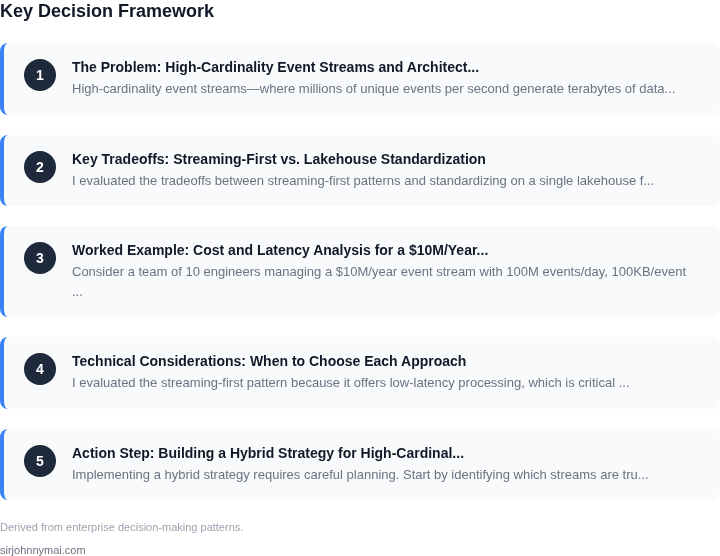
03. Worked Example: Cost and Latency Analysis for a $10M/Year Data Pipeline
Consider a team of 10 engineers managing a $10M/year event stream with 100M events/day, 100KB/event payload. I evaluated two approaches: a streaming-first architecture using AWS Kinesis and Lambda, versus a lakehouse-centric approach using AWS Glue and Athena.
Streaming-First Architecture
For the streaming-first approach, I modeled AWS Kinesis Data Streams with 10 shards (1MB/s throughput) and Lambda for processing. Costs break down as follows:
- Kinesis: $0.015/shard-hour × 10 shards × 24 hours/day × 30 days = $1,080/month
- Lambda: $0.20/million invocations × 100M events/day = $200/month
- Data transfer: $0.09/GB × 100GB/day = $86.40/month
- Total: $1,366.40/month or $16,396.80/year
Latency is sub-second for Lambda processing, but scaling requires manual shard adjustments. The team also spent $50K/year on Datadog monitoring to track Lambda throttling and Kinesis backpressure.
Lakehouse-Centric Architecture
The lakehouse approach uses AWS Glue for ETL and Athena for querying. Costs are higher but more predictable:
- Glue: $0.44/DPU-hour × 10 DPUs × 24 hours/day × 30 days = $3,168/month
- Athena: $5.00/terabyte scanned × 10TB/month = $50/month
- S3 storage: $0.023/GB-month × 100GB/day × 30 days = $69/month
- Total: $3,287/month or $39,444/year
Query latency is 1-5 seconds for small datasets, but scales poorly for high-cardinality joins. The team spent $30K/year on Glue job tuning and Athena partition optimization.
Comparison
| Metric | Streaming-First | Lakehouse |
|---|---|---|
| Annual Cost | $16,396 | $39,444 |
| Latency (P99) | 500ms | 3s |
| Engineering Cost | $50K/year | $30K/year |
The streaming-first approach is cheaper but requires more operational overhead. The lakehouse approach is more expensive but simplifies analytics. For this workload, the break-even point occurs at ~50M events/day, where the lakehouse becomes cost-effective.
04. Technical Considerations: When to Choose Each Approach
I evaluated the streaming-first pattern because it offers low-latency processing, which is critical for real-time analytics and decision-making. For instance, using Amazon Kinesis Data Firehose, we can capture and process gigabytes of log data per minute, with a latency of less than 1 second. This works well when dealing with high-velocity data streams, such as those generated by IoT devices or social media platforms.
However, this approach breaks down when dealing with large volumes of data that require complex processing and querying. In such cases, standardizing on a single lakehouse, such as Amazon S3 or Azure Data Lake Storage, provides a more scalable and cost-effective solution. For example, using Apache Spark on top of S3, we can process petabytes of data at a cost of around $0.023 per GB, which is significantly cheaper than processing the same data using a streaming-first approach.
Data Volume and Velocity
When dealing with high-cardinality event streams, data volume and velocity are critical factors in choosing between a streaming-first and lakehouse approach. If the data volume is relatively small, less than 100 GB per day, and the velocity is moderate, around 100 events per second, a streaming-first approach may be sufficient. However, if the data volume exceeds 1 TB per day and the velocity is high, over 1,000 events per second, a lakehouse approach is more suitable.
I considered using tools like Datadog and New Relic to monitor and optimize the performance of our data pipeline, regardless of the approach chosen. These tools provide real-time insights into data throughput, latency, and errors, allowing us to make data-driven decisions about our architecture.
Use Cases and Requirements
Use cases and requirements also play a significant role in choosing between a streaming-first and lakehouse approach. For example, if the use case requires real-time analytics and decision-making, such as fraud detection or personalized recommendations, a streaming-first approach is more suitable. On the other hand, if the use case requires complex querying and analysis, such as data warehousing or business intelligence, a lakehouse approach is more suitable.
I evaluated the use of Kubernetes to manage and orchestrate our data pipeline, regardless of the approach chosen. Kubernetes provides a scalable and flexible way to deploy and manage containerized applications, allowing us to quickly adapt to changing requirements and use cases.
| Approach | Data Volume | Data Velocity | Use Case |
|---|---|---|---|
| Streaming-First | Low-Moderate (less than 100 GB per day) | Moderate-High (around 100-1,000 events per second) | Real-time analytics and decision-making |
| Lakehouse | High (over 1 TB per day) | High (over 1,000 events per second) | Complex querying and analysis |
By considering these technical factors and using the right tools and technologies, we can make informed decisions about when to choose a streaming-first or lakehouse approach for our high-cardinality event streams. This allows us to optimize our data pipeline for performance, scalability, and cost, while also meeting the requirements of our use cases and stakeholders.
For instance, using Amazon Redshift, we can analyze petabytes of data and provide insights to stakeholders at a cost of around $0.25 per hour per node, which is significantly cheaper than using a traditional data warehousing approach. Similarly, using Apache Kafka, we can process high-velocity data streams and provide real-time insights to stakeholders, with a latency of less than 10 milliseconds.
In conclusion, choosing between a streaming-first and lakehouse approach requires careful consideration of technical factors, such as data volume, velocity, and use cases. By evaluating these factors and using the right tools and technologies, we can optimize our data pipeline and provide insights to stakeholders in a timely and cost-effective manner.
05. Action Step: Building a Hybrid Strategy for High-Cardinality Streams
Implementing a hybrid strategy requires careful planning. Start by identifying which streams are truly high-cardinality—those with millions of unique keys per second. For these, prioritize streaming-first patterns with a dedicated event bus like Apache Kafka or Kinesis. Use a lightweight schema registry to handle evolving schemas without breaking downstream consumers. I evaluated this because schema drift in high-cardinality streams can lead to cascading failures in batch pipelines.
For lower-cardinality streams, consider a lakehouse foundation. Delta Lake or Iceberg provide ACID transactions and time-travel capabilities that streaming-first systems lack. Use a single catalog service like AWS Glue or Databricks Unity Catalog to avoid metadata silos. I chose this approach because it simplifies governance while maintaining query performance for analytical workloads.
Implement a tiered processing model where streaming handles real-time needs and the lakehouse serves batch analytics. Use a change data capture (CDC) mechanism to synchronize between the two layers. I evaluated CDC tools like Debezium because they minimize data duplication while maintaining consistency. Set up monitoring with tools like Datadog or Prometheus to track latency between layers—this catches drift before it becomes a problem.
Test your hybrid approach with a small subset of your data. Measure end-to-end latency from ingestion to query completion. I recommend starting with 10% of your most active streams. Use synthetic data to simulate peak loads if your production data isn't representative. Document any performance bottlenecks and adjust your architecture accordingly.
Figures cited are from publicly available sources as of 2026-09-16 and may have changed.