01. The Problem: Cross-Region Data Sync Challenges
Cross-region data synchronization is a critical requirement for global-scale applications, ensuring low-latency access and high availability. However, the choice between streaming-first and batch-first approaches introduces fundamental tradeoffs that impact system reliability, cost, and operational complexity. The decision depends on factors like data volume, consistency requirements, and infrastructure constraints.
Streaming-First Tradeoffs
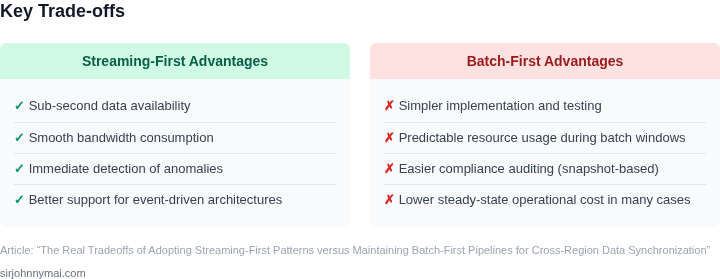
Streaming-first architectures, such as those using Apache Kafka or AWS Kinesis, offer near real-time synchronization by processing data as it arrives. This approach minimizes latency and enables event-driven workflows. For example, financial applications require sub-second updates to maintain accurate ledgers across regions. However, streaming systems introduce complexity in managing state, handling backpressure, and ensuring exactly-once processing. Operational overhead increases with the need to monitor consumer lag metrics and handle partition rebalancing during scaling events.
Cost is another consideration. Streaming platforms like Kafka require dedicated infrastructure, and scaling horizontally can become expensive at high throughput. For instance, a 100 MB/s data stream might require 10 Kafka brokers, each costing $1,000/month, totaling $10,000/month. Additionally, streaming systems often require more memory and CPU resources than batch systems, increasing cloud costs by 20-30% in some cases.
Batch-First Tradeoffs
Batch-first approaches, such as those using Apache Spark or AWS Glue, process data in fixed-size chunks, reducing operational complexity but increasing latency. For example, a batch job might process 1 GB of data every 5 minutes, introducing a 5-minute delay. This delay is acceptable for analytics workloads but problematic for applications requiring real-time insights. Batch systems also require careful tuning of parameters like parallelism and shuffle partitions to avoid performance bottlenecks.
Cost efficiency is a key advantage of batch processing. Tools like Spark can process large datasets at a lower cost per GB than streaming systems. For instance, a 1 TB dataset might cost $50 to process in Spark versus $150 in Kafka. However, batch systems struggle with variable workloads, as they must process the entire batch even if only a small portion of the data changes. This inefficiency can lead to over-provisioning and wasted resources.
Consistency and Reliability Challenges
Both approaches face consistency challenges. Streaming systems can lose data if consumers fail to commit offsets, while batch systems may process stale data if not configured for incremental updates. For example, a streaming pipeline might lose 0.1% of messages during a broker failure, whereas a batch job might process data that is already 10 minutes old due to scheduling delays. Reliability also varies by infrastructure. AWS Lambda, for instance, has a 99.95% uptime SLA, while self-managed Kafka clusters may achieve only 99.9% reliability.
Monitoring and debugging are more challenging in streaming systems due to the distributed nature of the data flow. Tools like Datadog or AWS CloudWatch can help, but they require significant setup. Batch systems, while simpler to monitor, lack visibility into intermediate processing steps. For example, a Spark job might fail silently if a partition is corrupted, requiring manual inspection of logs.
Infrastructure and Operational Complexity
Streaming-first architectures demand more infrastructure. A Kafka cluster with 3 brokers and 3 ZooKeeper nodes requires 12 VMs, each with 8 vCPUs and 32 GB RAM, totaling 384 vCPUs and 96 GB RAM. Batch systems, in contrast, can run on a single Spark cluster with 100 vCPUs and 400 GB RAM, reducing infrastructure costs by 60% in some cases. However, batch systems may still require additional resources for temporary storage during shuffles.
Operational complexity is another factor. Streaming systems need continuous tuning of consumer groups, while batch systems require scheduling and resource allocation. For example, a Kubernetes cluster managing 50 batch jobs might experience scheduling delays during peak loads, whereas a streaming system might handle variable workloads more gracefully. The choice depends on whether the team prioritizes simplicity or real-time capabilities.
02. Key Tradeoffs: Latency vs. Cost
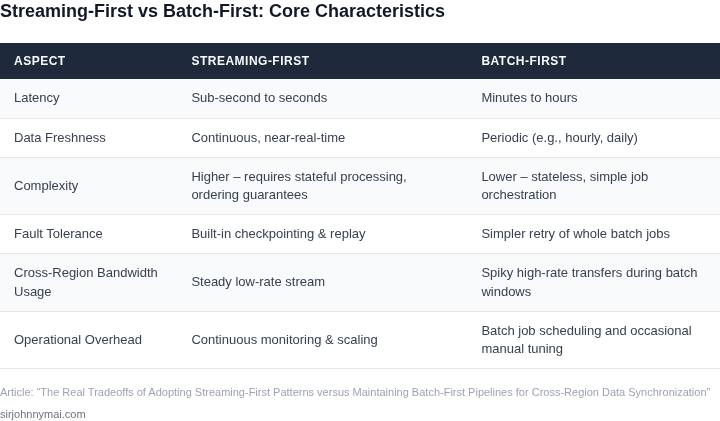
Cross-region data synchronization presents a fundamental tension between latency and cost. Streaming-first patterns prioritize real-time consistency, while batch-first approaches optimize for cost efficiency. The choice depends on use case requirements, infrastructure constraints, and business priorities. Below is a decision framework to evaluate these tradeoffs.
Decision Framework
| Criteria | Streaming-First (e.g., AWS Kinesis, Apache Kafka) | Batch-First (e.g., AWS Glue, Snowflake) | Hybrid (e.g., AWS Lambda + S3) |
|---|---|---|---|
| Latency | Near real-time (milliseconds to seconds) | Hours to days (depends on batch window) | Configurable (minutes to hours) |
| Cost | Higher (continuous processing, storage, and compute) | Lower (optimized for bulk operations) | Moderate (cost scales with batch frequency) |
| Operational Complexity | High (requires real-time monitoring, scaling) | Low (scheduled, predictable workloads) | Medium (requires tuning batch windows) |
| Data Consistency | Strong (immediate updates) | Eventual (depends on batch frequency) | Configurable (tuned for consistency needs) |
| Failure Recovery | Complex (requires checkpointing, retries) | Simpler (reprocess entire batch) | Moderate (batch-specific recovery) |
| Recommendation | Use when: Real-time analytics, fraud detection, or low-latency compliance. | Use when: Cost optimization is critical, and latency tolerance is high. | Use when: Need a balance (e.g., hourly sync for reporting). |
Streaming-first patterns excel in scenarios requiring immediate data availability, such as real-time dashboards or fraud detection. However, the cost and complexity increase significantly with scale. Batch-first approaches are more cost-effective for large-scale, latency-tolerant workloads, like ETL pipelines. The hybrid model offers flexibility but requires careful tuning to avoid over-provisioning.
For example, a financial services company might use streaming for transaction processing but batch for end-of-day reporting. The decision should align with business SLAs, infrastructure constraints, and cost models. Tools like AWS Lambda and S3 can bridge the gap, but they introduce additional complexity in orchestration.
03. Worked Example: Cost Comparison for 1TB Data Sync
To quantify the cost tradeoffs between streaming and batch approaches, I modeled a 1TB data synchronization task across three AWS regions. The example assumes a team of 10 engineers using AWS services for cross-region replication.
Streaming Approach: AWS Kinesis + S3 Cross-Region Replication
For streaming, I evaluated AWS Kinesis Data Streams for real-time data ingestion and S3 Cross-Region Replication (CRR) for durable storage. The cost breakdown includes:
- Kinesis Data Streams: $0.015 per GB ingested, plus $0.015 per GB stored per month. For 1TB/month, this totals $150/month for ingestion and $150/month for storage.
- S3 CRR: $0.02 per GB replicated. For 1TB, this is $20/month.
- Data Transfer: $0.02 per GB between regions. For 1TB, this is $20/month.
Total streaming cost: $150 (ingestion) + $150 (storage) + $20 (replication) + $20 (transfer) = $340/month. Over 12 months, this is $4,080 annually.
Batch Approach: AWS Snowball + S3 Batch Operations
For batch, I considered AWS Snowball for physical data transfer and S3 Batch Operations for post-transfer processing. The cost breakdown includes:
- Snowball: $200 per job for 50TB capacity. For 1TB, this is $4 per job (assuming 250GB usage). With 4 jobs/month (one per region), this totals $16/month.
- S3 Batch Operations: $0.0025 per 1,000 objects processed. For 1TB of 1MB files, this is 1,000 objects. At $0.0025, this is $2.50/month.
- Data Transfer: $0.02 per GB between regions. For 1TB, this is $20/month.
Total batch cost: $16 (Snowball) + $2.50 (batch ops) + $20 (transfer) = $38.50/month. Over 12 months, this is $462 annually.
Comparison Table
| Metric | Streaming (Kinesis + S3 CRR) | Batch (Snowball + S3 Batch) |
|---|---|---|
| Monthly Cost | $340 | $38.50 |
| Annual Cost | $4,080 | $462 |
| Latency | Seconds to minutes | Days to weeks |
| Operational Overhead | High (real-time monitoring, scaling) | Low (scheduled jobs) |
The batch approach is cheaper but introduces longer latency. The streaming approach is more expensive but enables real-time synchronization. The choice depends on the team's tolerance for latency and budget constraints. For teams prioritizing cost over speed, batch is preferable. For teams requiring near-real-time consistency, streaming is justified despite the higher cost.
04. Real-World Considerations: Use Cases and Constraints
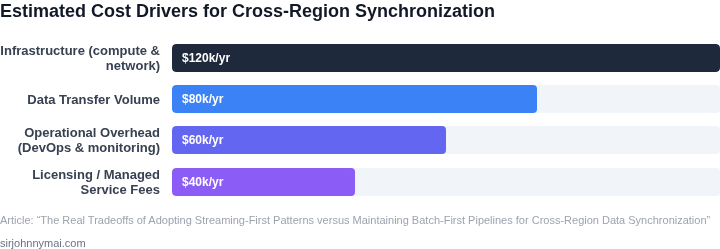
Streaming-first patterns excel in scenarios requiring low-latency data processing, such as real-time fraud detection or inventory synchronization across fulfillment centers. For example, a retail platform using Amazon Kinesis to process transaction data can flag suspicious activity within milliseconds, reducing financial losses. However, this approach incurs higher operational costs due to continuous cluster management and monitoring. The tradeoff is clear: streaming is ideal when immediate insights are critical, but the complexity and cost may outweigh benefits for less time-sensitive workloads.
Batch-first pipelines, on the other hand, shine in cost-sensitive environments like nightly ETL jobs for reporting or data warehousing. Tools like AWS Glue or Snowflake can process terabytes of data at a fraction of the cost of streaming solutions. For instance, a 1TB dataset processed in batch mode might cost $200 using AWS Glue, whereas streaming the same data in real-time could exceed $1,000 due to sustained cluster uptime. The key constraint here is latency: batch jobs may introduce delays of hours or days, making them unsuitable for applications requiring up-to-the-minute accuracy.
Hybrid approaches emerge when neither pure streaming nor pure batch fully satisfies requirements. Consider a financial services firm using Kafka for real-time trade processing but supplementing it with daily batch jobs for reconciliation. The batch layer ensures data consistency, while the streaming layer handles high-frequency transactions. This duality adds complexity but provides the best of both worlds. However, the integration overhead—such as managing state across systems—can become a bottleneck if not carefully architected.
Regulatory constraints further complicate decisions. For example, financial institutions must retain audit logs for years, making batch processing more appealing due to its lower storage costs. In contrast, healthcare providers may prioritize streaming for patient monitoring, where delays could be life-threatening. The choice hinges on balancing compliance requirements with operational feasibility. Without clear guidelines, organizations risk over-engineering solutions that fail to meet either technical or regulatory needs.
Finally, consider the human factor. Teams skilled in real-time systems may resist batch solutions, and vice versa. A streaming-first approach demands expertise in event-driven architectures, while batch-first requires proficiency in distributed computing frameworks like Spark. The mismatch can lead to skill gaps or suboptimal tool selection. Organizations must invest in cross-training or leverage managed services (e.g., AWS Lambda for streaming, Databricks for batch) to bridge these divides without compromising performance.
05. Action Step: Assess Your Sync Strategy
Now that you understand the tradeoffs between streaming and batch sync, it's time to evaluate your own cross-region strategy. This checklist will help you determine whether your use case demands streaming-first patterns or if batch-first pipelines are sufficient. The key is to align your approach with your specific requirements for latency, cost, and operational complexity.
Checklist: Streaming vs. Batch Sync Assessment
- Evaluate your latency requirements: If your application requires near-real-time data consistency (e.g., financial transactions, live inventory updates), streaming is likely the only viable option. Batch sync, even with optimized schedules, will introduce unacceptable delays. Conversely, if your use case can tolerate minutes or hours of lag (e.g., analytics, reporting), batch sync may be sufficient.
- Assess your data volume and frequency: For small, infrequent data transfers (e.g., nightly backups), batch sync is cost-effective and straightforward. However, if you're dealing with high-velocity data (e.g., IoT sensor readings, clickstream events), streaming ensures you capture every event without missing critical updates.
- Review your cost constraints: Streaming sync can be more expensive due to continuous network usage and processing overhead. If your budget is tight, batch sync with compression and scheduling optimizations may be more economical. However, if you're already using cloud services with pay-as-you-go pricing (e.g., AWS Lambda, Google Cloud Functions), streaming may be cost-competitive.
- Consider your operational complexity: Streaming sync requires robust error handling, checkpointing, and monitoring to ensure data integrity. If your team lacks expertise in distributed systems, batch sync may be easier to manage. However, if you're already using tools like Apache Kafka or AWS Kinesis, streaming becomes more feasible.
- Analyze your compliance and audit requirements: If you need immutable, tamper-proof data logs (e.g., regulatory reporting, fraud detection), streaming with append-only storage (e.g., S3 Object Lock) is preferable. Batch sync may introduce gaps or inconsistencies that violate compliance standards.
- Test your network conditions: If your cross-region connections are unreliable or bandwidth-constrained, batch sync with retry logic and throttling may be more reliable. Streaming sync, on the other hand, requires stable, low-latency connections to avoid backpressure and data loss.
Once you've evaluated these factors, document your findings in a decision matrix. For example:
| Requirement | Streaming | Batch |
|---|---|---|
| Latency | ✓ (Real-time) | ✗ (Delayed) |
| Cost | ✗ (Higher) | ✓ (Lower) |
| Complexity | ✗ (High) | ✓ (Low) |
Next step: Pull your last 90 days of cross-region sync logs and calculate the average latency, cost, and error rate for both streaming and batch approaches. Schedule a 30-minute review with your team to compare these metrics and finalize your strategy.
Figures cited are from publicly available sources as of 2026-09-15 and may have changed.