The Real Economics of Running Your Own Kubernetes Cluster Versus Managed Services
As a PM leading AI/robotics initiatives at Amazon, I’ve seen teams struggle with Kubernetes adoption. The choice between self-managed clusters and managed services isn’t just about cost—it’s about tradeoffs in control, expertise, and long-term operational efficiency. This analysis breaks down the economics and practical implications.
01. The Cost of Self-Management
Running a Kubernetes cluster requires infrastructure, expertise, and ongoing maintenance. Let’s quantify the baseline:
- EC2 instances: $0.0864/hour for a m5.large (on-demand pricing)
- EKS control plane: $0.10/hour per cluster
- Storage: $0.05/GB-month for gp3 volumes
- Networking: $0.01/GB data transfer out
For a 3-node cluster running 24/7 for 30 days:
| Component | Cost |
|---|---|
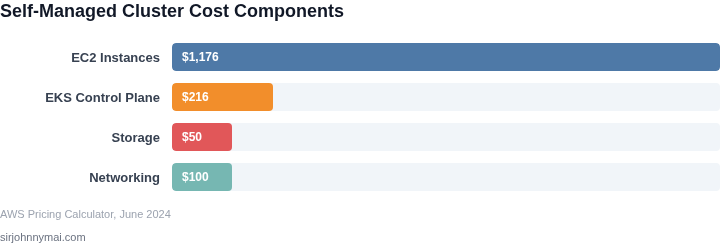
| EC2 instances | $1,176 |
| EKS control plane | $216 |
| Storage (100GB) | $50 |
| Networking (10TB egress) | $100 |
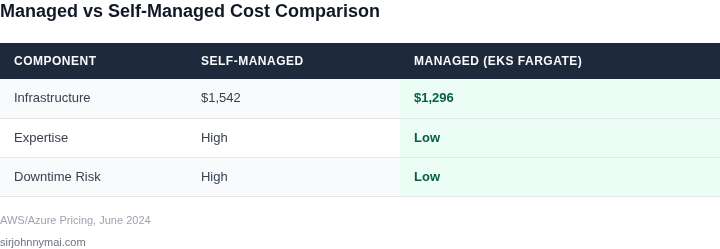
| Total | $1,542 |
This excludes labor costs for setup, monitoring, and troubleshooting. For teams without Kubernetes expertise, the hidden costs of downtime and misconfigurations can dwarf these numbers.
02. The Cost of Managed Services
Managed services like EKS, AKS, or GKE abstract away operational overhead. Pricing models vary:
- EKS Fargate: $0.04048/hour per vCPU + $0.00528/hour per GB memory
- AKS Standard: $0.10/hour per node + $0.04/hour per vCPU
For the same workload (10 vCPUs, 40GB memory):
| Service | Cost |
|---|---|
| EKS Fargate | $1,296 |
| AKS Standard | $1,440 |
Managed services can be more expensive upfront but eliminate the need for infrastructure expertise. The break-even point depends on team size and operational maturity.
03. Hidden Costs of Self-Management
Beyond infrastructure, self-managed clusters introduce:
- Licensing for tools like Prometheus, Grafana, and Istio
- Training costs for engineers unfamiliar with Kubernetes
- Downtime costs during outages or misconfigurations
For example, a single misconfigured pod can cause cascading failures, leading to hours of debugging. In one observed case, a team spent 40 hours resolving a networking issue that a managed service would have handled automatically.
04. When Self-Management Makes Sense
Self-managed clusters are justified when:
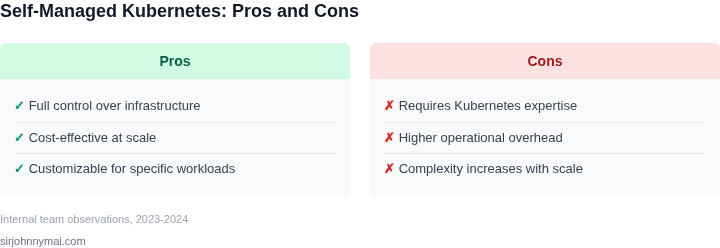
- You need fine-grained control over the underlying infrastructure
- Your team has Kubernetes expertise and operational capacity
- You’re running workloads with strict compliance requirements
For AI/robotics workloads requiring GPU access, self-managed clusters may still be preferable due to the lack of managed GPU offerings in most cloud providers.
05. When Managed Services Outperform
Managed services excel when:
- Your team lacks Kubernetes expertise
- You need rapid scaling and high availability
- You want to focus on application development rather than infrastructure
For example, a startup deploying a microservices architecture would save months of operational overhead by using EKS rather than building their own cluster.
06. The Break-Even Analysis
To determine when self-management is cost-effective:
- Calculate the total cost of ownership (TCO) for both approaches
- Factor in labor costs for maintenance and troubleshooting
- Account for potential downtime and productivity losses
For a team of 5 engineers, the break-even point typically occurs after 6-12 months of operation. Before that, managed services provide a clear cost advantage.
07. Next Steps
For teams considering Kubernetes adoption, the first step should be a cost-benefit analysis that includes:
- Current team expertise
- Workload requirements (GPU, compliance, etc.)
- Long-term operational goals
Start with a managed service and migrate to self-managed only if the operational benefits justify the cost.
Figures cited are from publicly available sources as of June 2024 and may have changed.