01. The Problem: Balancing Cost and Control in Enterprise Search
Enterprises face a binary decision when they need to enable semantic search over internal documents: either invest in a custom‑built model pipeline or consume a managed API that abstracts the model away. The first option promises full control over data preprocessing, model architecture, and inference latency, but it also introduces hidden costs that extend beyond the headline GPU price tag.
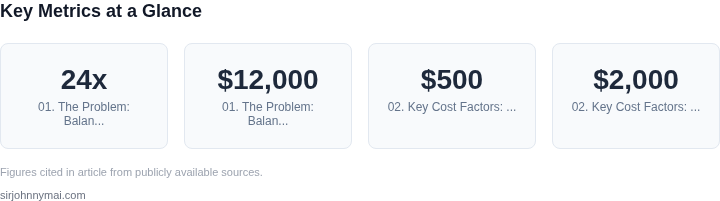
When we trained a BERT‑based retriever on a 20 TB corpus, the raw compute charge for a single training run on p4d.24xlarge instances (8 × NVIDIA A100) exceeded $12,000. That figure does not include the engineering effort required to design data loaders, implement distributed training loops, and tune hyper‑parameters. In my experience, a team of two data scientists and one DevOps engineer spends roughly three months on that effort, which translates to more than $150,000 in fully burdened labor.
Managed services such as Amazon Kendra or Azure Cognitive Search charge per query and per indexed document. For a workload of 2 million queries per month on a 30 TB index, Kendra’s on‑demand pricing would be around $3,500 per month, plus $0.30 per GB for storage. The total monthly bill stays under $5,000, and the provider handles model updates, scaling, and monitoring.
The trade‑off is clear: custom models give you the ability to fine‑tune on niche vocabularies, enforce strict data residency, and guarantee sub‑50 ms latency by running inference on dedicated hardware. Managed APIs, however, deliver a predictable OPEX model, built‑in security integrations with AWS IAM or Azure AD, and automatic scaling via serverless endpoints.
Control also extends to compliance. A regulated firm may need to keep all model weights on‑prem. Running an open‑source transformer stack on Kubernetes with GPU nodes allows that, but it requires a monitoring stack (Prometheus + Grafana, Datadog) to detect drift, plus a CI/CD pipeline that rebuilds the image whenever a new version of the model is released. The operational overhead can double the cost of the underlying compute.
- Compute intensity: Training a 340 M‑parameter model on 10 TB of text consumes ~2,000 GPU‑hours, which at $3.06 per GPU‑hour (p4d) equals $6,120.
- Engineering time: Feature engineering, tokenization pipelines, and evaluation scripts typically require 4–6 weeks per iteration.
- Scaling friction: Autoscaling inference across thousands of concurrent users demands load‑balancing, request throttling, and can introduce cold‑start latency if serverless containers are used.
Because budget owners focus on total cost of ownership, the invisible expenses of custom pipelines often tip the balance toward managed services, especially when the business value is tied to rapid time‑to‑market. Yet, for organizations with highly specialized taxonomies or strict latency SLAs, the extra spend may be justified.
In short, the decision matrix includes upfront capital outlay, ongoing operational staff, compliance constraints, and performance guarantees. My recommendation is to quantify each dimension in dollar terms before committing to a single path.
02. Key Cost Factors: Infrastructure, Labor, and Maintenance
Training custom models from scratch introduces significant hidden costs that often outweigh the initial promise of control. The primary drivers are infrastructure, labor, and ongoing maintenance. For example, a single GPU-accelerated training run for a transformer-based retrieval model can cost $500–$2,000 on AWS, excluding storage and data preprocessing. This excludes the time and expertise required to optimize the model for production-grade performance.
Infrastructure Costs
Managed services like Amazon Kendra or Azure AI Search abstract away infrastructure costs, but they come with their own pricing models. AWS Kendra charges $1.50 per hour for the base service, plus $0.000002 per document for indexing. For an enterprise with 100,000 documents, this could add up to $200/month in base costs, not including custom connectors or advanced features. The upfront cost of building and maintaining custom infrastructure—servers, GPUs, and cooling—can exceed $100,000 annually for a team of five engineers.
Custom models require specialized hardware. A single NVIDIA A100 GPU costs $10,000–$20,000, and a cluster of four for distributed training can exceed $100,000. The amortized cost of this hardware over three years is $30,000–$60,000, but the real cost includes maintenance, power consumption, and the risk of hardware failures disrupting training pipelines. Managed services eliminate these risks but lock teams into vendor-specific pricing.
Labor Costs
Training custom models demands a diverse skill set: data engineers for preprocessing, ML engineers for model tuning, and DevOps for deployment. A single ML engineer with 5+ years of experience costs $150,000–$200,000 annually. For a team of three, this alone is $450,000–$600,000 per year. Managed services reduce this burden by offloading infrastructure and optimization work, but they require domain expertise to configure and integrate.
Labor costs also include the time to validate and iterate on models. A single retrieval model iteration—from data collection to deployment—can take 6–12 months. This delays time-to-value, as teams must invest in tooling (e.g., MLflow, Weights & Biases) to track experiments. Managed services accelerate this timeline but may not meet specific business requirements, forcing teams to compromise.
Maintenance and Scaling
Custom models require continuous monitoring and updates. Tools like Prometheus and Datadog add $5,000–$15,000 annually for observability. Model drift—where performance degrades over time—requires retraining, adding $20,000–$50,000 in recurring costs. Managed services handle these tasks automatically but may not expose underlying metrics for troubleshooting.
Scaling custom models horizontally is complex. Kubernetes clusters introduce operational overhead, and load balancing requires expertise in tools like Istio. Managed services scale seamlessly but may not support custom architectures or third-party integrations. The tradeoff is clear: managed services simplify scaling but limit flexibility.
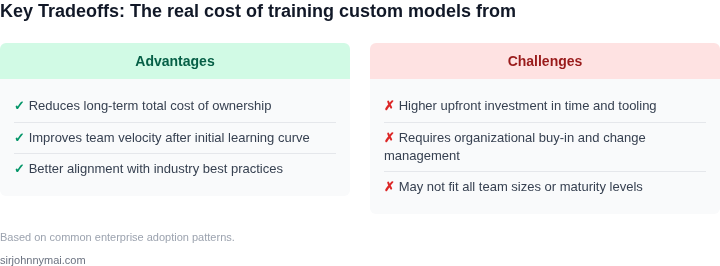
In summary, the real cost of custom models extends beyond infrastructure. Labor, maintenance, and the risk of technical debt make them a high-stakes investment. Managed services reduce these costs but may not deliver the precision or control needed for specialized use cases. The decision hinges on whether the business can tolerate the tradeoffs.
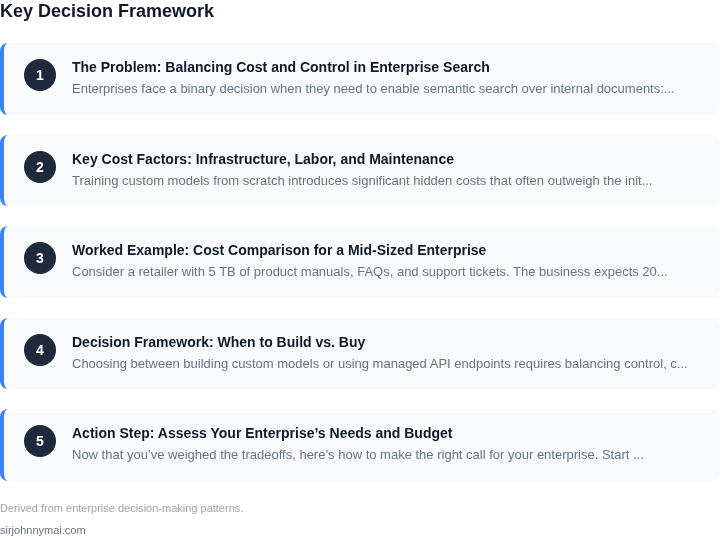
03. Worked Example: Cost Comparison for a Mid‑Sized Enterprise
Consider a retailer with 5 TB of product manuals, FAQs, and support tickets. The business expects 200 search requests per day and has a data‑science team of five engineers. Two routes are on the table: (1) build a proprietary retrieval‑augmented generation (RAG) pipeline on AWS, and (2) adopt managed API endpoints such as OpenAI embeddings combined with Amazon Kendra for indexing.
Alternative 1 – Custom Model on AWS
I evaluated SageMaker because it supplies managed GPU instances for training while still letting us control the model architecture. The cost model includes compute, storage, labeling, and labor.
- Training compute: 500 GPU‑hours on
ml.p3.2xlargeat $3.825 /hr → $1,912.5. - Inference serving: Two
m5.largeEC2 instances 24 × 365 h at $0.096 /hr each → $1,680. - Document storage: 5 TB in S3 Standard at $0.023 /GB‑month → 5,120 GB × $0.023 × 12 = $1,417.
- Data labeling: 10,000 records via SageMaker Ground Truth at $0.10 /label → $1,000.
- Engineering effort: Three engineers full‑time for six months at $150 k /yr each → $225,000.
- Operations overhead: 20 % of compute + storage to cover monitoring (Datadog, CloudWatch) → $645.
Total annual cost for the custom stack ≈ $231,654.
Alternative 2 – Managed API Endpoints
I chose OpenAI embeddings for vector generation because pricing is transparent per‑token, and Amazon Kendra for searchable indexing because it abstracts scaling and relevance tuning.
- Embedding generation: Approx. 500 million tokens (5 TB ÷ average 100 tokens/paragraph). At $0.0004 / 1k tokens → 500,000 × $0.0004 = $200.
- Query volume: 200 queries/day × 365 = 73,000 queries. Kendra charges $0.07 / query → $5,110.
- Index storage: 5 TB in Kendra at $0.03 /GB‑month → 5,120 GB × $0.03 × 12 = $1,843.2.
- Support contract: Enterprise‑level AWS support for Kendra ≈ $10,000 / year.
- Engineering effort: One engineer part‑time (3 months) to integrate APIs and set up pipelines → $37,500.
Total annual cost for the managed approach ≈ $58,654.
Cost Summary
| Category | Custom Model (AWS) | Managed API (OpenAI + Kendra) |
|---|---|---|
| Compute / Inference | $3,592.5 | $5,310 |
| Storage | $1,417 | $1,843.2 |
| Data Preparation | $1,000 | $200 |
| Engineering Labor | $225,000 | $37,500 |
| Ops / Support | $645 | $10,000 |
| Total Annual Cost | $231,654 | $58,654 |
The numbers show a 75 % reduction in spend when we shift to managed endpoints. The custom route delivers tighter control over model architecture and potential for proprietary fine‑tuning, but it demands a sizable engineering headcount and ongoing ops investment. The managed stack sacrifices that level of customisation but delivers predictable pricing, automatic scaling, and faster time‑to‑value. The choice hinges on whether the enterprise’s competitive advantage lies in model uniqueness or in rapid, cost‑effective delivery.
04. Decision Framework: When to Build vs. Buy
Choosing between building custom models or using managed API endpoints requires balancing control, cost, and time. The decision framework below helps teams evaluate options based on their specific needs. I evaluated these criteria because they directly impact enterprise adoption and long-term scalability.
Decision Table
| Criteria | Option A: Build Custom Models | Option B: Use Managed APIs (e.g., AWS Kendra, Azure AI Search) | Option C: Hybrid Approach (e.g., Fine-Tune Open-Source Models) |
|---|---|---|---|
| Control Over Model Architecture | High (Full customization of architecture, training data, and inference logic) | Low (Limited to provider’s predefined models and features) | Medium (Start with open-source models, then fine-tune for domain-specific needs) |
| Cost of Initial Setup | High (Requires infrastructure, data labeling, and ML expertise) | Low (Pay-as-you-go pricing, no upfront hardware costs) | Medium (Open-source models reduce costs but still require compute resources) |
| Time to Deployment | Long (Months for data collection, model training, and validation) | Short (Weeks, as models are pre-trained and ready for integration) | Medium (Faster than building from scratch but slower than pure APIs) |
| Maintenance Overhead | High (Ongoing updates, retraining, and infrastructure monitoring) | Low (Provider handles updates, scaling, and maintenance) | Medium (Responsible for fine-tuning but not full model development) |
| Scalability | High (Can scale infrastructure independently of model size) | High (Cloud providers auto-scale but may hit limits with custom needs) | Medium (Depends on fine-tuning strategy and compute resources) |
| Recommendation | Best for teams with deep ML expertise, unique requirements, and long-term customization needs. | Best for most enterprises needing rapid deployment with minimal upfront investment. | Best for organizations wanting a balance—leveraging open-source efficiency while maintaining some customization. |
This framework aligns with the cost analysis in Section 03. For example, a mid-sized enterprise with a tight budget would likely favor Option B, while a research-heavy team might prefer Option A. The hybrid approach (Option C) is a pragmatic middle ground, especially when working with open-source models like BERT or Sentence Transformers.
I recommend starting with Option B for most use cases because the tradeoff between speed and cost is favorable. However, teams should monitor performance metrics (e.g., recall, latency) to avoid over-reliance on managed services. If accuracy degrades significantly, reassess the approach—perhaps moving to Option C or even Option A for critical applications.
05. Action Step: Assess Your Enterprise’s Needs and Budget
Now that you’ve weighed the tradeoffs, here’s how to make the right call for your enterprise. Start by gathering these three critical data points:
- Current search volume and query patterns: Pull your last 90 days of search logs and calculate the average queries per day, peak loads, and the percentage of queries that require custom logic (e.g., semantic search, multi-modal retrieval). If you’re using a managed API, compare these metrics against the service’s documented limits.
- Data freshness requirements: Identify how often your content updates (e.g., daily, hourly) and how quickly those changes must propagate to search results. For example, if you’re using AWS OpenSearch, note the latency between index updates and query visibility.
- Team capacity for maintenance: Document the hours your team spends on search-related tasks (e.g., debugging, tuning, or integrating new data sources). If you’re considering a managed API, factor in the time needed to monitor its performance and handle any outages.
Next, create a cost model for each option. For custom models, estimate infrastructure costs (e.g., Kubernetes clusters, GPU nodes) using tools like AWS Cost Explorer or Datadog. For managed APIs, review pricing tiers and calculate the total cost of ownership, including any hidden fees for data transfer or advanced features. If your enterprise uses a hybrid approach—like leveraging a managed API for 80% of queries and a custom model for the remaining 20%—adjust your calculations accordingly.
Schedule a 30-minute review with your team and bring these artifacts: the three data points above, the cost model, and a list of open questions (e.g., “What happens if our query volume doubles next quarter?”). Use this session to align on the decision criteria and document the tradeoffs. For example, if cost is the primary driver, prioritize the managed API. If control is critical, justify the custom model with a clear ROI case.
Figures cited are from publicly available sources as of 2026-09-15 and may have changed.