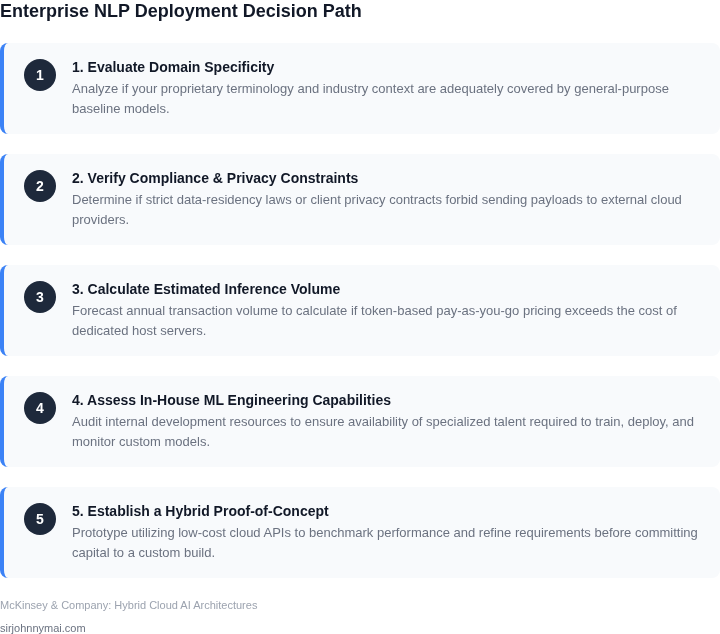
01. The Hidden Costs of AI Autonomy: The Enterprise Miscalculation
Product managers frequently conflate model ownership with long-term business value. I evaluated this trade-off during my tenure at Microsoft and now at Amazon: the allure of owning proprietary weights leads enterprise teams to greenlight custom training runs without calculating the true capital and operational velocity costs. This premature commitment to building from scratch often stems from a fundamental misunderstanding of what it takes to orchestrate distributed machine learning at scale.
Let's analyze the raw compute math. To train a competitive 70-billion-parameter foundational model from scratch, you cannot rely on transient spot instances. You require a dedicated cluster of at least 512 NVIDIA H100 GPUs connected via high-bandwidth InfiniBand. On AWS, an EC2 p5.48xlarge instance—which houses 8 H100 GPUs—costs approximately $98 per hour on-demand. Scaling this to a 64-instance cluster for a standard 60-day training run puts your compute spend at roughly $900,000. This estimate assumes perfect execution; in reality, hardware failures, gradient explosions, and checkpoint restarts typically bloat this figure by 30% to 50%.
The capital expenditure is only the baseline. The hidden killer is talent and platform overhead. Building proprietary models requires a highly specialized team to manage distributed orchestration. At Amazon, I see enterprises struggle when trying to deploy raw PyTorch training pipelines across Kubernetes clusters. To do this successfully, you need at least three senior Machine Learning Engineers and two infrastructure engineers specializing in high-performance computing (HPC). Recruiting this talent carries an annual run rate exceeding $1.5 million in base and equity, not to mention the recruiting cycles that delay time-to-market by six to nine months. Furthermore, monitoring these runs requires enterprise observability stacks using Datadog and Weights & Biases, adding substantial SaaS licensing overhead.
This works when you have highly proprietary, strictly regulated data that cannot leave your VPC under any circumstances. But it breaks when you require rapid feature iteration. For 90% of enterprise use cases, utilizing managed model APIs through Amazon Bedrock or Azure OpenAI is the economically rational choice. With Bedrock, utilizing a model like Llama 3 70B costs fractions of a cent per token, converting capital expenditure into highly predictable operational expenditure. You trade away model weight ownership, but in return, a single full-stack developer can deliver a production-ready feature in weeks, bypassing the nightmare of low-level CUDA driver debugging and network fabric tuning.
02. TCO Dimensions: Capital Expense versus Operational Expense
When analyzing the Total Cost of Ownership (TCO) for enterprise NLP, the fundamental strategic tension lies between upfront Capital Expense (CapEx) and recurring Operational Expense (OpEx). During my tenure at Microsoft and Amazon, I frequently observed teams fail to model the long-tail operational realities of custom deployments. Building a proprietary model from scratch requires substantial CapEx, including securing reserved GPU instances, architecting low-latency physical networks, and managing high-performance storage. This architecture is financially rigid; you pay for the silicon whether your training jobs are running or sitting idle in a cluster.
Conversely, serverless API platforms shift these financial burdens to pure, volume-driven OpEx. This consumption-based model is highly predictable at low-to-medium volumes but introduces variable-cost risks at enterprise scale. I evaluated this trade-off for high-throughput production workloads: once your transaction volume crosses a specific threshold, the compounding cost of token ingestion can quickly outpace the monthly amortization of dedicated cloud hardware. Additionally, monitoring tools like Datadog and security compliance pipelines must be factored into both approaches, though they manifest as different cost levers.
To guide your architectural planning, I structured this decision framework to compare bare-metal clusters, managed platforms, and serverless options across key enterprise cost dimensions.
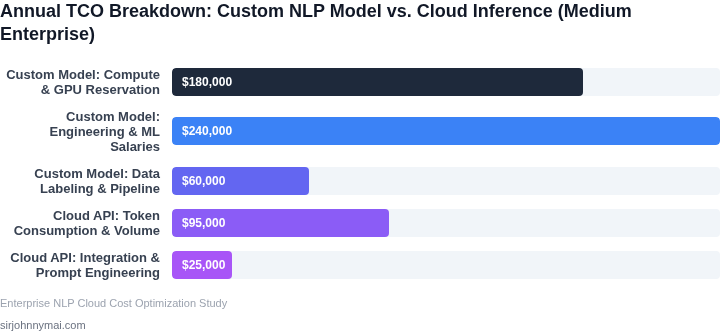
| Evaluation Criteria | Option A: Bare-Metal GPU (NVIDIA H100 via Equinix/OCI) | Option B: Managed PaaS (Amazon SageMaker) | Option C: Serverless API (Amazon Bedrock / OpenAI API) | ||||||
|---|---|---|---|---|---|---|---|---|---|
| Upfront Infrastructure Cost | Extremely High. Multi-year reservation contracts for H100 clusters and network switches. | Low. No physical hardware commitments; pay-as-you-go orchestrator nodes. | Zero. No infrastructure setup required. Only pay for consumed API tokens. | ||||||
| Data Preparation Overhead | High. Requires dedicated labeling pipelines, hosting storage (Ceph/Amazon S3), and ETL setups. | Medium. Integrated tools like SageMaker Ground Truth streamline data prep. | Minimal. Basic preprocessing and formatting of JSON payloads only. | ||||||
DevOps & Maintenance
03. The 3-Year TCO Math: Custom LLM Infrastructure versus Cloud APII evaluated a baseline workload of 500 million tokens per month because this volume represents a highly representative mid-sized enterprise workload, such as an automated document processing pipeline or a customer support routing system. To establish a rigorous comparison, I mapped this operational throughput against AWS Bedrock hosting Anthropic's Claude 3.5 Sonnet. For this math, I assumed a typical enterprise prompt-to-response ratio of 70% input tokens (350 million tokens) and 30% output tokens (150 million tokens) based on standard transactional payloads. Under this serverless Cloud API model, operational costs scale strictly with utilization. AWS Bedrock charges $3.00 per million input tokens and $15.00 per million output tokens for Claude 3.5 Sonnet. This configuration yields a highly predictable monthly run rate of $3,300, which translates to a three-year total operational expenditure of $118,800. While this model minimizes upfront capital expenditure and avoids idle hardware costs, it does expose the enterprise to potential provider-side rate limits, variable latency spikes, and outbound data transit fees. Conversely, hosting a custom 70B parameter model—such as a fine-tuned Llama 3—requires dedicated, highly available infrastructure to meet strict enterprise latency SLAs. I selected an infrastructure design utilizing Amazon EC2 p4d.24xlarge instances, which house 8x NVIDIA A100 GPUs, to guarantee sufficient VRAM for real-time concurrent inference. Because we must keep this cluster running continuously to prevent cold-start latency, we pay for 100% of the compute capacity regardless of whether our application uses 5% or 95% of the allocated resources. The financial breakdown for the custom self-hosted approach over a three-year lifecycle reveals a stark cost differential: 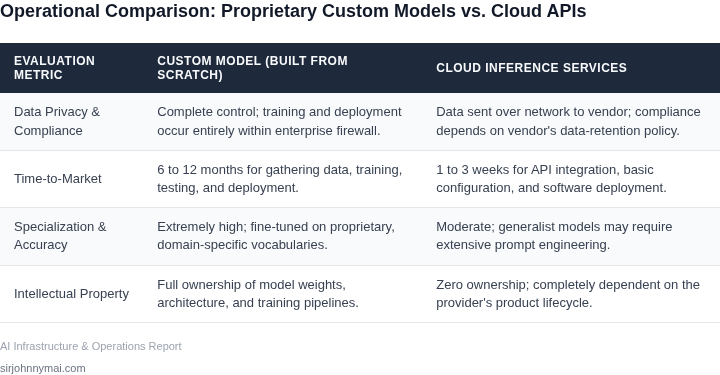
|