The real cost of training custom language models versus using foundation model APIs for enterprise use
01. The Illusion of Cheap AI: The Hidden TCO of Custom Model Training
Product managers frequently face internal pressure to "own" their AI capabilities, often leading to a bias toward custom language model development. This perceived advantage, however, can mask a significantly underestimated total cost of ownership (TCO) compared to leveraging existing foundation model APIs. We evaluated the decision to build vs. buy, and the recurring theme is that initial training costs are merely the tip of a much larger iceberg. Ignoring the massive overhead of data engineering, specialized talent acquisition, and relentless compute maintenance consistently leads to budget overruns and delayed time-to-market.
The most substantial hidden cost resides in data engineering. Building a performant custom model requires an immense investment in data acquisition, cleaning, labeling, and transformation. For instance, preparing a high-quality dataset suitable for fine-tuning a large language model can consume 60% or more of initial project timelines. This isn't a one-time effort; data pipelines using tools like AWS Glue or custom Apache Spark jobs must be continuously maintained and updated as data sources evolve or model requirements shift, requiring dedicated engineering resources. Any subtle shift in input data distribution can introduce model performance degradation.
Beyond data, specialized talent scarcity drives up personnel costs dramatically. A successful custom LLM initiative demands more than just data scientists. You need Machine Learning Engineers to build robust training and inference pipelines, MLOps specialists to manage deployment and monitoring, and infrastructure engineers proficient in cloud environments like AWS. Senior ML engineering roles in major tech hubs commonly command salaries ranging from $200,000 to $400,000 annually, not including benefits or recruiting costs. As we've observed across several internal projects, assembling and retaining such a diverse, highly-skilled team quickly becomes a dominant factor in the overall TCO.
Initial model training costs, while substantial, are often disproportionately emphasized. A custom LLM’s lifecycle extends far beyond its first training run. Ongoing compute maintenance for inference, periodic fine-tuning, and full model retraining cycles can quickly escalate cloud expenditure. Maintaining multi-GPU clusters leveraging NVIDIA A100 or H100 instances for these tasks requires careful optimization and continuous monitoring. Furthermore, operational expenses for MLOps tooling—such as Amazon SageMaker for model management, CloudWatch for logging, and Datadog for performance monitoring—are non-negotiable for production stability and compliance.
We also contend with critical, often overlooked, ongoing risks. Model drift, where a deployed model’s performance degrades over time due to changes in real-world data, necessitates continuous evaluation and retraining. Detecting and mitigating bias, ensuring security patches are applied, and adapting to evolving regulatory compliance requirements add significant, unbudgeted labor. This continuous investment ensures the model remains relevant and responsible. The illusion of a "cheap" custom model dissipates quickly when the full lifecycle of data, talent, infrastructure, and risk management is properly calculated.
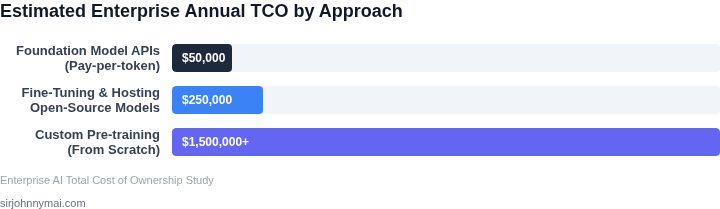
Annual cost comparison chart showing the total cost of ownership differences between Foundation APIs, Fine-tuning, and Pre-training custom models.
02. Framework for Comparison: Direct and Indirect Cost Dimensions
I evaluated these three execution paths because relying solely on per-token pricing leads to severe architectural dead-ends. When comparing serverless APIs to custom self-hosted pipelines, the primary driver of Total Cost of Ownership (TCO) is not GPU compute time. It is the fully burdened cost of engineering overhead, cluster idle capacity, and operational maintenance. We must measure these indirect dimensions to understand the true cost of scaling our generative AI features.
Self-hosted deployments on Amazon EKS or EC2 UltraClusters look financially superior on paper at high, steady-state throughput volumes. However, this economic model breaks down under volatile enterprise workloads where we must pay for idle, reservation-locked Nvidia H100 or AWS Trainium instances to maintain latency SLAs. Conversely, proprietary APIs offer zero-infrastructure overhead but introduce margin erosion
Efficient Fine-Tuning (PEFT) using LoRA, and run model evaluation checks. For production hosting, I selected two AWS g5.2xlarge instances (featuring NVIDIA A10G GPUs) to guarantee high availability across multiple availability zones under an Amazon EKS cluster. We also included the cost of enterprise-grade observability tooling like Datadog to monitor real-time token latency and potential model drift, along with AWS Elastic Container Registry (ECR) for version control.
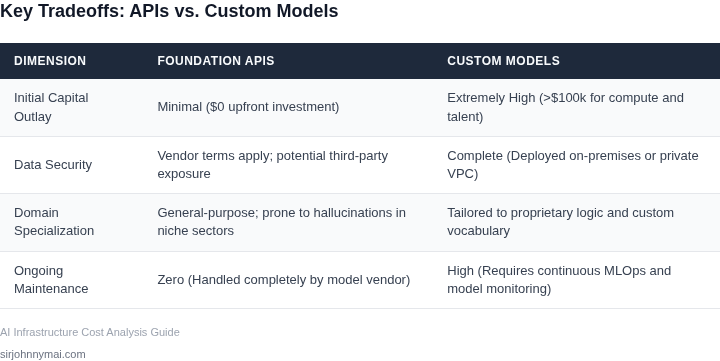
Table comparing key attributes and trade-offs of developing custom Large Language Models versus integrating with Foundation Model APIs for enterprise use.
Cost Category
Option A: Custom Llama 3-8B on AWS
Option B: GPT-4o-mini API
Labor (Engineering FTE)
04. Risk and Latency Trade-Offs: Balancing Cost with Performance
Beyond the direct and indirect financial outlays detailed in prior sections, product managers must critically evaluate qualitative dimensions that bear significant long-term implications for enterprise AI adoption. I evaluated these factors because overlooking them can lead to substantial hidden costs, reputational damage, or system performance bottlenecks that undermine business objectives, regardless of initial budget adherence.
Data Privacy Compliance: Control Versus Shared Responsibility
For custom language models, an enterprise assumes full responsibility for data privacy and compliance. This necessitates rigorous internal controls: data anonymization pipelines, robust encryption for data at rest and in transit via services like AWS Key Management Service (KMS) or Azure Key Vault, strict access management, and comprehensive auditing using tools such as AWS CloudTrail or Splunk. Non-compliance with regulations like GDPR, HIPAA, or CCPA can incur fines up to 4% of global annual revenue, a risk that custom models place squarely on the enterprise. I evaluated this because a single breach or regulatory fine can easily eclipse years of cost savings on compute, making it a critical risk vector.
Conversely, utilizing foundation model APIs, such as those offered by AWS Bedrock, Azure OpenAI Service, or Google Vertex AI, shifts much of this burden to the provider. These platforms typically offer contractual guarantees regarding data isolation, non-usage of customer data for further model training (without explicit opt-in), and certifications like SOC 2 or ISO 27001. While the enterprise remains responsible for ensuring its input data adheres to internal and external policies, the operational overhead of securing the underlying model infrastructure is significantly reduced. This trade-off balances granular control and ultimate accountability with vendor trust and simplified compliance operations.
Model Obsolescence Cycles: Continuous Investment Versus Vendor Updates
Custom models demand continuous investment to counteract model obsolescence. I evaluated model obsolescence cycles because neglecting this leads to degrading performance and a rapid erosion of the model's business value. Data drift, concept drift, and the rapid pace of ML research mean that a model performing optimally today will likely degrade without intervention. Maintaining peak performance typically demands a retraining cycle every 3-6 months, consuming compute resources and engineering hours equivalent to 20-40% of the initial development cost annually. This involves dedicated MLOps teams managing data pipelines, retraining infrastructure (e.g., Kubernetes clusters on AWS EKS or Azure AKS), and model versioning.
With foundation model APIs, the vendor shoulders the burden of model evolution and improvement. As providers like OpenAI, Google, or Anthropic release newer, more capable versions (e.g., from GPT-3.5 to GPT-4), enterprises can often upgrade by simply adjusting an API version or deploying a new endpoint. This provides access to state-of-the-art capabilities with minimal integration effort and no direct operational cost for model maintenance or retraining. The trade-off here is between having full control over your model's lifecycle and improvements versus relying on a vendor's roadmap and absorbing innovation as part of the service cost.
Operational Latency Guarantees: Bespoke Optimization Versus SLA-Backed Performance
Operational latency is a critical performance metric, particularly for real-time applications. I evaluated operational latency guarantees because performance directly impacts user experience and downstream system dependencies, affecting revenue or core business processes. For a custom model, achieving stringent latency targets (e.g., P99 latencies below 100ms) necessitates significant investment in optimized inference infrastructure, such as AWS Inferentia or NVIDIA GPU instances, meticulous model serving architectures (e.g., using Kubeflow or SageMaker Inference Endpoints), and robust monitoring via tools like Datadog or Prometheus. This level of optimization can represent hundreds of thousands annually in infrastructure and specialized engineering talent.
Foundation model APIs, conversely, typically provide published Service Level Agreements (SLAs) for latency. While these may not always match the absolute lowest latency achievable with a hyper-optimized custom model on dedicated hardware, they offer predictable performance within a defined range (e.g., typical latencies between 200-800ms for complex requests). For many enterprise use cases, such as content generation, summarization, or internal search, this performance is entirely adequate and comes with no infrastructure management overhead. The trade-off is between investing heavily for ultimate, bespoke performance control and leveraging a reliable, scalable, and SLA-backed service that meets most operational requirements without added complexity.
Tradeoff matrix comparing Foundation APIs and Custom Models on capital outlay, data security, domain specialization, and operational maintenance.Bar chart illustrating the typical estimated annual enterprise costs for custom Large Language Model development versus foundation model API usage, showing initial and ongoing phases.
05. The 30-Day Build-vs-Buy Decision Protocol
I designed this 30-day protocol because enterprise teams routinely waste capital training custom models before establishing an operational baseline. By forcing a strict, time-bound API evaluation first, we decouple functional validation from infrastructure engineering. This protocol prevents the sunk-cost trap of committing to custom cluster reservations before understanding actual workload behavior.
Phase 1: Days 1 to 14 – The Managed API Baseline
In the first two weeks, your engineering team must deploy a functional prototype using a managed foundation model via Amazon Bedrock or Azure OpenAI. The objective is not optimization, but capturing production-representative telemetry. You must instrument this prototype with monitoring tools like Datadog or AWS CloudWatch to establish baseline metrics for p95 latency, input/output token distributions, and system accuracy. This phase works because it exposes edge cases in your data pipeline without the overhead of model compilation or GPU scheduling. However, it breaks if your domain requires strict data residency that managed APIs cannot legally accommodate, which forces an immediate pivot to self-hosted instances.
Phase 2: Days 15 to 30 – The Hard ROI Gate
With two weeks of real traffic telemetry, you can now project annual run-rates. Compare these empirical token volumes against the custom training costs we calculated in Section 03. I evaluate this decision using a specific threshold: if your projected API costs do not exceed $20,000 per month, custom training on dedicated AWS SageMaker HyperPod or Kubernetes-managed H100 clusters is mathematically unjustifiable. You must factor in the fully loaded cost of your platform engineers and data scientists, not just the raw GPU rental prices. Additionally, assess the organizational capability; if your team lacks experience with low-level libraries like Megatron-LM or DeepSpeed, add a 50% time-to-market delay penalty to the custom build estimate.
The Build-vs-Buy Decision Matrix
Metric
API Buy Case (e.g., Bedrock)
Custom Build Case (e.g., SageMaker)
Monthly Query Volume
Under 10 Million Tokens
Over 1 Billion Tokens
Engineering Overhead
0.5 FTE (Integration)
3+ FTEs (Infra & Ops)
Time to Market
Days
3 to 6 Months
This systematic comparison prevents subjective biases from driving your architectural roadmap. If the API baseline meets your latency and accuracy SLAs while keeping costs below the custom threshold, lock in the API architecture for the fiscal year. Only greenlight custom pre-training or deep fine-tuning if the API baseline exposes systematic, unresolvable domain gaps or prohibitive scaling costs.
Next Action Step
Export your last 30 days of application payload logs to AWS S3, run an Athena query to calculate your average input/output token ratio per transaction, and map this volume against the pricing tiers of your target managed API.
Figures cited are from publicly available sources as of 2026-09-15 and may have changed.
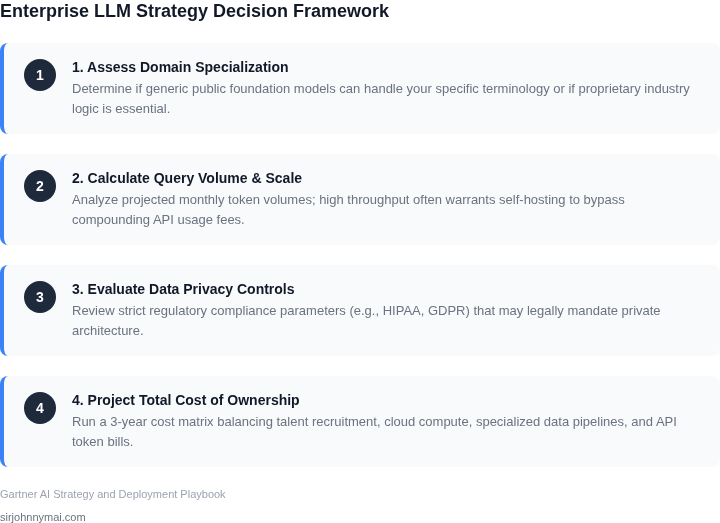
A four-step decision framework for enterprises selecting between API integration and custom LLM development.Pros and cons of developing custom large language models versus integrating with foundation model APIs for enterprise AI initiatives, focusing on strategic advantages.