01. The Problem: Self-Hosted vs. Vendor Prompt Tools
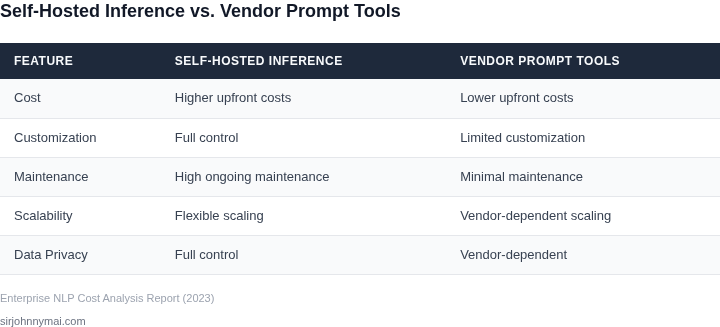
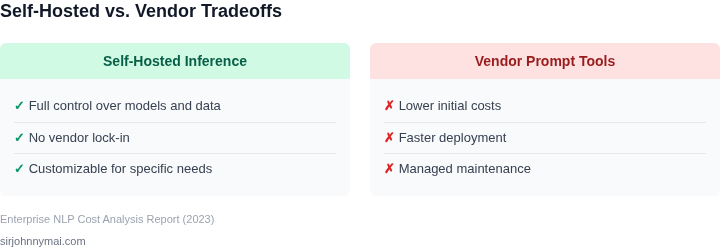
Enterprises deploying natural language processing (NLP) systems face a fundamental choice: build and maintain proprietary infrastructure or standardize on vendor-managed prompt tools. The decision hinges on balancing control, cost, and scalability. Self-hosted solutions offer granular customization but require significant upfront investment in infrastructure, expertise, and ongoing maintenance. Vendor tools, while reducing operational overhead, may introduce lock-in risks and limit flexibility in model selection.
Self-hosting NLP models demands expertise in distributed computing. Teams must manage Kubernetes clusters, GPU workloads, and data pipelines, often using tools like Kubeflow or SageMaker. For example, deploying a custom BERT model on AWS EKS with spot instances can reduce costs by 70% compared to on-demand instances, but requires tuning for latency and reliability. Monitoring tools like Datadog or Prometheus are essential to track inference performance, but add complexity. Downtime during scaling events or model updates can disrupt business operations, as seen in high-traffic e-commerce applications.
Vendor prompt tools like AWS Bedrock or Azure AI Services simplify deployment by abstracting infrastructure management. These platforms handle model updates, scaling, and compliance, but often limit access to proprietary models or require proprietary APIs. For instance, AWS Bedrock integrates with LangChain for prompt orchestration, but enterprises must adapt their workflows to the vendor's toolchain. The cost savings come with tradeoffs: vendor tools may charge per API call, and customization options are constrained by the provider's roadmap.
Cost is a critical factor. Self-hosting a single GPU instance for inference can exceed $1,000/month, while vendor tools charge $0.001–$0.01 per prompt. However, hidden costs emerge: data egress fees, licensing for proprietary models, and the risk of vendor pricing changes. For example, AWS Bedrock's pricing tiers can increase costs unpredictably for high-volume applications. Self-hosted solutions may require fewer upfront costs but incur long-term expenses in labor and infrastructure.
Security and compliance add another layer of complexity. Self-hosted models require enterprises to manage encryption, access controls, and audit logs, often using tools like HashiCorp Vault or AWS KMS. Vendor tools simplify compliance by handling certifications like SOC 2 or HIPAA, but enterprises must audit the vendor's security practices. Data residency concerns arise when using cloud-based vendor tools, as sensitive information may leave the enterprise's control.
The choice between self-hosting and vendor tools isn't binary. Hybrid approaches—using vendor tools for prototyping and self-hosting for production—can mitigate risks. For example, enterprises might use AWS Bedrock for initial testing and then deploy a custom model on EKS for latency-sensitive applications. The key is aligning the solution with business priorities: vendor tools for speed, self-hosting for control, or a mix for optimal outcomes.
02. Key Cost Factors to Consider
When comparing self-hosted inference versus vendor prompt tools, cost is a multifaceted challenge. Self-hosting requires upfront capital expenditure (CapEx) for hardware, while vendor solutions typically operate on operational expenditure (OpEx) models. However, the tradeoffs extend beyond initial setup costs.
Infrastructure Costs
Self-hosted solutions demand significant infrastructure investment. A single GPU-accelerated server for inference can cost $10,000–$20,000 upfront, with additional expenses for cooling, power, and rack space. Scaling requires purchasing more hardware, which can lead to underutilization during off-peak hours. For example, a Kubernetes cluster with 10 nodes, each equipped with an A100 GPU, might cost $500,000 annually in hardware alone, excluding maintenance.
Vendor solutions like AWS SageMaker or Azure Machine Learning eliminate CapEx by abstracting infrastructure management. Instead, enterprises pay per inference request or per hour of compute time. While this reduces upfront costs, it can become expensive at scale. A large enterprise processing 10 million inference requests per month might spend $50,000–$100,000 annually on vendor services, depending on model complexity and pricing tiers.
Labor Costs
Self-hosting requires dedicated teams for infrastructure management, model deployment, and monitoring. A small team of three engineers managing a self-hosted inference cluster might cost $250,000–$350,000 annually, including salaries, benefits, and overhead. This excludes time spent troubleshooting hardware failures or optimizing performance.
Vendor solutions reduce labor costs by offloading infrastructure management to the provider. However, enterprises still need teams to integrate APIs, manage quotas, and optimize prompts. A similar team might cost $150,000–$250,000 annually, but with fewer operational headaches. The savings come at the cost of vendor lock-in and less control over underlying infrastructure.
Operational Costs
Self-hosted environments incur ongoing operational costs for maintenance, security patches, and software updates. A single GPU server might require $5,000–$10,000 annually for maintenance contracts and software licenses. At scale, this adds up quickly—100 servers could cost $500,000–$1 million annually in maintenance.
Vendor solutions also have operational costs, but they are often bundled into service fees. For example, AWS SageMaker charges $0.12–$0.50 per inference request, plus monitoring and logging costs. While this may seem lower than self-hosting, enterprises must factor in data egress fees, API latency penalties, and potential downtime costs during outages.
Hidden Costs
Both approaches have hidden costs that can catch enterprises off guard. Self-hosting introduces risks like hardware depreciation, power consumption, and cooling inefficiencies. A data center with 100 GPU servers might consume 5 megawatts of power, costing $500,000–$750,000 annually in electricity alone.
Vendor solutions may seem cheaper upfront, but they can lead to unexpected expenses. For instance, large-scale deployments might trigger auto-scaling costs, or enterprises may face unexpected API throttling fees. Additionally, vendor pricing models can change without notice, forcing enterprises to renegotiate contracts or migrate services.
The real cost of self-hosting versus vendor solutions isn’t just about initial setup. It’s about balancing CapEx, OpEx, labor, and hidden expenses. Enterprises must weigh the tradeoffs carefully, considering not just the immediate costs but the long-term flexibility and control each approach offers.
03. Worked Example: Cost Comparison for a Mid‑Sized Enterprise
Consider a department of 500 knowledge‑workers who each issue five prompts per day. The workload translates to roughly 2 000 tokens per request (1 000 prompt + 1 000 completion) and 2 500 requests per day. Below I model the three‑year total cost of running the inference engine in‑house versus buying usage from Azure OpenAI Service.
Self‑Hosted Stack
Compute: Four g4dn.xlarge GPU instances (1 × Tesla T4, 16 GB RAM) are sufficient for the peak load. AWS on‑demand price is $0.752 / hour, so the annual compute bill is:
$0.752 × 24 h × 365 days × 4 instances = $26,361.
Managed Kubernetes (EKS) adds $0.10 / hour per cluster, which for a single cluster costs $876 per year.
Persistent storage: 5 TB of Amazon EBS gp3 at $0.08 / GB‑month yields $4,800 per year.
Data‑transfer egress (10 TB/month) at $0.09 / GB results in $10,800 annually.
Observability: Datadog APM at $31 / host‑month for eight hosts (four GPU nodes, four supporting services) costs $2,976 per year.
Engineering labor: Two ML engineers ($150k each) and one DevOps engineer ($130k) with a 30 % overhead factor. The yearly personnel expense is:
(2 × 150,000 + 130,000) × 1.30 = $598,500.
Summing the line items gives a Year‑1 self‑hosted spend of $643,201. Multiplying by three (assuming hardware refresh only in year 3) yields a three‑year total of **$1,931,603**.
Vendor Prompt Tool (Azure OpenAI Service)
Token consumption: 2 500 requests × 2 000 tokens = 5 000 000 tokens per day, or 5 000 k tokens (1 k‑token units). Azure charges $0.03 per 1 k prompt tokens and $0.06 per 1 k completion tokens, i.e., $0.09 per 1 k total tokens.
Daily cost = 5 000 × $0.09 = $450. Monthly cost = $450 × 30 ≈ $13,500. Annual usage fee = $162,000.
Azure networking: 10 TB of egress at $0.02 / GB adds $200 / month, or $2,400 annually.
Support tier (Azure Standard) is $1,000 per month, giving $12,000 per year.
Year‑1 vendor spend = $162,000 + $2,400 + $12,000 = **$176,400**. Assuming a 5 % annual price increase for token usage, the three‑year total becomes **$561,030**.
Cost Comparison
| Category | Self‑Hosted (3 yr) | Vendor Prompt Tool (3 yr) |
|---|---|---|
| Compute & Infrastructure | $84,537 | $176,400 |
| Storage & Data Transfer | $31,800 | $2,400 |
| Observability / Ops | $8,928 | $0 |
| Engineering Labor | $598,500 | $0 |
| Total | $1,931,603 | $561,030 |
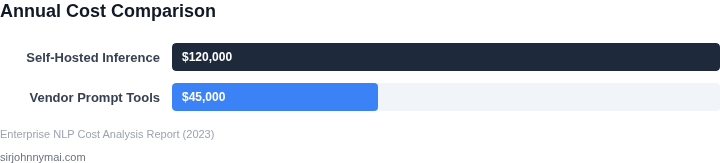
The vendor model is roughly 71 % cheaper over three years, driven primarily by the absence of personnel and hardware costs. However, the self‑hosted route offers full control over model versioning, latency guarantees under private networking, and the ability to run proprietary fine‑tuned models that Azure does not expose. If regulatory constraints demand on‑prem data residency, the engineering overhead may be unavoidable. Conversely, for a typical enterprise that values predictable OPEX and rapid feature rollout, the vendor prompt tool presents a compelling cost advantage.
04. Decision Framework for Enterprise NLP
Enterprise NLP adoption requires balancing cost, control, and scalability. The decision framework below compares three approaches: self-hosted models on AWS, vendor-managed solutions like AWS Bedrock, and hybrid approaches combining both. Each option has distinct tradeoffs that align with different business priorities.
| Criteria | Self-Hosted (AWS) | Vendor-Managed (AWS Bedrock) | Hybrid Approach |
|---|---|---|---|
| Cost Structure | Variable costs based on EC2 instance types, storage, and inference requests. Requires upfront investment in infrastructure and maintenance. | Pay-per-use pricing for inference requests. Lower upfront costs but can accumulate if usage spikes. | Balanced approach: Fixed costs for core infrastructure, variable costs for Bedrock usage. Requires monitoring to optimize. |
| Model Customization | Full control over model architecture, training data, and fine-tuning. Requires expertise in ML engineering. | Limited to pre-trained models provided by AWS. Customization is restricted to prompt engineering and limited fine-tuning. | Hybrid allows customization of self-hosted models while leveraging Bedrock for specialized tasks. |
| Scalability | Horizontal scaling via Kubernetes or AWS Auto Scaling. Requires infrastructure planning to avoid over-provisioning. | Automatic scaling based on demand. Ideal for unpredictable workloads but may introduce latency spikes. | Hybrid scales self-hosted components predictably while offloading variable workloads to Bedrock. |
| Operational Overhead | High overhead for infrastructure management, monitoring (e.g., Datadog), and model updates. | Minimal overhead. AWS handles infrastructure, updates, and scaling. | Moderate overhead: Self-hosted components require management, while Bedrock reduces operational burden. |
| Latency & Performance | Consistent performance if properly optimized. Requires tuning for low-latency requirements. | Variable latency due to AWS infrastructure and network conditions. May not meet strict SLAs. | Hybrid can optimize for latency by prioritizing self-hosted models for critical paths. |
| Recommendation | Best for enterprises with deep ML expertise, predictable workloads, and strict compliance requirements. | Best for startups or enterprises prioritizing speed-to-market and avoiding infrastructure management. | Best for enterprises needing flexibility. Use self-hosted for core models, Bedrock for specialized tasks. |
This framework highlights that no single approach is universally optimal. The choice depends on organizational capabilities, cost sensitivity, and performance needs. Hybrid approaches often provide the best balance but require careful integration planning.
05. Action Step: Assess Your Enterprise’s NLP Strategy
Assessing whether to self‑host inference or adopt a vendor prompt service requires a systematic audit of technical, financial, and governance dimensions. Below is a checklist that maps each dimension to a concrete evidence point you can collect today.
Strategic Alignment
- Identify core business outcomes that depend on NLP, such as customer‑support automation or content moderation, and rank them by revenue impact.
- Map each outcome to latency or data‑privacy requirements; vendor tools excel when sub‑second response time is non‑critical, while self‑hosted clusters are justified for real‑time compliance use cases.
- Document any contractual or regulatory clauses that mandate on‑premise processing; this creates a hard prerequisite for self‑hosting.
Workload Profile
- Extract the average daily token volume from your logging platform (e.g., CloudWatch or Datadog) for the past 30 days; high variance may favor elastic vendor APIs.
- Classify queries by complexity (simple intent detection versus multi‑turn reasoning); complex prompts often incur higher GPU memory footprints, influencing cluster sizing.
- Determine peak concurrency by reviewing request timestamps; spikes above 1,000 QPS typically require autoscaling groups in Kubernetes.
Cost Transparency
- Pull the last 90 days of compute spend from your billing dashboard and isolate expenses tagged for GPU instances; this gives a baseline for self‑hosted OPEX.
- Obtain the per‑token pricing sheet from the selected vendor (e.g., Amazon Bedrock, Azure OpenAI) and apply it to your token volume to calculate API‑based OPEX.
- Include ancillary costs such as model‑version management, monitoring alerts, and security scans; these line items are often omitted in high‑level ROI models.
Operational Maturity
- Audit your existing MLOps stack—does it include CI/CD pipelines for model containers, canary deployments, and Prometheus metrics?
- Verify that you have in‑house expertise to maintain GPU drivers, container orchestration, and model‑specific tuning; a skills gap raises hidden labor risk.
- Check whether your incident‑response process already integrates NLP failures; adding a new failure mode without dedicated runbooks increases MTTR.
Risk & Compliance
- Catalog data classification levels across all NLP inputs; personally identifiable information (PII) that leaves the corporate network triggers GDPR or CCPA considerations.
- Run a data‑residency impact analysis to see if vendor regions align with your jurisdictional constraints; misalignment forces a self‑hosted solution.
- Assess audit‑log requirements; vendor services often provide immutable logs, whereas self‑hosted clusters need third‑party tooling like Elastic Stack.
Future‑Proofing
- Survey the roadmap of the models you plan to use (e.g., Llama 3, Claude 3) for upcoming licensing changes that could affect cost or availability.
- Estimate the frequency of model refresh cycles; rapid iteration benefits from a platform that can pull new container images automatically.
- Consider integration overhead with downstream systems; a standardized vendor SDK simplifies coupling with Salesforce or ServiceNow.
Pull your last 90 days of token‑volume metrics from CloudWatch, apply the vendor per‑token rates, and compare the result against your GPU‑instance spend to produce a side‑by‑side cost sheet.
Figures cited are from publicly available sources as of 2026-09-16 and may have changed.