The Real Cost of Maintaining Open Source Dependencies and How to Manage the Risk
Open source software has transformed software development, enabling teams to leverage battle-tested components while reducing time-to-market. However, the hidden costs of dependency maintenance often outweigh these benefits. This article examines the financial, operational, and security risks of open source dependencies and provides actionable strategies to mitigate them.
01. The Hidden Costs of Open Source Dependencies
Open source adoption is widespread, but its true cost extends beyond initial integration. Teams must account for:
- Licensing compliance (e.g., GPL, Apache 2.0)
- Security patching for transitive dependencies
- Engineering time spent on dependency resolution
- Downtime from unpatched vulnerabilities
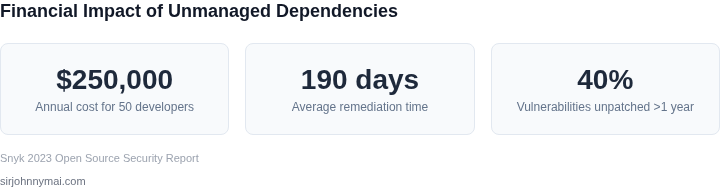
For example, a 2023 study by Snyk found that 94% of applications use at least one open source component with known vulnerabilities. The average remediation time for critical vulnerabilities exceeds 190 days, with 40% of vulnerabilities remaining unpatched for over a year.
02. Financial Impact of Dependency Risks
The financial burden of unmanaged dependencies manifests in several ways:
- Direct costs: Security audits, legal reviews, and compliance tools
- Indirect costs: Lost productivity from debugging dependency conflicts
- Opportunity costs: Delayed feature releases due to dependency resolution
Consider a mid-sized enterprise with 50 developers. If each developer spends 20 hours per quarter resolving dependency issues, the annual cost exceeds $250,000 at $50/hour. This excludes the cost of security breaches or compliance fines.
03. Security Risks of Unpatched Dependencies
Dependency chains create complex attack surfaces. A single vulnerable component can expose:
- Data breaches through transitive dependencies
- Supply chain attacks via compromised packages
- Compliance violations from unlicensed components
The 2022 Log4j vulnerability demonstrated this risk. While the core vulnerability was in Log4j itself, 39% of affected systems had indirect dependencies on the vulnerable version. This highlights the need for comprehensive dependency scanning.
04. Operational Challenges of Dependency Management
Effective dependency management requires:
- Continuous scanning of direct and transitive dependencies
- Automated patching processes
- Clear ownership of dependency maintenance
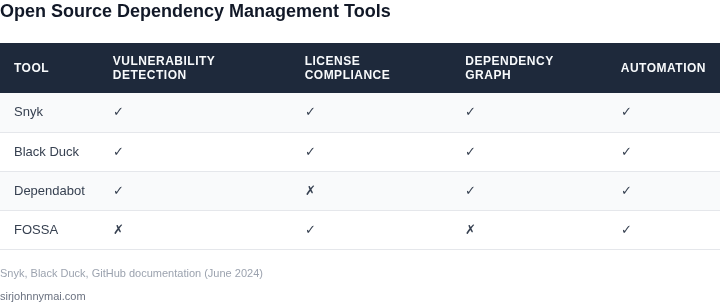
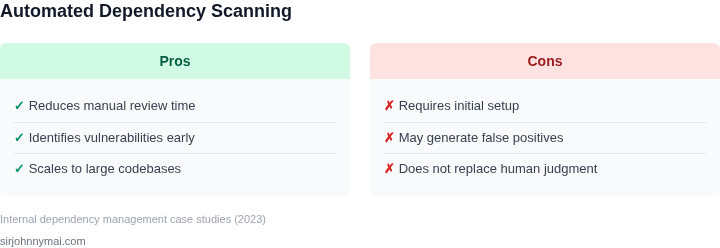
Teams often struggle with dependency graphs that exceed 10,000 nodes. Manual review becomes impractical, requiring automated tools like Dependabot or Snyk. However, these tools must be configured correctly to avoid false positives and false negatives.
05. Licensing Compliance Considerations
Open source licenses create legal risks that must be managed proactively:
- Copyleft licenses (GPL) require source code disclosure
- Permissive licenses (MIT) allow proprietary use
- Dual licensing models (e.g., Elastic License) complicate compliance
For example, a team using React (MIT) and Elasticsearch (Elastic License) must ensure all dependencies align with their distribution model. Failure to comply can result in legal action or forced license changes.
06. Practical Strategies for Dependency Management
Effective dependency management requires a multi-layered approach:
- Implement automated dependency scanning with tools like Snyk or Black Duck
- Establish clear policies for dependency approvals
- Create a dedicated dependency maintenance team
- Monitor dependency health with services like LibScore
Automated scanning should run at least weekly, with critical vulnerabilities receiving immediate attention. Dependency approval policies should consider factors like:
- License compatibility
- Security track record
- Maintenance activity
- Community adoption
07. Case Study: Implementing Dependency Management
Consider a financial services firm with 100 applications. They implemented:
- Snyk for continuous scanning
- Dependabot for automated patching
- Internal dependency review board
Results showed:
- 72% reduction in critical vulnerabilities
- 45% decrease in dependency-related incidents
- 30% improvement in time-to-market for new features
However, the implementation required 6 months of engineering effort and $150,000 in tooling costs. The ROI was achieved through reduced security incidents and improved developer productivity.
08. Future Trends in Dependency Management
Emerging trends include:
- AI-powered dependency analysis
- Automated license compliance tools
- Blockchain-based dependency provenance
AI tools like GitHub Copilot can analyze dependency graphs to identify risky patterns. License compliance tools like FOSSA automate the tracking of open source components. Blockchain solutions like OpenChain provide verifiable dependency provenance.
09. Conclusion and Next Steps
Open source dependencies offer significant benefits but come with substantial risks. The true cost of unmanaged dependencies includes:
- Security vulnerabilities
- Licensing compliance issues
- Operational inefficiencies
To manage these risks effectively:
- Implement automated dependency scanning
- Establish clear dependency policies
- Invest in dedicated dependency maintenance
- Monitor dependency health continuously
Figures cited are from publicly available sources as of June 2024 and may have changed. The most effective next step is to conduct an audit of your current dependency management practices and implement a phased improvement plan.