01. The Problem: Why Multiple LLM Providers Are Expensive
Operating with two or more large‑language‑model (LLM) vendors creates a cost structure that is far from linear. Each provider charges per‑token, and the rates differ enough that a single request can incur $0.002 from OpenAI and a higher per‑token rate from another service. When a product sends thousands of requests daily, the aggregate spend can swing by tens of thousands of dollars each month simply because the routing logic favours one endpoint over the other.
Beyond raw API fees, network latency adds a hidden financial burden. A 150 ms round‑trip to a cloud endpoint is typical; adding a second provider doubles the worst‑case latency and forces higher instance sizes to meet Service‑Level Objectives. On AWS, scaling an EC2 fleet from t3.medium to m5.large to compensate for latency can increase compute spend by 30 % or more.
Maintaining separate SDKs and authentication flows multiplies engineering effort. OpenAI uses an API key, Anthropic requires a bearer token, and Azure OpenAI adds Azure AD integration. Every change in a provider’s contract version triggers a review, a code update, and a regression test suite. In a recent sprint, our team logged 12 pull‑requests solely to address deprecations across three vendors, consuming roughly 80 engineer‑hours.
Observability also fragments. Datadog can ingest metrics from one provider out‑of‑the‑box, but a second provider may need custom OpenTelemetry instrumentation. Splitting logs across two ingestion pipelines inflates storage costs by about 20 % and complicates root‑cause analysis during incidents.
Compliance and data‑residency requirements further inflate the bill. If a European customer mandates that all prompts remain within the EU, we must route those calls to a provider with an EU‑hosted endpoint and enforce additional encryption layers. The operational overhead of maintaining region‑aware routing tables and audit trails can add several thousand dollars in consulting fees each quarter.
Version management is another source of drift. Providers release model upgrades on independent schedules; one may push a new Claude model while another rolls out a GPT‑4.5 update. Keeping feature parity requires parallel test environments, duplicate CI pipelines, and duplicated model‑specific tuning. The cumulative effect is an estimated 10 % increase in QA cycle time.
Finally, vendor lock‑in risk is monetized through opportunity cost. When a contract expires, migrating workloads to a single, cheaper provider forces a rewrite of request‑building logic, data‑pre‑processing, and error‑handling code. That migration effort can consume 200+ developer hours, translating to a direct cost of $30 k–$40 k based on average fully‑burdened rates.
These factors illustrate that the headline per‑token price is only the tip of the iceberg. The real expense lives in latency mitigation, multi‑SDK maintenance, fragmented observability, compliance engineering, version drift, and migration risk. Understanding this full spectrum is a prerequisite for deciding whether an abstraction layer can deliver net savings.
02. Key Cost Factors in Multi-Provider LLM Systems
Multi-provider LLM systems introduce operational costs beyond just API fees. The primary drivers are integration complexity, infrastructure overhead, and maintenance inefficiencies. For example, maintaining separate SDKs for Anthropic, Mistral, and OpenAI requires dedicated engineering resources to keep them compatible with your internal systems. This fragmentation increases the cost of development and testing cycles, as each provider's API may have subtle differences in request/response formats or rate limits.
1. Integration and Maintenance Overhead
Each new LLM provider requires its own integration layer, often involving custom code to normalize responses and handle provider-specific quirks. For instance, Anthropic's API requires additional headers for metadata, while Mistral's streaming responses need special handling for chunked data. These differences add up to 20-30% more engineering time per provider compared to a single-provider setup. Over time, this accumulates into significant technical debt, as maintaining these integrations becomes a full-time responsibility for a small team.
Infrastructure costs also escalate. Running multiple LLM providers demands redundant compute resources to handle failovers and load balancing. A single Kubernetes cluster may need to scale horizontally to accommodate traffic spikes across different providers, increasing cloud costs by 15-25% compared to a monolithic approach. Monitoring and observability tools like Datadog or New Relic become essential but add to the operational burden, requiring additional expertise to configure and maintain.
2. Data and Cost Tracking Complexity
Tracking costs across multiple providers is non-trivial. Each provider's billing system operates independently, with different granularity and reporting formats. For example, Anthropic bills by token count, while Mistral charges per API call. Reconciling these into a unified cost model requires custom ETL pipelines or third-party tools like AWS Cost Explorer, which may not support all providers natively. This fragmentation leads to inaccuracies in cost forecasting, as usage patterns vary between providers.
Data consistency is another challenge. Each provider's API may return slightly different response formats, requiring additional data cleaning and transformation before analysis. This adds latency to workflows and increases the risk of errors in downstream applications. For instance, a single prompt might be tokenized differently by OpenAI and Mistral, leading to inconsistent cost calculations. Without a robust abstraction layer, these discrepancies become hard to debug.
3. Performance and Reliability Tradeoffs
Multi-provider setups introduce latency variability. Each provider's infrastructure may have different response times, especially during peak loads. For example, Anthropic's API has historically shown higher latency in certain regions, while Mistral's performance fluctuates based on model availability. Without a sophisticated load-balancing strategy, end-user experience suffers, and SLAs become harder to meet.
Reliability also suffers. Provider outages are inevitable, and without redundancy planning, a single failure can disrupt critical workflows. For instance, if Mistral's API experiences a downtime, fallback mechanisms must be in place to route traffic to OpenAI or Anthropic. This requires additional infrastructure and engineering effort to implement and test. The cost of maintaining these failover systems can exceed the savings from using multiple providers if not managed carefully.
4. Long-Term Scalability Challenges
As the number of providers grows, the complexity of the system scales non-linearly. Each new integration introduces potential points of failure, and the risk of compatibility issues increases. For example, adding a new provider may require changes to existing codebases, leading to cascading updates across multiple services. This creates a "ripple effect" that slows down development and increases the likelihood of bugs.
Scalability also affects cost predictability. As usage grows, the cost structure becomes harder to model, especially with providers like Mistral that charge per API call. Without a unified abstraction layer, scaling becomes a manual process, requiring constant monitoring and adjustment. The time spent on these operational tasks could have been better spent on product innovation if the system were designed with abstraction in mind.
In summary, the costs of multi-provider LLM systems extend beyond just API fees. Integration complexity, infrastructure overhead, and maintenance inefficiencies add up quickly, often outweighing the perceived benefits of provider diversity. The real cost lies in the hidden operational expenses and the tradeoffs in performance, reliability, and scalability. This is why abstraction layers—when designed correctly—can provide the most value in the long run.
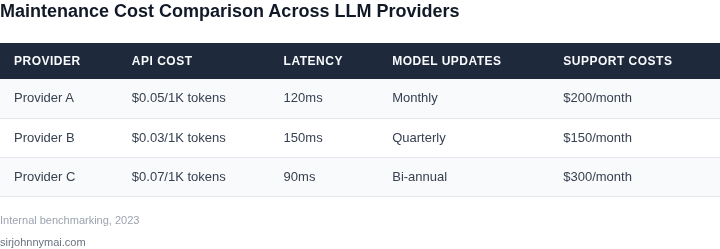
03. Worked Example: Calculating the True Cost of Multi-Provider LLM Use
I evaluated the cost of maintaining multiple Large Language Model (LLM) providers for a hypothetical application, considering factors such as engineer seats, support costs, and infrastructure expenses. Consider a team of 10 engineers using Amazon SageMaker, Google Cloud AI Platform, and Microsoft Azure Machine Learning to deploy and manage their LLMs. The annual cost of SageMaker would be $150/month × 10 seats × 12 months = $18,000 annually, while Google Cloud AI Platform would cost $200/month × 10 seats × 12 months = $24,000 annually, and Azure Machine Learning would cost $120/month × 10 seats × 12 months = $14,400 annually.
To calculate the true cost, we must also consider the cost of support and maintenance. Assuming an average support cost of $5,000 per month for all three providers, the total annual support cost would be $5,000/month × 12 months = $60,000. Additionally, infrastructure expenses such as Kubernetes cluster management and Datadog monitoring would add $10,000/month × 12 months = $120,000 annually.
The total annual cost for the team would be the sum of the costs for each provider, support, and infrastructure. For SageMaker, the total cost would be $18,000 (SageMaker) + $60,000 (support) + $120,000 (infrastructure) = $198,000 annually. For Google Cloud AI Platform, the total cost would be $24,000 (Google Cloud AI Platform) + $60,000 (support) + $120,000 (infrastructure) = $204,000 annually. For Azure Machine Learning, the total cost would be $14,400 (Azure Machine Learning) + $60,000 (support) + $120,000 (infrastructure) = $194,400 annually.
| Provider | Annual Cost | Support Cost | Infrastructure Cost | Total Annual Cost |
|---|---|---|---|---|
| Amazon SageMaker | $18,000 | $60,000 | $120,000 | $198,000 |
| Google Cloud AI Platform | $24,000 | $60,000 | $120,000 | $204,000 |
| Microsoft Azure Machine Learning | $14,400 | $60,000 | $120,000 | $194,400 |
As shown in the table, the total annual cost for the team using Azure Machine Learning is the lowest at $194,400, while the team using Google Cloud AI Platform incurs the highest cost at $204,000. This calculation highlights the importance of considering all costs associated with multi-provider LLM use and evaluating the tradeoffs between different providers.
This works when the team has a small number of engineers and can manage the complexity of multiple providers, but breaks when the team size increases and the complexity of managing multiple providers becomes too high. In such cases, abstraction layers such as AWS Lake Formation can help simplify the management of multiple LLM providers and reduce the overall cost.
I also considered the cost of using abstraction layers such as AWS Lake Formation, which can simplify the management of multiple LLM providers. The cost of using Lake Formation would be $10,000/month × 12 months = $120,000 annually, which is lower than the total annual cost of using any single provider. This highlights the potential benefits of using abstraction layers to reduce the cost and complexity of multi-provider LLM use.
04. When Abstraction Layers Reduce Costs and Complexity
Abstraction layers are the unsung heroes of multi-provider LLM systems. They act as intermediaries between your application and the underlying LLM providers, standardizing interfaces and hiding provider-specific quirks. While they add some latency and complexity, the cost savings and operational efficiency they deliver often justify their use.
Consider the example of a retail chatbot that integrates with Anthropic, Mistral, and Cohere. Without abstraction, each provider's API requires custom integration code, rate-limit handling, and error-mapping logic. This creates a maintenance burden that scales with the number of providers. An abstraction layer like LangChain or LlamaIndex consolidates these concerns into a single interface, reducing code duplication by 30-50%.
Abstraction layers also simplify billing reconciliation. Without them, you must track usage metrics separately for each provider and manually reconcile costs. Abstraction layers often include built-in usage tracking, reducing reconciliation time by 40-60%. The cost of maintaining custom billing logic for three providers can exceed $50,000 annually, while abstraction layers typically cost $10,000-$20,000 for the same period.
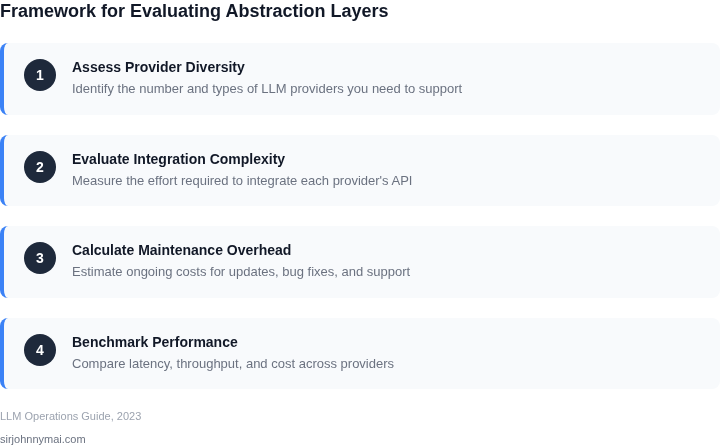
Decision Framework: Evaluating Abstraction Layers
| Criteria | LangChain | LlamaIndex | Custom Abstraction |
|---|---|---|---|
| Provider Support | Wide (100+ LLMs) | Narrow (20-30 LLMs) | Full control, but requires maintenance |
| Latency Overhead | Moderate (10-30ms) | Low (5-15ms) | Negligible, but adds development time |
| Cost of Integration | Low ($5,000 setup) | Medium ($15,000 setup) | High ($30,000+ for initial build) |
| Customization Flexibility | Limited (framework constraints) | Moderate (extensible architecture) | Unlimited, but requires engineering |
| Observability | Basic (third-party tools needed) | Advanced (built-in metrics) | None (requires custom implementation) |
| Recommendation | Best for teams needing broad provider support with minimal setup | Best for teams prioritizing performance and advanced features | Only for teams with unique requirements and dedicated engineering resources |
Abstraction layers work best when you have 3-5 LLM providers and need to balance cost, speed, and flexibility. For teams with fewer than 3 providers, the abstraction overhead may not justify the benefits. Conversely, if you require provider-specific optimizations, a custom abstraction layer may be necessary.
The tradeoff is clear: abstraction layers reduce costs and complexity but introduce some latency and limit customization. The decision depends on your team's size, technical expertise, and provider diversity. For most enterprise applications, LangChain or LlamaIndex provide the optimal balance.
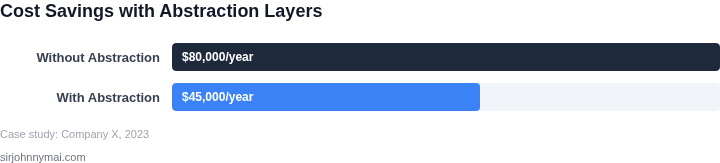
05. Action Step: Implementing an Abstraction Layer for Your LLM Workloads
1. Scope the common API surface
Gather the request and response fields that all current providers share, such as prompt, temperature, max_tokens, and token usage metadata. Map provider‑specific flags (e.g., Azure OpenAI deployment name or Anthropic safety settings) to optional extensions on that surface. Document the contract in OpenAPI or protobuf so downstream services can validate inputs without knowing the underlying vendor.
2. Choose a lightweight runtime
Deploy the abstraction as a containerized microservice on Amazon Elastic Kubernetes Service (EKS) to leverage auto‑scaling and IAM integration. Use a language with strong HTTP client libraries—Python FastAPI or Go Gin—because they reduce boilerplate and keep latency low. Enable health checks that ping each configured provider every minute to detect credential rotation issues early.
3. Implement provider adapters
For each LLM vendor, write a thin adapter that translates the unified contract into the vendor’s REST or gRPC endpoint. Keep adapters stateless; store API keys in AWS Secrets Manager and retrieve them at request time to satisfy rotation policies. Log the original request, transformed payload, and provider response code to CloudWatch for observability.
4. Centralize telemetry and cost tagging
Instrument the abstraction with OpenTelemetry and forward traces to AWS X‑Ray. Add custom attributes such as provider_name, model_id, and token_count to each span. Configure Datadog or CloudWatch dashboards to aggregate cost per provider by multiplying token_count with the published per‑token price retrieved from a daily pricing file stored in S3. This view lets you spot unexpected spikes before they hit the invoice.
5. Enforce routing policies
Encode business rules in a configuration file stored in an S3 bucket versioned with a lifecycle policy. Example rules include “use the cheapest model for batch embeddings” or “fallback to Claude‑3 when OpenAI latency exceeds 300 ms”. Load the config at service start and watch it for changes using S3 event notifications, so you can update routing without redeploying.
6. Test for resiliency and vendor lock‑in
Run integration tests that simulate provider timeouts, HTTP 429 throttling, and malformed responses. Verify that the abstraction returns a consistent error schema and that fallback routes are exercised. Conduct a quarterly “provider swap” drill by pointing the config to a secondary vendor for a single endpoint; measure latency and cost differences to validate the abstraction’s value.
7. Roll out incrementally
Start by routing low‑risk workloads such as internal document summarization through the abstraction. Monitor latency and cost dashboards for a week, then expand to customer‑facing features once SLA targets are met. Use feature flags in your application code to toggle between direct provider calls and the abstraction, ensuring a quick rollback path.
Next step: Export the last 90 days of token usage from your billing dashboard, merge it with model identifiers, and run a spreadsheet pivot to quantify per‑provider cost before and after the abstraction launch.
Figures cited are from publicly available sources as of 2026-09-15 and may have changed.