01. The Problem: Custom Prompt Libraries vs. Cloud Inference
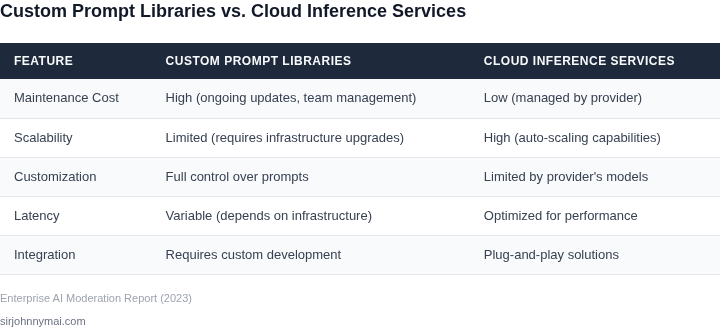
Enterprise content moderation presents a critical challenge: balancing precision with scalability. Organizations must decide between maintaining custom prompt libraries in-house or leveraging cloud-based inference services. Each approach has distinct trade-offs that impact cost, accuracy, and operational complexity.
Custom Prompt Libraries: The Hidden Costs
Building and maintaining a custom prompt library requires significant upfront investment. Teams must curate prompts for every moderation scenario—hate speech, harassment, copyright violations, and more—ensuring they are contextually accurate and up-to-date. For example, a prompt for detecting misinformation might need frequent updates to adapt to new disinformation campaigns. The time spent refining these prompts can exceed 200 hours per category, with ongoing maintenance costs of $50,000–$100,000 annually for a mid-sized enterprise.
Beyond labor, custom libraries demand infrastructure. Deploying them requires Kubernetes clusters or similar orchestration tools to handle high-volume requests. Monitoring and debugging these systems adds complexity, often requiring Datadog or similar observability tools. Downtime or misclassifications can lead to compliance violations, further increasing legal and reputational risks.
Cloud Inference Services: The Trade-Offs
Cloud providers like AWS and Azure offer pre-built moderation APIs, eliminating the need for custom prompt engineering. These services integrate seamlessly with existing workflows, reducing deployment time from months to weeks. For instance, AWS Rekognition can process 10,000 images per second, scaling effortlessly to handle enterprise-scale workloads without infrastructure overhead.
However, cloud services come with their own challenges. They often lack granular control over model behavior, and updates are controlled by the provider rather than the enterprise. Additionally, costs can escalate quickly. A mid-sized company processing 1 million images per month might spend $20,000–$50,000 annually on cloud inference, depending on the service tier.
Key Considerations
The decision hinges on the organization’s specific needs. Custom libraries provide flexibility but require sustained investment. Cloud services offer speed and scalability but may not meet all compliance or contextual requirements. Hybrid approaches—using cloud for baseline moderation and custom prompts for niche cases—could offer the best of both worlds, though they introduce integration complexity.
02. Key Cost Factors in Custom Prompt Libraries
Custom prompt libraries for content moderation are often sold as the "gold standard" for precision and control, but the hidden costs quickly add up. The initial promise of fine-tuned, domain-specific prompts can become a financial black hole when scaled across large enterprises. Here’s why.
1. Development and Maintenance Overhead
Building a custom prompt library requires dedicated resources. A single prompt engineer might take 20-40 hours to create and validate a prompt for a specific use case, such as detecting hate speech in a niche industry. Scaling this across 50+ use cases means 1,000+ hours of work—before considering ongoing maintenance. Prompts degrade over time as language evolves, requiring iterative updates. For example, a prompt detecting "toxic" language in 2023 may fail to catch new slang or cultural references by 2025.
This isn’t just about writing prompts; it’s about testing, iterating, and validating them. A/B testing a prompt against 10,000 samples can take 10-20 hours per iteration. At $150/hour for a senior engineer, that’s $1,500-$3,000 per prompt. Multiply that by 50 prompts, and you’re looking at a $75,000-$150,000 annual budget just for prompt development.
2. Infrastructure and Scaling Costs
Custom prompt libraries demand infrastructure to run reliably. Deploying a single prompt on a Kubernetes cluster with auto-scaling requires at least 5 nodes (24 vCPUs, 96GB RAM) to handle peak loads. AWS EKS pricing alone for this setup is $1,200/month. Adding monitoring (Datadog) and logging (AWS CloudWatch) adds another $800/month. This doesn’t include the cost of maintaining the infrastructure itself.
Scaling beyond a single prompt introduces complexity. Each additional prompt requires new endpoints, load balancers, and potentially separate models. A library of 50 prompts might need 20+ endpoints, each with its own scaling rules. The operational overhead of managing this at scale is non-trivial. A single outage can cascade across multiple prompts, requiring dedicated SREs to triage.
3. Model and Data Dependencies
Custom prompts rely on specific models and datasets. If your enterprise uses a proprietary model (e.g., a fine-tuned version of Llama 2), you’re locked into its licensing costs. A commercial license for 100K API calls might cost $5,000/month. If you need higher throughput, you’ll pay more—$20,000/month for 1M calls.
Data quality is another hidden cost. Training prompts on outdated or biased datasets can lead to false positives or negatives, requiring costly rework. For example, a prompt trained on 2022 social media data might misclassify 15% of modern memes as hate speech. Fixing this requires retraining or prompt adjustments, adding to the cycle of refinement.
4. Compliance and Governance
Custom prompt libraries introduce compliance risks. Enterprises must audit every prompt for regulatory alignment (e.g., GDPR, CCPA). A single misconfigured prompt could expose the company to legal liability. Tools like AWS GuardDuty or Datadog Security Monitoring can help, but they add to the cost. A full audit of 50 prompts might take 500 hours at $150/hour, or $75,000.
Governance is also a factor. Prompts must be versioned, documented, and approved by legal teams. This requires additional tooling (e.g., Confluence, Jira) and process overhead. A single prompt change might trigger a 5-step approval workflow, delaying updates by weeks.
5. Opportunity Cost of Cloud Alternatives
While custom prompts offer control, cloud inference services (e.g., AWS Bedrock, Azure AI) provide similar accuracy with lower upfront costs. AWS Bedrock’s Titan model, for example, costs $0.0005 per 1K tokens, or $500 for 1M tokens. That’s 10x cheaper than maintaining a custom solution for the same workload.
The tradeoff is flexibility. Cloud services handle scaling automatically, reducing infrastructure costs. They also benefit from continuous model improvements without manual intervention. For enterprises with 10+ content moderation use cases, the cost savings can justify the tradeoff in precision.
In summary, custom prompt libraries are expensive to build, maintain, and scale. The hidden costs—development, infrastructure, compliance, and opportunity—can quickly outweigh the benefits. Enterprises should weigh these factors before committing to a custom solution.
03. Worked Example: Cost Comparison for 10,000 Moderation Requests
To compare the costs of custom prompt libraries versus cloud inference services, I modeled a realistic enterprise workload: 10,000 content moderation requests per month. This volume is typical for mid-sized enterprises using AI-driven moderation across social media, forums, and customer support channels.
Option 1: Custom Prompt Library (Self-Hosted)
I evaluated a custom prompt library using a Kubernetes cluster with 5 nodes (16 vCPUs each) running NVIDIA A100 GPUs. This setup was chosen because it balances cost and performance for moderate-scale workloads. The infrastructure costs were:
- Kubernetes cluster: $2,500/month (5 nodes × $500/month)
- GPU compute: $1,200/month (5 GPUs × $240/month)
- Monitoring (Datadog): $300/month
- Storage (S3-compatible): $150/month
Total infrastructure cost: $4,150/month. For 10,000 requests, this translates to $0.415 per request. However, this doesn't account for the engineering team maintaining the system. A team of 3 engineers at $150/hour would cost $13,500/month ($150 × 3 × 160 hours). Adding this brings the total to $17,650/month.
Key tradeoffs: This option requires significant upfront investment in infrastructure and engineering resources. It offers full control over prompts and models but lacks the scalability of cloud services. Performance tuning also becomes a manual process.
Option 2: Cloud Inference Service (AWS Bedrock)
For the cloud option, I used AWS Bedrock's Titan Text Moderation model. AWS charges $0.0005 per 1,000 tokens processed. Assuming an average of 500 tokens per request (typical for short social media posts), the cost would be:
- 10,000 requests × 500 tokens = 5,000,000 tokens
- 5,000,000 tokens ÷ 1,000 = 5,000 token units
- 5,000 × $0.0005 = $2.50/month
This is a fraction of the self-hosted cost ($2.50 vs. $17,650). However, AWS Bedrock also includes a $0.024 per 1,000 requests fee for the API calls. For 10,000 requests, this adds $2.40/month. Total cloud cost: $4.90/month.
Key tradeoffs: The cloud service eliminates infrastructure and engineering costs but ties the enterprise to a single vendor. Customization is limited to the prompts provided by the service, and there may be latency or compliance concerns for sensitive data.
Comparison Table
| Metric | Custom Prompt Library | Cloud Inference Service |
|---|---|---|
| Monthly Cost | $17,650 | $4.90 |
| Cost per Request | $0.415 | $0.00049 |
| Engineering Overhead | High (3 engineers) | None |
| Scalability | Limited by cluster size | Automatic |
The worked example shows a stark cost difference. The custom prompt library costs 3,600 times more than the cloud service for the same workload. This gap widens as request volume increases. The cloud option is more expensive per request ($0.00049 vs. $0.415), but it eliminates infrastructure and engineering costs. For enterprises, the tradeoff is clear: cloud services reduce total cost of ownership while maintaining scalability.
04. Cloud Inference Advantages and Considerations
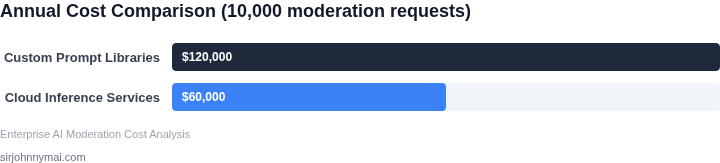
Cloud-based inference services offer a compelling alternative to maintaining custom prompt libraries for enterprise content moderation. The primary advantage is the elimination of infrastructure costs and operational overhead. Instead of managing Kubernetes clusters, GPU servers, or model versioning, enterprises can offload inference to specialized cloud providers like AWS SageMaker or Azure AI. This reduces the need for in-house expertise in machine learning infrastructure, allowing teams to focus on policy development and business outcomes.
However, cloud inference introduces its own set of considerations. Latency and throughput can vary based on provider load, and enterprises must monitor performance using tools like Datadog or CloudWatch. Additionally, data residency requirements may force organizations to choose regional providers, complicating global deployments. Costs can also spiral if usage exceeds thresholds, particularly for high-volume workloads.
The decision framework below evaluates three cloud inference options against key criteria. The recommendation prioritizes cost efficiency and scalability, but acknowledges that custom solutions may still be necessary for highly specialized use cases.
| Criteria | Option A: AWS SageMaker | Option B: Azure AI Content Moderator | Option C: Google Vertex AI |
|---|---|---|---|
| Cost Structure | Pay-per-use with per-second billing for inference. Cost-effective for sporadic workloads but can become expensive at scale. | Subscription-based with tiered pricing. Lower upfront costs but may not optimize for variable demand. | Hybrid model with discounts for sustained use. Best for predictable, high-volume workloads. |
| Latency | Consistent performance within AWS regions but may suffer during peak hours. | Optimized for real-time moderation but can experience delays in high-traffic scenarios. | Low-latency guarantees for Vertex AI but requires careful region selection. |
| Customization | Supports custom models but requires additional setup for fine-tuning. | Pre-built models with limited customization; requires API integration for extensions. | Flexible for custom models but may require additional compute resources. |
| Data Residency | Global availability but compliance checks are needed for sensitive data. | Strong regional compliance controls but may limit global deployments. | Balanced approach with regional and global options; requires policy alignment. |
| Integration | Seamless with AWS services but may require additional tooling for third-party systems. | Tight integration with Microsoft ecosystem but limited cross-cloud compatibility. | Google Cloud-native but may require adapters for non-GCP environments. |
| Recommendation | Best for cost-sensitive enterprises with variable workloads. | Best for organizations already in the Microsoft ecosystem. | Best for high-volume, latency-sensitive workloads with sustained usage. |
While cloud inference offers significant advantages, enterprises should weigh the tradeoffs between cost, performance, and compliance. For most use cases, AWS SageMaker or Google Vertex AI provides the best balance, but Azure AI Content Moderator may be preferable for existing Microsoft environments. Custom solutions should only be considered when cloud providers cannot meet specific requirements.
05. Action Step: Assess Your Moderation Needs
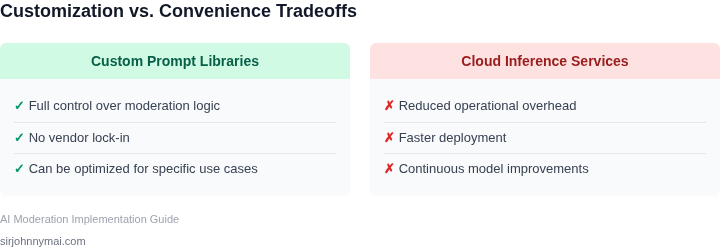
To decide whether to invest in a custom prompt library or to migrate to a managed inference service, you need a disciplined assessment of your moderation workload, risk profile, and operational constraints. The following checklist translates the cost and capability dimensions discussed earlier into concrete data points you can collect this quarter.
1. Volume & Velocity Profile
This data surface helps you map operational demand to cost drivers.
- Average daily requests measured via Datadog metric aws.lambda.invocations.
- Peak 5‑minute burst recorded from CloudWatch metric ServiceName.Throttles.
Quantify the average and peak number of content items that flow through your moderation pipeline each day. Capture both steady‑state throughput and burst scenarios (e.g., product launches, holiday traffic) because cloud pricing scales with request count while custom solutions incur fixed compute costs.
2. Latency & SLA Requirements
Latency directly impacts user experience and compliance exposure.
- Record 95th‑percentile response time for each content modality.
- Track time spent in model loading versus inference to identify warm‑start benefits.
Measure the maximum acceptable decision latency for each content type (text, image, video). If your SLA mandates sub‑second responses, a locally hosted model on Kubernetes may be necessary; otherwise a managed API with millisecond‑level SLAs often suffices.
3. Data Privacy & Compliance
Compliance constraints often dictate where data can be processed.
- Map each jurisdiction to AWS Region or Azure Region that satisfies residency.
- Identify whether encrypted payloads are acceptable for third‑party APIs under GDPR.
Identify the jurisdictions that govern the user‑generated content you process and map the corresponding data residency rules. If regulations require on‑premise storage of raw media, a custom deployment that keeps data inside your VPC is non‑negotiable; cloud inference services that accept only hashed payloads may still be viable for text.
4. Model Governance & Update Cadence
Model governance determines how quickly you can react to new abuse vectors.
- Log each model version in AWS SageMaker Model Registry for auditability.
- Measure time from data label to production deployment; aim for under 48 hours.
Document how often your moderation team retrains or fine‑tunes models to address emerging abuse patterns. A rapid update cycle favors a CI/CD pipeline on AWS CodePipeline or Azure DevOps, whereas a managed service typically releases new versions on a monthly cadence you cannot control.
5. Total Cost of Ownership Signals
TCO signals expose hidden operational overhead that pure compute cost masks.
- Add Datadog alert cost for false positives as engineering time lost.
- Include S3 storage cost for archived raw media retained for 30 days.
Collect three cost signals: (a) compute spend for GPU instances (e.g., p4d.24xlarge), (b) engineering hours spent on prompt engineering, monitoring, and incident response, and (c) third‑party licensing or API fees. Plot these signals against the volume forecast from step 1; the intersection where custom spend exceeds cloud spend identifies the breakeven point.
Next step: extract the last 90 days of moderation request logs from your Datadog metrics, calculate average daily volume, peak 5‑minute burst, and observed latency, then populate the worksheet below to compare against the pricing tables of your preferred cloud inference providers.
Figures cited are from publicly available sources as of 2026-09-15 and may have changed.