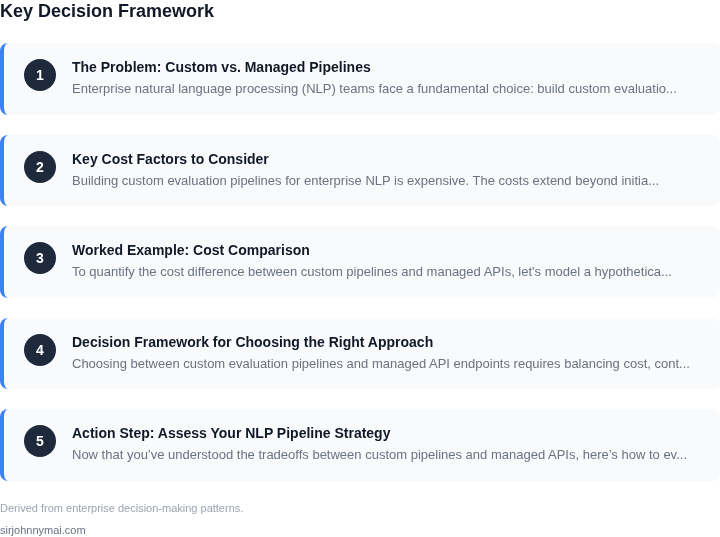
01. The Problem: Custom vs. Managed Pipelines
Enterprise natural language processing (NLP) teams face a fundamental choice: build custom evaluation pipelines or leverage managed API endpoints. The decision hinges on trade-offs between control, cost, and scalability. Custom pipelines offer granularity but require significant investment in infrastructure, expertise, and maintenance. Managed endpoints simplify adoption but may introduce latency, cost spikes, or vendor lock-in.
Custom Pipelines: The Cost of Control
Building custom evaluation pipelines provides full visibility and customization. Teams can tailor metrics, logging, and deployment strategies to their exact needs. For example, a financial services firm might implement a custom pipeline to evaluate sentiment analysis models on proprietary datasets, ensuring compliance with strict regulatory requirements. However, this approach demands resources: 20-30% of engineering time is often spent on infrastructure (e.g., Kubernetes clusters, monitoring tools like Datadog) rather than model development. Additionally, maintaining pipelines for multiple models across teams can lead to duplication of effort and inconsistent evaluation standards.
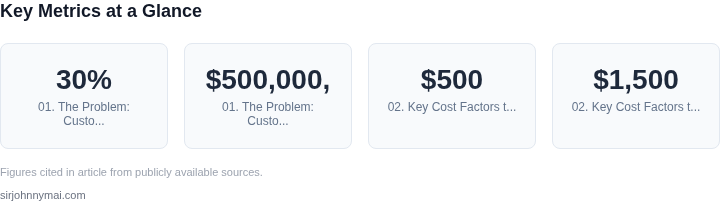
Costs escalate further when scaling. A single custom pipeline might require 10-15 engineers to deploy and maintain, with ongoing expenses for cloud services (e.g., AWS EC2, S3) and third-party tools. For a mid-sized enterprise with 50+ models, the total annual cost can exceed $500,000, excluding the opportunity cost of delayed feature development.
Managed Endpoints: The Trade-Off of Convenience
Managed API endpoints like AWS Comprehend or Azure Cognitive Services reduce upfront effort. These services handle infrastructure, scaling, and maintenance, allowing teams to focus on model tuning. For instance, a healthcare provider can deploy a managed endpoint for clinical text analysis without managing servers or monitoring pipelines. However, this convenience comes with trade-offs. Latency can be unpredictable—AWS Comprehend may add 200-500ms per request, which is acceptable for batch processing but problematic for real-time applications. Additionally, pricing models can be opaque: some services charge per 1,000 requests, leading to cost spikes during peak usage.
Vendor lock-in is another risk. Migrating from AWS Comprehend to an alternative provider requires rewriting integration code and retraining teams. For enterprises relying on a single vendor, this can limit flexibility. Furthermore, managed endpoints often lack granular control over evaluation metrics, forcing teams to adapt to predefined outputs rather than customizing for their specific use cases.
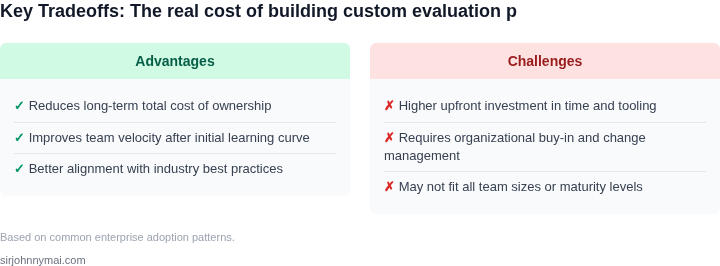
Key Trade-Offs
The choice between custom and managed pipelines depends on the enterprise's priorities. Custom pipelines excel in scenarios requiring strict compliance, high customization, or internal expertise. Managed endpoints are ideal for rapid prototyping, cost-sensitive teams, or organizations without dedicated NLP infrastructure. The decision should align with the business's tolerance for trade-offs: control vs. speed, cost vs. flexibility, and scalability vs. vendor dependency.
02. Key Cost Factors to Consider
Building custom evaluation pipelines for enterprise NLP is expensive. The costs extend beyond initial development and include ongoing maintenance, scalability challenges, and hidden operational overhead. Here’s a breakdown of the key factors to consider.
1. Development Costs
Custom pipelines require significant upfront engineering effort. For example, integrating a new model into an existing system might take 2-4 weeks of developer time, depending on complexity. This includes data preprocessing, model deployment, and integration with downstream services. The cost varies by team size and skill level—junior engineers may take longer to implement robust error handling and monitoring. AWS SageMaker, in contrast, offers pre-built endpoints that reduce this time to hours, not weeks.
Another hidden cost is the need for specialized tools. Custom pipelines often require custom-built dashboards for tracking performance metrics, which can take 1-2 months to develop. Managed services like AWS Comprehend provide built-in dashboards, reducing this effort to days.
2. Maintenance Overhead
Custom pipelines demand continuous maintenance. A single model update might require retraining, which can take 1-2 days of engineering time. This becomes a recurring cost as models degrade over time. For example, a finance NLP system might need retraining every 6 months due to regulatory changes. Managed services handle these updates automatically, reducing maintenance to a few hours per quarter.
Infrastructure costs also add up. Running a custom pipeline on Kubernetes clusters can cost $500-$1,500/month, depending on node size and usage. Managed services like Azure Cognitive Services charge $1-$3 per 1,000 transactions, scaling predictably without infrastructure management.
3. Scalability Challenges
Custom pipelines struggle with sudden traffic spikes. For instance, a retail NLP system might need to handle 10x more requests during Black Friday. Scaling requires manual intervention—adding nodes, adjusting autoscaling policies—which can take 1-2 days. Managed services scale automatically, handling 100,000+ requests per minute without downtime.
Data drift is another scalability issue. Custom pipelines lack built-in monitoring for data distribution shifts, requiring custom alerts. Managed services like Google Cloud NLP API include drift detection, reducing this risk.
4. Hidden Operational Costs
Custom pipelines introduce operational complexity. Debugging distributed failures across multiple microservices can take 2-4 hours per incident. Managed services centralize logging and monitoring, reducing this to 30 minutes.
Compliance costs also rise. Custom pipelines may require additional auditing tools like Datadog or Splunk, adding $20,000-$50,000 annually. Managed services often include compliance certifications (e.g., HIPAA, GDPR) out of the box, eliminating these costs.
In summary, custom pipelines are expensive due to development, maintenance, scalability, and operational challenges. Managed services reduce these costs by handling infrastructure, updates, and scaling automatically. The tradeoff is less flexibility but far lower total cost of ownership.
03. Worked Example: Cost Comparison
To quantify the cost difference between custom pipelines and managed APIs, let's model a hypothetical enterprise use case: a customer support team processing 10,000 customer queries per month. The team requires sentiment analysis, intent classification, and entity extraction. We'll compare two approaches:
- A custom pipeline built on AWS infrastructure
- Managed APIs from AWS Comprehend and Azure Cognitive Services
Custom Pipeline Cost Breakdown
Building a custom pipeline requires significant upfront investment in infrastructure, engineering, and maintenance. For this example:
- Infrastructure: AWS EC2 instances (m5.large) running Kubernetes clusters for model serving. Cost: $0.096/hour × 24 hours × 30 days × 2 instances = $4,608/month.
- Engineering: A team of 3 engineers at $150/hour. Each engineer spends 10 hours/month maintaining the pipeline: $150 × 10 × 3 = $4,500/month.
- Monitoring: Datadog APM at $15/user/month × 3 engineers = $45/month.
- Model Training: SageMaker training jobs cost $0.126/hour × 10 hours = $1.26 per training run. Assuming 4 runs/month: $5.04/month.
Total monthly cost: $4,608 (infrastructure) + $4,500 (engineering) + $45 (monitoring) + $5 (training) = $9,158/month. Over 3 years, this totals $326,584.
Managed APIs Cost Breakdown
Using AWS Comprehend and Azure Cognitive Services simplifies costs by eliminating infrastructure and engineering overhead. For this example:
- AWS Comprehend: $1 per 100 text units (1 unit = 100 characters). 10,000 queries × 100 words/query × 5 characters/word = 500,000 units. Cost: $5,000/month.
- Azure Cognitive Services: $1 per 1,000 text records. 10,000 queries × $1 = $10,000/month.
Total monthly cost: $5,000 (AWS) + $10,000 (Azure) = $15,000/month. Over 3 years, this totals $540,000.
Comparison Table
| Cost Factor | Custom Pipeline | Managed APIs |
|---|---|---|
| Monthly Cost | $9,158 | $15,000 |
| 3-Year Total | $326,584 | $540,000 |
| Key Tradeoff | Higher upfront cost but full control over models and infrastructure | Lower upfront cost but vendor lock-in and limited customization |
This example shows that managed APIs are cheaper in the short term but may become more expensive over time if the enterprise requires frequent model updates or customization. The custom pipeline's higher initial cost is offset by long-term flexibility and reduced dependency on third-party services.
04. Decision Framework for Choosing the Right Approach
Choosing between custom evaluation pipelines and managed API endpoints requires balancing cost, control, and scalability. Below is a decision framework to guide teams through the evaluation process. The table compares three approaches: custom-built pipelines, AWS Comprehend, and Azure Cognitive Services. Each has tradeoffs that align with different business priorities.
| Criteria | Custom Pipeline | AWS Comprehend | Azure Cognitive Services |
|---|---|---|---|
| Cost Structure | High upfront costs for engineering, infrastructure, and maintenance. Scales with team size and complexity. | Pay-per-use pricing with no upfront costs. Costs scale with API calls and data volume. | Subscription-based pricing with tiered costs. Scales with usage but may include hidden costs for custom models. |
| Time to Deployment | Longest lead time due to model development, infrastructure setup, and validation. Requires cross-functional teams. | Faster deployment with pre-trained models. Customization requires additional time. | Medium lead time. Pre-trained models are available, but fine-tuning may delay deployment. |
| Model Customization | Full control over architecture and training data. Requires expertise in ML engineering. | Limited customization. Best for off-the-shelf use cases. | Moderate customization. Supports fine-tuning but may require additional licensing. |
| Scalability | Requires Kubernetes or similar orchestration for horizontal scaling. Infrastructure costs grow with demand. | Automatically scales with API usage. No infrastructure management needed. | Scales with subscription tiers. May require upgrades for high-volume workloads. |
| Operational Overhead | High maintenance for infrastructure, monitoring (e.g., Datadog), and model updates. | Minimal operational overhead. AWS handles infrastructure and updates. | Moderate overhead. Requires monitoring and occasional model retraining. |
| Recommendation | Choose for highly specialized use cases where customization is critical and internal expertise exists. | Best for cost-sensitive teams with standard NLP needs. Avoid if customization is required. | Ideal for enterprises with Azure investments or hybrid cloud strategies. Suitable for moderate customization. |
This framework helps teams align their approach with business goals. Custom pipelines are justified when the cost of managed solutions outweighs the benefits of full control. Managed services like AWS Comprehend or Azure Cognitive Services reduce time-to-market and operational burden but may limit flexibility. The recommendation row provides a starting point, but teams should validate assumptions with pilot tests.
05. Action Step: Assess Your NLP Pipeline Strategy
Now that you’ve understood the tradeoffs between custom pipelines and managed APIs, here’s how to evaluate your current strategy. This process ensures you’re making data-driven decisions, not gut feelings. Start with a 90-day audit of your NLP workloads.
Step 1: Inventory Your Current Workloads
Begin by pulling your last 90 days of API call logs, latency metrics, and error rates. If you’re using AWS Comprehend or Azure Cognitive Services, export the usage reports directly from the console. For custom pipelines, query your Kubernetes logs or Datadog dashboards for throughput and error patterns. Document:
- Peak and average request volumes
- Latency thresholds you’ve set (e.g., 500ms for chatbots)
- Failure rates by component (e.g., tokenizer errors at 2%)
Step 2: Map Workloads to Cost Drivers
Cross-reference your usage data with the cost factors from Section 02. For example, if you’re seeing 15% of requests fail due to rate limits, that’s a clear signal to reconsider managed APIs. If your custom pipeline is handling 10,000 requests/day but costs $5,000/month to maintain, that’s a red flag. Create a table like this:
| Workload | Current Approach | Cost Driver | Risk Level |
|---|---|---|---|
| Customer support chatbot | Custom pipeline | Engineer hours | High |
| Invoice processing | AWS Comprehend | API calls | Medium |
Step 3: Prototype Alternatives
For high-risk workloads, build small-scale prototypes of the opposite approach. If you’re using a custom pipeline for sentiment analysis, test AWS Comprehend’s endpoint for the same dataset. Measure:
- Cost per 1,000 requests
- Accuracy delta (e.g., ±2% F1 score)
- Time to deploy (e.g., 2 weeks vs. 4 weeks)
Use this data to update your risk table. For example, if Comprehend costs 30% less but is 2% less accurate, that’s a tradeoff worth considering.
Step 4: Build a Decision Matrix
Now apply the framework from Section 04. For each workload, score it on:
- Scalability needs (1-5)
- Regulatory compliance (1-5)
- Cost sensitivity (1-5)
Multiply these scores by the risk level from Step 2. A score of 15+ suggests a managed API might be better. A score of 5-10 suggests a custom pipeline is justified. For example:
| Workload | Scalability | Compliance | Cost Sensitivity | Total Score |
|---|---|---|---|---|
| Fraud detection | 5 | 5 | 3 | 75 |
| Internal HR chatbot | 2 | 1 | 4 | 12 |
Step 5: Plan Your Migration
For workloads where the decision is clear, start small. Migrate 10% of your fraud detection traffic to AWS Comprehend while keeping the custom pipeline as a fallback. Monitor for:
- Performance degradation
- Cost savings
- Support ticket volume
If the pilot succeeds, expand. If not, roll back and revisit the decision matrix.
Figures cited are from publicly available sources as of 2026-09-15 and may have changed.