01. The Problem: Why Custom Pipelines Are Expensive
Building a home‑grown content‑moderation pipeline looks attractive because it promises full control over model selection, feature engineering, and business logic. In practice, each layer—from data ingestion to decision logging—requires a distinct software component, its own runtime, and a dedicated operations playbook. The sum of those pieces quickly exceeds the budget of most enterprise AI teams.
A senior ML engineer typically commands $180,000 + annual salary, and a full‑stack developer adds another $130,000, meaning the labor cost to stitch together an end‑to‑end workflow often tops $300,000 in the first year. Beyond initial development, you must allocate 20 % of that headcount to ongoing model drift monitoring, feature flag management, and compliance audits. Over a three‑year horizon the cumulative labor bill therefore approaches $1 million, a figure that many CFOs find hard to justify against a subscription‑based alternative.
Running inference on‑premises usually means provisioning GPU instances such as an NVIDIA A100, which costs roughly $10,000 in capital expense and $3,500 per month in power and cooling. If you instead rely on AWS SageMaker, the ml.m5.large instance is priced at $0.115 per hour, translating to about $84 per month for a continuously running endpoint. However, scaling to a peak of 10 k RPS for image moderation adds $0.20 per 1 M Lambda invocations and $0.023 per GB‑month of S3 storage for raw assets, which can push the monthly bill above $15 k when traffic spikes.
Visibility into latency, error rates, and drift requires a monitoring stack; Datadog’s standard APM starts at $18 per host per month, while AWS CloudWatch logs cost $0.50 per GB ingested. A typical moderation service runs on at least five hosts to achieve high availability, meaning pure monitoring alone adds $90 per month, plus an estimated $200 for log storage during a busy quarter. When you factor in alert routing, incident response tooling, and the engineering time to fine‑tune dashboards, the operational overhead can exceed $5 k annually.
Enterprises must also satisfy data residency, audit logging, and GDPR or CCPA requirements, which often forces the use of VPC endpoints, encryption‑at‑rest, and separate IAM roles for each moderation tier. Implementing those controls in Kubernetes adds another layer of Helm chart maintenance and policy‑as‑code tooling such as Open Policy Agent, typically consuming an additional 5 % of the engineering headcount. The hidden cost of a compliance breach—average $3.9 million per incident according to IBM—means the risk premium for a custom stack is non‑trivial.
When you aggregate labor, hardware, scaling, monitoring, and compliance, the first‑year total cost of ownership for a bespoke moderation pipeline often lands between $400 k and $600 k. In contrast, AWS Rekognition’s content‑moderation API charges $0.01 per 1 k images, resulting in an annual spend of roughly $12 k for a volume of 1 M images per month. The price differential is driven not by feature gaps but by the elimination of hidden engineering overhead, which is exactly the trade‑off enterprises need to quantify.
02. Cloud Inference Services: A Cost-Effective Alternative
Having examined the significant investments required for custom content moderation pipelines, I've evaluated cloud inference services as a pragmatic and cost-effective alternative. These managed solutions address many challenges by abstracting away infrastructure complexity, allowing organizations to focus resources on core business logic rather than undifferentiated heavy lifting. I assessed their viability because they offer a clear path to reducing both the upfront capital expenditure and ongoing operational overhead for enterprise content moderation.
A primary benefit is the dramatic reduction in initial infrastructure investment. Building a custom pipeline necessitates procuring specialized hardware, such as NVIDIA A100 GPUs which can cost between $10,000 and $15,000 each, alongside the associated server racks, power, and cooling systems. Cloud inference services, like those offered by Amazon Rekognition or Google Cloud Vision AI, eliminate this capital expenditure entirely. Instead, they operate on a pay-as-you-go model, transforming a substantial upfront capital outlay into a more predictable operational expense.
Furthermore, cloud inference services significantly streamline deployment and ongoing operations. Our teams no longer need to provision and manage individual virtual machines, orchestrate containers with Kubernetes, or build extensive CI/CD pipelines specifically for inference endpoints. This reduces the engineering effort required for initial setup, which can easily translate to hundreds of thousands of dollars in personnel costs during the build phase. Cloud providers also handle critical operational tasks such as operating system patching, security updates, and underlying hardware maintenance, freeing up our engineering talent for higher-value activities.
The dynamic scalability of these services offers substantial cost optimization. Platforms like Amazon SageMaker or the managed inference capabilities of Azure Cognitive Services automatically scale compute resources to match demand in real-time. This eliminates the costly problem of over-provisioning infrastructure to handle peak loads, a common pitfall with custom, static deployments where idle resources accrue unnecessary costs. We only pay for the inference capacity actively consumed, making costs directly proportional to actual usage.
Moreover, these services leverage highly optimized hardware and software stacks, leading to superior performance and cost-efficiency per prediction. Cloud providers invest heavily in custom silicon, such as AWS Inferentia processors, and highly specialized model optimizations for common tasks like image and video moderation. For example, using Amazon Rekognition for image moderation starts at approximately $0.001 per image for the first million images, offering a transparent and predictable cost per unit that's difficult to achieve with a custom, amortized infrastructure approach.
By offloading the complexities of infrastructure and foundational model management, our content moderation teams can reallocate engineering talent strategically. This allows them to concentrate on developing sophisticated, custom classifiers for niche abuse cases, refining moderation policies, and integrating human review workflows more effectively. The result is an acceleration of iteration cycles on business logic, leading to faster improvements in content safety and user experience.
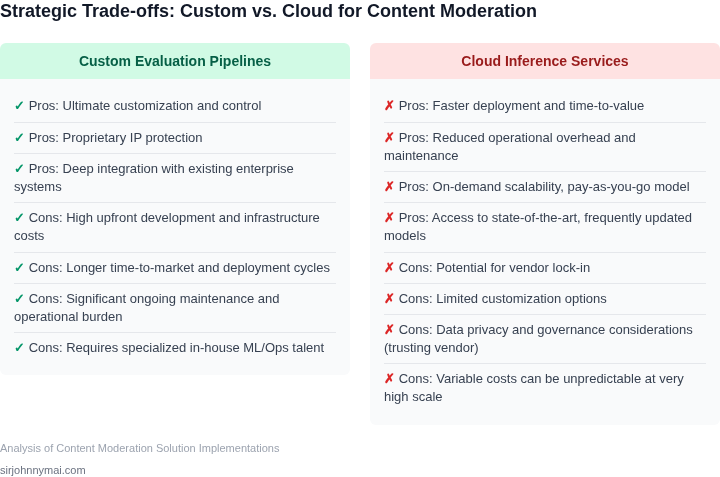
While cloud inference services offer immense benefits, it's crucial to acknowledge potential tradeoffs. Adopting a specific cloud provider's managed services can introduce a degree of vendor lock-in and may limit granular control over proprietary model architectures or specific data residency requirements beyond what the API exposes. However, for the majority of enterprise content moderation needs, particularly for general-purpose detection, the significant operational efficiencies and cost predictability typically outweigh these limitations, allowing teams to deliver value more rapidly and reliably.
03. Worked Example: Cost Comparison for a Medium-Sized Enterprise
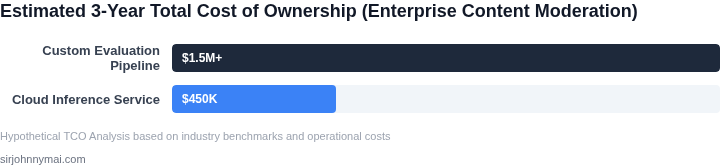
To ground the discussion, let's consider a medium-sized enterprise needing content moderation evaluation for approximately 100,000 items per month. This volume is significant enough to demand robust tooling but perhaps not so vast that a custom solution feels immediately justifiable. The goal is to accurately assess model performance, identify drift, and ensure moderation policies are being correctly applied at scale.
Scenario 1: Building a Custom Evaluation Pipeline
Building a custom pipeline involves substantial upfront and ongoing investments. This typically requires a dedicated engineering team, specific infrastructure, and various software licenses. We are considering an initial build-out phase of 6-9 months, followed by ongoing maintenance and iteration.
Personnel Costs (Annualized)
For a custom build, I've seen teams allocate significant resources. Consider a core team consisting of: 1 MLOps Engineer (L5), 1 Data Scientist (L5), and 0.25 of a Project/Product Manager (L6) for oversight and requirements gathering. Factoring in overheads like benefits and equipment, average fully loaded salaries are roughly $200,000 for an L5 engineer and $250,000 for an L6 PM.
- 1 MLOps Engineer: $200,000/year
- 1 Data Scientist: $200,000/year
- 0.25 PM: $62,500/year
- Total Personnel (Initial Build & Year 1 OpEx): $462,500
Infrastructure & Tooling Costs (Annualized)
A custom pipeline needs infrastructure for data ingestion, storage, processing, model hosting for evaluation models, and robust monitoring. I evaluated a setup using AWS: EKS for orchestration, S3 for data lakes, EC2 GPU instances for compute, and Datadog for observability. This also includes basic CI/CD tooling like GitHub Actions runners.
- AWS EKS/EC2 (compute for evaluation models, batch processing): $3,000/month × 12 = $36,000
- AWS S3 (data storage, logging): $500/month × 12 = $6,000
- Datadog (monitoring, logging): $1,500/month × 12 = $18,000
- CI/CD (e.g., GitHub Actions runners, artifact storage): $500/month × 12 = $6,000
- Total Infrastructure & Tooling: $66,000
Software Licenses & Maintenance (Annualized)
Specialized tools are often required for data labeling, experiment tracking, or advanced reporting. Ongoing maintenance, including security patches, dependency upgrades, and minor feature enhancements, also consumes engineering time. This is a non-trivial component often underestimated.
- Data Labeling Platform (e.g., Scale AI light tier or internal tool licenses): $1,000/month × 12 = $12,000
- Experiment Tracking/MLOps Platform (e.g., MLflow, Weights & Biases): $500/month × 12 = $6,000
- Maintenance Overhead (estimated 0.25 MLOps Engineer time): $50,000/year
- Total Software & Maintenance: $68,000
Total Custom Pipeline Cost (Year 1): $462,500 (Personnel) + $66,000 (Infra) + $68,000 (Software) = $596,500
Scenario 2: Using Cloud Inference Services for Evaluation
Leveraging cloud inference services significantly shifts the cost structure, primarily moving from CapEx/OpEx dominated by personnel to OpEx dominated by service consumption. This approach assumes we're using a vendor's pre-trained model for the initial moderation, and then potentially using a more specialized vendor service or a simple internal model for evaluation data.
Personnel Costs (Annualized)
The personnel footprint is drastically reduced. We still need someone to integrate APIs, monitor service health, and analyze results. Consider 0.25 of a Data Scientist (L5) and 0.1 of a Project/Product Manager (L6) for basic oversight and reporting.
- 0.25 Data Scientist: $50,000/year
- 0.1 PM: $25,000/year
- Total Personnel: $75,000
Cloud Inference Service Costs (Annualized)
For the purpose of this illustrative example, let's assume a composite average cost of $2.50 per 1,000 moderation checks for a sophisticated cloud AI service like Amazon Rekognition or Azure Content Moderator, capable of analyzing various content types. For 100,000 items/month, this is $250/month.
- 100,000 items/month × $2.50/1,000 items = $250/month
- $250/month × 12 months = $3,000
- Total Cloud Service: $3,000
Ancillary Infrastructure & Integration (Annualized)
Minimal infrastructure for API integration, storing results (e.g., S3 bucket), and basic dashboards (e.g., QuickSight or Power BI). We aren't building an entire pipeline, just orchestrating calls and data storage.
- AWS S3/Lambda (integration, data storage): $100/month × 12 = $1,200
- BI Tool (dashboards for results): $200/month × 12 = $2,400
- Total Ancillary Costs: $3,600
Total Cloud Inference Service Cost (Year 1): $75,000 (Personnel) + $3,000 (Service) + $3,600 (Ancillary) = $81,600
Cost Comparison Summary
The contrast is stark, particularly in the initial build and first year of operation. The custom pipeline cost doesn't fully account for initial ramp-up time or potential overruns.
| Cost Category | Custom Pipeline (Year 1) | Cloud Inference Service (Year 1) |
|---|---|---|
| Personnel | $462,500 | $75,000 |
| Infrastructure & Tooling | $66,000 | $3,600 |
| Software Licenses & Services | $68,000 | $3,000 |
| Total Estimated Cost (Year 1) | $596,500 | $81,600 |
This comparison clearly illustrates why a "buy versus build" analysis is critical. While custom solutions offer unparalleled control and customization, the cost implications, especially in the initial years, are profound. The cloud inference model significantly reduces the overhead, allowing for quicker deployment and resource reallocation to core business problems rather than infrastructure management.
04. Key Decision Factors: When to Build vs. Buy
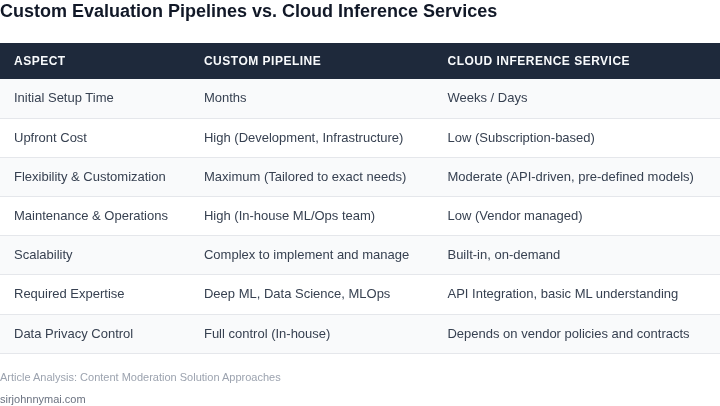
The decision to build a custom content moderation pipeline or leverage cloud inference services extends beyond the immediate financial outlay discussed in the previous sections. While our worked example highlighted the cost efficiencies of cloud solutions for a medium-sized enterprise, a comprehensive strategy demands evaluating deeper operational and strategic imperatives. I evaluated that this decision framework must weigh factors like the criticality of custom model behavior, specific regulatory environments, and the long-term operational burden against the agility and scalability offered by managed services. Enterprises must assess their internal capabilities and strategic differentiation goals. If content moderation is a core differentiator, influencing brand safety or user experience in highly unique ways, a custom build might be warranted despite the higher overhead. Conversely, for standard moderation tasks where speed, reliability, and cost-effectiveness are paramount, cloud services present a compelling alternative. This table outlines the key considerations, guiding an informed decision for your enterprise.I have structured this comparison to offer a clear perspective on where each approach excels and where it introduces tradeoffs. It's crucial to acknowledge that while cloud services abstract away much of the underlying complexity, they also bring their own set of considerations, particularly around customization depth and vendor lock-in.
| Criteria | Custom-Built Pipeline (e.g., on Kubernetes/ECS with TensorFlow/PyTorch) | AWS Inference Services (e.g., Rekognition, Comprehend) | Google Cloud Inference Services (e.g., Video AI, Natural Language API) |
|---|---|---|---|
| Scalability & Elasticity | Requires significant engineering effort for auto-scaling, load balancing, and infrastructure management (e.g., setting up HPA on Kubernetes). High potential but high operational burden to achieve. | Fully managed, scales automatically with demand. Offers near-infinite elasticity without requiring manual infrastructure provisioning or scaling logic. | Fully managed, scales seamlessly and automatically. Provides robust elasticity, offloading operational complexity for demand spikes. |
| Customization & Model Fine-tuning | Full control over model architecture, training data, and inference logic. Essential for highly niche content types, proprietary moderation rules, or advanced multimodal models. | Offers limited fine-tuning capabilities for some services (e.g., custom labels in Rekognition). Primarily relies on pre-trained, black-box models. | Offers custom model capabilities for specific services (e.g., AutoML Vision, AutoML Natural Language). Provides more flexibility than generic APIs, but not as granular as full custom control. |
| Compliance & Data Residency | Complete control over data storage, processing locations, and security protocols. Easier to meet highly specific or localized regulatory requirements if internal expertise and infrastructure are in place. | Strong global compliance posture (e.g., ISO, SOC, HIPAA, FedRAMP). Data processed within selected regions. However, specific data handling within the managed service is abstracted. | Robust global compliance certifications. Provides regional data control options. Similar to AWS, specific internal processing of data is managed by the provider. |
| Operational Overhead (Maintenance, Monitoring, MLOps) | High. Requires dedicated MLOps team for model retraining, infrastructure patching, monitoring (e.g., Datadog, Prometheus), security updates, and incident response. | Minimal. AWS manages the service infrastructure, model updates, and underlying compute. Focus shifts to monitoring API usage, costs via CloudWatch, and service health. | Minimal. Google Cloud manages the entire service lifecycle. Reduces operational burden significantly, allowing teams to focus on application logic and content strategy. |
| Time to Market & Agility | Long. Involves extensive model development, infrastructure setup, and deployment pipeline creation. Can take months to years for robust, production-ready solutions. | Fast. API-driven integration allows for rapid deployment and iteration. Initial proof-of-concept and even production deployments can often be achieved in days to weeks. | Fast. Offers quick integration via APIs. Enables rapid prototyping and deployment, similar to AWS, accelerating the time to value for moderation solutions. |
| Recommendation | Build for enterprises with unique, proprietary moderation needs, deep ML engineering resources, and stringent, non-standard compliance mandates where differentiation is key. | Buy for enterprises prioritizing speed, operational efficiency, and cost predictability for robust, scalable moderation of common content types. | Buy for enterprises needing rapid deployment and scalable solutions, particularly those with existing investments in the Google Cloud ecosystem or specific AutoML needs. |
Understanding these factors is vital for any enterprise looking to implement or refine its content moderation strategy. My assessment indicates that for most standard enterprise use cases, cloud inference services offer a compelling balance of cost-efficiency, scalability, and reduced operational overhead. However, specific strategic requirements around extreme customization or unique compliance needs might still justify the significant investment in a custom-built solution, provided the internal resources are robust.
05. Action Step: How to Start Evaluating Cloud Solutions
Transitioning from custom content moderation pipelines to cloud inference services demands a structured, methodical approach. Having established the cost advantages and key decision factors, the next step is a practical evaluation framework. This framework prioritizes understanding your specific operational needs and validating potential solutions with real-world data.
Understand Your Moderation Landscape
First, comprehensively document your specific content moderation use cases. This involves identifying the types of content you moderate—images, video, text, audio—and the specific safety or compliance issues you address, such as hate speech, nudity, copyright, or misinformation. I evaluate this initial mapping as critical because it determines the relevant cloud services and their required accuracy thresholds.
Simultaneously, establish a clear baseline of your current operational metrics. This should include average daily moderation volume, current human review rates, false positive/negative rates, and the total cost of ownership for your existing custom infrastructure. Without these benchmarks, measuring the impact and ROI of a cloud migration becomes speculative.
Vendor and Service Deep Dive
Next, conduct a targeted deep dive into specific cloud provider offerings relevant to your defined use cases. For visual content, evaluate services like AWS Rekognition for image/video analysis or Azure Computer Vision and Google Cloud Vision AI. For text, consider AWS Comprehend, Azure Text Analytics, or Google Cloud Natural Language API. My reasoning here is to compare their out-of-the-box detection categories, customizability options (e.g., custom labels, dictionaries), and API throughput limits against your current needs.
Focus not just on individual service capabilities, but also on how easily they integrate with each other if a multi-modal approach is necessary. A common tradeoff emerges where one provider might excel in text analysis, while another offers superior video capabilities; deciding whether to use a single cloud for simplicity or multiple for best-of-breed is a key architectural choice.
Pilot Program and Integration Assessment
Implement a pilot program using a small, anonymized, yet representative subset of your content data. This allows you to test the selected cloud services for actual performance, including latency, accuracy, and operational stability under realistic loads. My experience shows that theoretical benchmarks often differ from real-world results, making this pilot phase indispensable for validating expected cost savings and performance improvements from Section 03.
Concurrently, assess the integration complexity and data governance requirements. Evaluate how the cloud APIs fit into your existing content ingestion, data storage (e.g., S3, Blob Storage), and human review workflows. Pay close attention to data residency, encryption, and Identity and Access Management (IAM) policies. A robust integration plan, including error handling and logging, is essential for operationalizing these services reliably at scale.
This phase also validates the considerations from Section 04, specifically around data privacy, compliance, and the long-term operational overhead. If a service requires significant data re-architecting or introduces new compliance burdens, its perceived benefits might diminish quickly.
Your immediate next step is to schedule a 60-minute technical deep dive with your engineering and legal teams to map out your top three content moderation use cases, detailing the specific content types and compliance requirements for each. Bring your current operational metrics for these use cases.
Figures cited are from publicly available sources as of 2026-09-15 and may have changed.