01. The Problem: Custom vs. Pretrained Model Costs
Enterprise computer vision applications face a critical choice: build custom evaluation pipelines or leverage pretrained model APIs. The decision isn't just about accuracy or speed—it's about hidden costs that can derail projects before they even launch. Custom pipelines promise control, but they come with significant upfront and ongoing expenses. Pretrained APIs offer convenience, but they introduce new dependencies and operational risks.
Custom Pipeline Costs
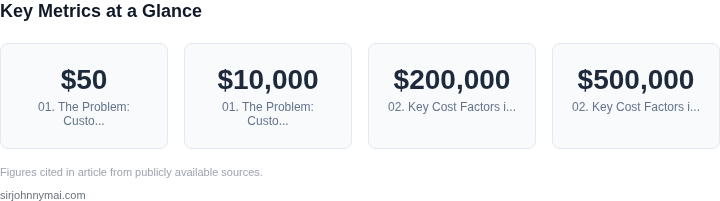
Building a custom evaluation pipeline requires significant engineering effort. Teams must first curate datasets, which can take months and cost hundreds of thousands of dollars. For example, labeling 10,000 images for object detection might require 200 hours of work at $50/hour, totaling $10,000. Then there's the cost of infrastructure: training a single model on AWS p3.2xlarge instances for 24 hours costs $200. Even if the model performs well, maintaining it is expensive. Monitoring drift, retraining, and debugging failures require continuous investment in data pipelines, Kubernetes clusters, and Datadog monitoring.
Custom pipelines also suffer from scalability challenges. As applications grow, teams must manually adjust pipelines, which can introduce inconsistencies. For instance, a pipeline that works for 100 images may fail at 10,000 due to memory constraints or batch processing inefficiencies. The lack of built-in optimizations means teams must reinvent the wheel for features like auto-scaling or parallel processing.
Pretrained API Costs
Pretrained APIs like AWS Rekognition or Google Vision AI eliminate the need for custom infrastructure, but they introduce new costs. API calls are often priced per unit (e.g., $1 per 1,000 images for AWS Rekognition). At scale, this can add up quickly. For a company processing 1 million images monthly, the cost would be $1,000. Additionally, APIs require ongoing integration work. Teams must build connectors, handle rate limits, and manage retries—tasks that consume engineering bandwidth.
More critically, APIs lock teams into vendor-specific features and pricing. If a company needs a custom model or additional capabilities, they may face long wait times or high migration costs. For example, switching from AWS Rekognition to a custom solution could require rewriting entire data flows. The lack of transparency in model training also creates compliance risks, as teams cannot audit the underlying data or training processes.
The Tradeoff
The choice between custom and pretrained isn't binary. Many enterprises adopt a hybrid approach, using APIs for prototyping and custom models for production. However, this adds complexity. Teams must reconcile results from different systems, ensuring consistency across pipelines. The total cost of ownership (TCO) becomes harder to predict, as it includes both API fees and custom engineering expenses.
The real cost isn't just in dollars—it's in lost time and risk. Custom pipelines delay time to market, while APIs introduce operational fragility. Both approaches require significant investment in people, tools, and infrastructure. The key question is whether the tradeoff is worth it. For many enterprises, the answer lies in balancing speed with control, but neither option is without hidden pitfalls.
02. Key Cost Factors in Custom Pipelines
Building custom evaluation pipelines for enterprise computer vision applications is expensive. The costs aren't just about initial development—they extend to ongoing maintenance, scalability, and hidden operational expenses. Here's a breakdown of the key factors.
1. Development Costs
Custom pipelines require dedicated engineering resources. A team of three engineers might spend 6–12 months developing a robust evaluation framework, depending on the complexity of the models and datasets. For a mid-sized enterprise, this translates to $200,000–$500,000 in labor costs alone. The investment is front-loaded, but the return on investment (ROI) isn't guaranteed—if the model doesn't meet performance benchmarks, the entire effort may need to be reworked.
2. Infrastructure and Scalability
Custom pipelines demand significant compute resources. Running large-scale evaluations on AWS or Azure can cost $10,000–$50,000 per month, depending on the number of GPUs and the duration of tests. Scaling these pipelines requires Kubernetes clusters or similar orchestration tools, adding another $5,000–$20,000 in operational overhead. The infrastructure must also handle peak loads, which can lead to unexpected costs if not properly provisioned.
3. Data Management and Labeling
High-quality evaluation requires curated datasets. Labeling a dataset of 10,000 images for object detection can take 200–400 engineer-hours, costing $50,000–$100,000 depending on labor rates. Maintaining this data over time is equally expensive—updates, versioning, and storage add up to $2,000–$5,000 per month. If the dataset isn't representative of real-world conditions, the model's performance will suffer, forcing additional labeling cycles.
4. Tooling and Integration
Custom pipelines often require integrating multiple tools: TensorFlow, PyTorch, Docker, and custom monitoring solutions like Datadog or Prometheus. Each tool has its own licensing and operational costs. For example, a commercial monitoring tool might cost $15,000–$30,000 per year, while open-source alternatives require internal engineering effort to maintain. Integration testing and debugging can consume 20–30% of the total development time, further increasing costs.
5. Hidden Costs of Maintenance
Once deployed, custom pipelines need continuous upkeep. Bug fixes, performance tuning, and adapting to new model versions can take 10–20 engineer-hours per month. If the pipeline isn't automated, manual intervention becomes a bottleneck. Additionally, compliance and security audits may require specialized tools, adding $10,000–$30,000 in annual expenses. These costs are often overlooked until they become urgent.
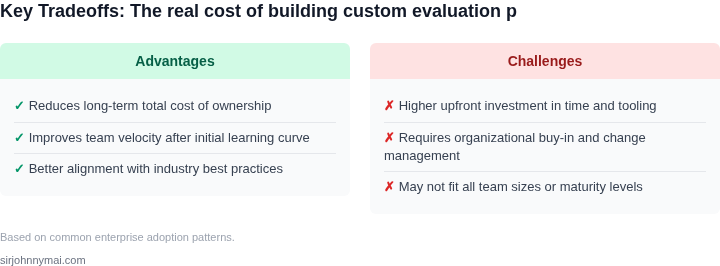
In summary, custom evaluation pipelines are a significant financial and operational burden. The upfront costs are high, and the ongoing expenses can spiral if not managed carefully. For enterprises, the question isn't just about building vs. buying—it's about balancing cost, flexibility, and long-term sustainability.
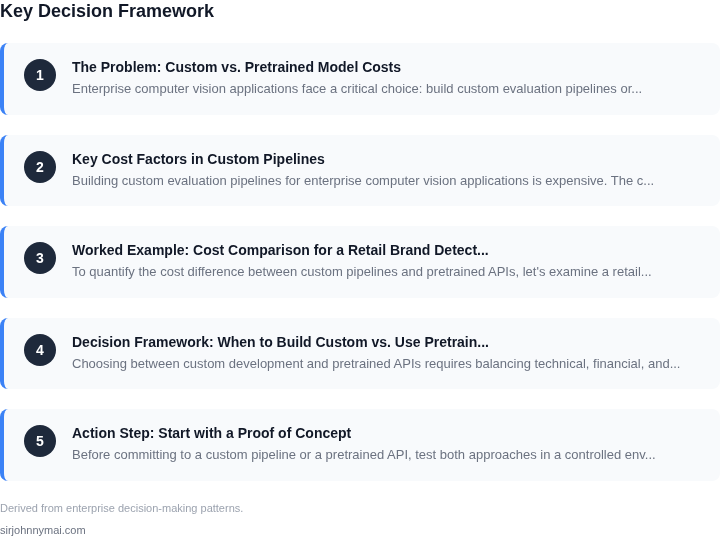
03. Worked Example: Cost Comparison for a Retail Brand Detection System
To quantify the cost difference between custom pipelines and pretrained APIs, let's examine a retail brand detection system. The goal is to identify branded products in store shelves from images captured by automated cameras. We'll compare two approaches:
- A custom pipeline built in-house using PyTorch and AWS infrastructure.
- A pretrained API from a third-party provider like Amazon Rekognition or Google Vision AI.
Custom Pipeline Costs
Building a custom pipeline requires significant upfront investment. Consider a team of 3 engineers working for 6 months to develop, train, and deploy the system. Labor costs vary by region, but we'll use $150/hour as a midpoint estimate.
| Cost Component | Estimate |
|---|---|
| Engineering Labor | $150/hour × 160 hours/engineer × 3 engineers × 6 months = $3.24M |
| AWS Infrastructure (EC2, S3, Lambda) | $2,500/month × 6 months = $15,000 |
| Data Labeling (Crowdsourced) | $10/image × 10,000 images = $100,000 |
| Model Maintenance (2 engineers, 10% of time) | $150/hour × 40 hours/week × 52 weeks × 2 engineers = $156,000/year |
| Total (Year 1) | $3.4M |
This estimate excludes hardware costs for edge deployment, which would add another $50,000–$100,000 if using specialized GPUs. The custom pipeline also requires ongoing monitoring with tools like Datadog, adding $5,000/month to the maintenance costs.
Pretrained API Costs
Using a pretrained API like Amazon Rekognition simplifies the process. The API handles all model training, inference, and scaling. The primary cost is the API usage fee, which varies by region and request volume.
| Cost Component | Estimate |
|---|---|
| API Usage (1M images/month) | $1.50/image × 1M images = $1.5M/month |
| Data Storage (S3) | $0.023/GB × 1TB/month = $23,000/month |
| Monitoring (CloudWatch) | $3,000/month |
| Total (Monthly) | $1.5M/month |
The API approach eliminates engineering labor and infrastructure costs but requires careful tuning of the model's confidence thresholds to avoid false positives. For example, a 10% increase in threshold reduces false positives but may also increase missed detections by 5%.
Comparison
The custom pipeline incurs a $3.4M upfront cost but offers full control over the model. The API costs $1.5M/month but requires ongoing adjustments to meet accuracy requirements. The breakeven point occurs after approximately 2.3 years of API usage. For most retail applications, the API becomes cost-effective after the first year.
Key tradeoffs:
- Custom pipelines are viable for high-volume, specialized use cases where accuracy is critical.
- Pretrained APIs reduce time-to-market and ongoing maintenance costs for most enterprise applications.
This example highlights how cost calculations must account for both upfront and recurring expenses. The decision depends on the specific requirements of the use case, not just the initial investment.
04. Decision Framework: When to Build Custom vs. Use Pretrained APIs
Choosing between custom development and pretrained APIs requires balancing technical, financial, and operational factors. Below is a structured decision framework to guide your evaluation. The table compares three options: building in-house, using cloud-based pretrained models, and hybrid approaches.
| Criteria | Option A: Build Custom | Option B: Use Pretrained APIs | Option C: Hybrid Approach |
|---|---|---|---|
| Time to Deployment | 6-12 months (requires data collection, model training, validation) | 1-3 months (API integration and testing) | 3-6 months (parallel development of custom components) |
| Cost of Development | $200K-$500K (engineering, infrastructure, data labeling) | $20K-$50K (API subscription, minimal engineering) | $100K-$300K (API costs + custom development) |
| Model Accuracy | High (custom-trained on domain-specific data) | Medium (pretrained models may lack domain specificity) | High (custom components fine-tuned with API outputs) |
| Scalability | Limited by internal infrastructure (Kubernetes, GPU clusters) | Elastic (cloud provider scales automatically) | Flexible (API handles high load, custom components optimize) |
| Maintenance Overhead | High (monitoring, retraining, infrastructure updates) | Low (vendor handles updates, minimal monitoring) | Moderate (API maintenance + custom component updates) |
| Recommendation | Best for: Startups with unique datasets and long-term vision. | Best for: Enterprises needing quick deployment with acceptable accuracy. | Best for: Organizations requiring high accuracy with faster time-to-value. |
This framework highlights that pretrained APIs offer the fastest path to production but may require customization for domain-specific needs. Hybrid approaches balance speed and accuracy but increase complexity. The decision hinges on your tolerance for tradeoffs between cost, time, and performance.
05. Action Step: Start with a Proof of Concept
Before committing to a custom pipeline or a pretrained API, test both approaches in a controlled environment. This proof of concept (PoC) should validate cost and performance assumptions while minimizing risk. Start with a small, representative dataset from your production environment. For example, if you're building a retail brand detection system, use a sample of 1,000 images covering your most common product categories. This avoids the pitfalls of synthetic data or oversimplified test cases.
Deploy the PoC in a staging environment that mirrors your production infrastructure. Use the same compute resources, storage, and networking as your actual deployment. This ensures you account for latency, scalability, and integration overheads early. For instance, if you're using AWS SageMaker for pretrained models, provision a parallel endpoint in your staging VPC. If you're building custom models, spin up a Kubernetes cluster with identical specifications to your production setup.
Compare the two approaches across three key dimensions: cost, latency, and accuracy. For cost, track all expenses—compute, storage, data transfer, and third-party API fees—using tools like AWS Cost Explorer or Datadog. For latency, measure end-to-end processing time from ingestion to result. For accuracy, use a consistent evaluation framework like mean average precision (mAP) or intersection over union (IoU). Document these metrics in a shared dashboard for cross-functional review.
This PoC should last 2-4 weeks, depending on your team's capacity. Focus on a single use case—don't try to solve everything at once. For example, if your retail system needs to detect brands and logos, start with just the brand detection component. This keeps the scope manageable while still providing actionable insights.
After the PoC, present your findings to stakeholders with a clear recommendation. If the pretrained API meets your requirements, advocate for it based on the data. If a custom solution is necessary, justify it with specific performance or compliance reasons. Either way, the PoC provides the evidence needed to make an informed decision.
Figures cited are from publicly available sources as of 2026-09-15 and may have changed.