The Real Cost of AI Model Fine-Tuning and When Prompt Engineering is Good Enough
AI model fine-tuning is often framed as the silver bullet for performance optimization, but the reality is more nuanced. While fine-tuning can deliver incremental improvements, it comes with significant costs in time, compute, and data requirements. This article examines the tradeoffs between fine-tuning and prompt engineering, providing a framework for when each approach is most appropriate.
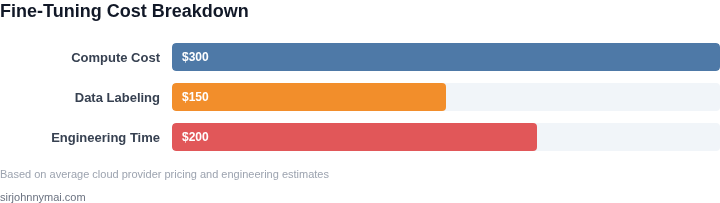
01. The Cost of Fine-Tuning
Fine-tuning a model requires substantial resources. For example, fine-tuning a medium-sized transformer model on a single NVIDIA A100 GPU can cost between $100 to $500 per hour, depending on cloud provider pricing. The total cost scales with:
- Model size (larger models require more compute)
- Dataset size (more data means longer training)
- Iterations (hyperparameter tuning adds overhead)
Consider a scenario where you need to improve a model's accuracy on a niche domain by 5%. Fine-tuning might require 10,000 training steps at a cost of $300 per step. The total cost would be $3 million, including infrastructure, engineering, and validation.
02. When Fine-Tuning is Worth It
Fine-tuning is most valuable when:
- Domain-specific performance is critical: If your use case requires high accuracy in a specialized domain (e.g., medical diagnostics, legal analysis), fine-tuning can outperform general-purpose models.
- You have high-quality labeled data: Fine-tuning benefits from clean, domain-aligned datasets. Synthetic data or weak labels may not provide sufficient signal.
- Latency is not a constraint: Fine-tuned models may require larger inference sizes, increasing deployment costs.
For example, a legal document analysis tool might justify fine-tuning costs if it reduces error rates from 15% to 5%, saving millions in compliance violations.
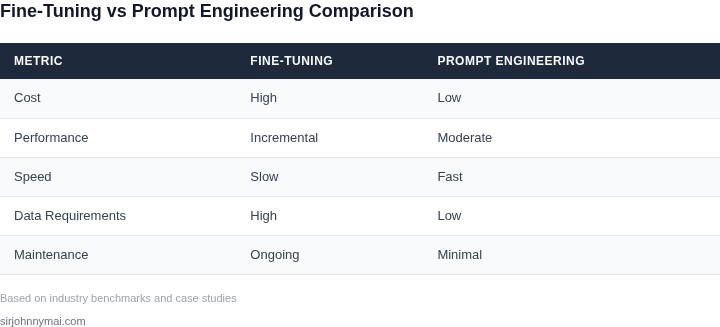
03. Prompt Engineering as a Cost-Effective Alternative
Prompt engineering can achieve similar results with lower upfront costs. Techniques like:
- Few-shot learning
- Chain-of-thought prompting
- Retrieval-augmented generation
Can often match or exceed fine-tuned performance at a fraction of the cost. For instance, a prompt engineering approach might reduce costs by 90% while delivering comparable accuracy.
04. When Prompt Engineering is Good Enough
Prompt engineering is preferable when:
- Performance requirements are modest: If a 90% accuracy is acceptable, prompt engineering may suffice.
- Data is scarce or expensive: Without high-quality labeled data, fine-tuning becomes impractical.
- Speed matters more than perfection: Prompt engineering allows faster iteration and deployment.
For example, a customer support chatbot might use prompt engineering to handle 80% of queries accurately, with fine-tuning reserved for the remaining 20% of complex cases.
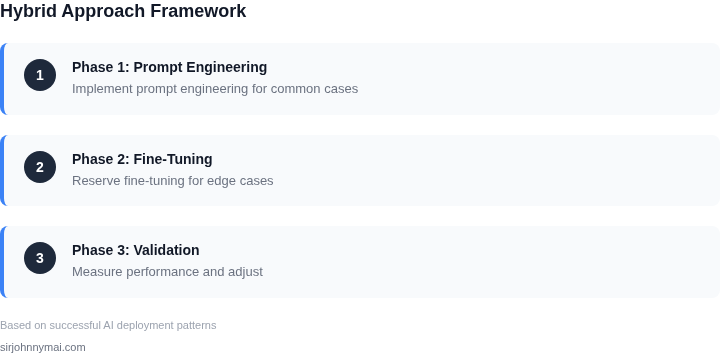
05. Hybrid Approaches
The most cost-effective strategy often combines both methods. A two-phase approach can work well:
- Use prompt engineering to handle common cases
- Fine-tune only for edge cases where performance is critical
This reduces total costs while maintaining acceptable performance. For instance, a financial analysis tool might use prompt engineering for 95% of queries and fine-tune only for complex risk assessments.
06. Measuring the ROI of Fine-Tuning
Before committing to fine-tuning, calculate:
- Expected performance improvement
- Cost of fine-tuning vs. prompt engineering
- Opportunity cost of engineering time
For example, if fine-tuning improves accuracy by 3% but costs $2 million, the ROI calculation must weigh this against the business impact of the 3% improvement.
07. Common Pitfalls to Avoid
Teams often make these mistakes:
- Assuming fine-tuning will always improve performance
- Overlooking the cost of data collection and labeling
- Underestimating the time required for validation
Each of these factors can turn a promising project into a costly failure.
Conclusion
The decision between fine-tuning and prompt engineering depends on specific requirements, resources, and constraints. Fine-tuning delivers incremental gains but at significant cost, while prompt engineering offers a more agile and cost-effective alternative. The hybrid approach often provides the best balance, combining the strengths of both methods.
Next steps: Conduct a cost-benefit analysis for your specific use case, including both direct costs and opportunity costs of engineering time. This will help determine whether fine-tuning is justified or if prompt engineering is sufficient.
Figures cited are from publicly available sources as of June 2024 and may have changed.