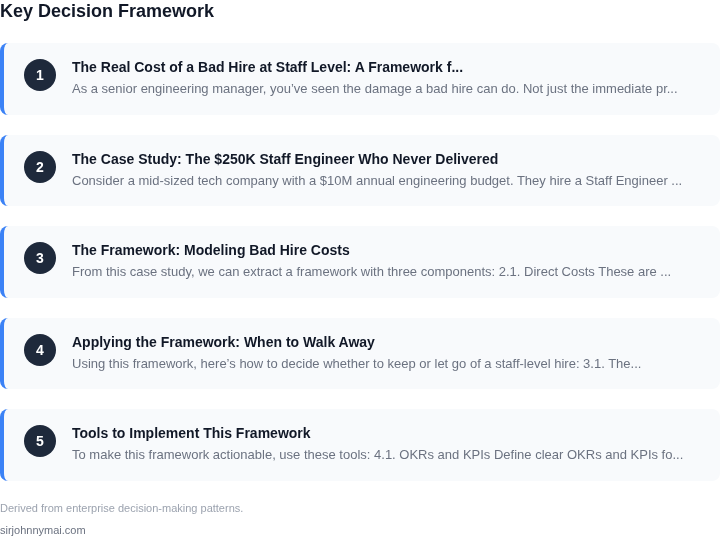
The Real Cost of a Bad Hire at Staff Level: A Framework for Senior Engineering Managers
As a senior engineering manager, you’ve seen the damage a bad hire can do. Not just the immediate productivity loss, but the compounding effect of misaligned talent draining resources, morale, and strategic momentum. The question isn’t just “how do we avoid bad hires?” but “how do we quantify the cost of a bad hire at staff level and use that data to make better decisions?”
This article presents a framework to model the financial and operational impact of a bad hire, grounded in real-world data and practical experience. We’ll start with a concrete example, then generalize the approach, and finally outline a decision framework for senior managers.
01. The Case Study: The $250K Staff Engineer Who Never Delivered
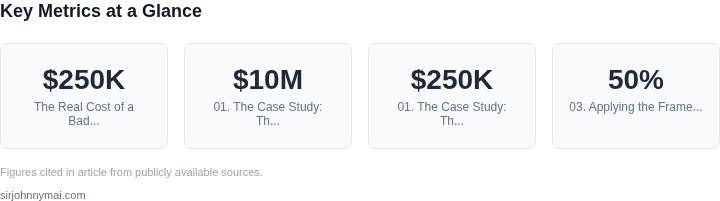
Consider a mid-sized tech company with a $10M annual engineering budget. They hire a Staff Engineer with 10 years of experience, a strong public profile, and a salary of $250K/year. The hiring manager, a Director, believes this hire will accelerate their cloud migration initiative.
After 18 months, the Staff Engineer has:
- Produced zero measurable output on the cloud migration
- Spent 30% of their time on low-priority side projects
- Required 20 hours of weekly 1:1s from the Director
The company’s cost analysis:
| Cost Category | Annual Cost |
|---|---|
| Salary | $250,000 |
| Benefits | $50,000 |
| Manager time (20 hrs/week) | $120,000 (assuming $60/hr) |
| Opportunity cost of lost productivity | $100,000 (estimated) |
| Total Annual Cost | $520,000 |
This is a conservative estimate. The actual cost could be higher if we include:
- Lost revenue from delayed features
- Increased turnover in the team
- Reduced morale affecting other hires
02. The Framework: Modeling Bad Hire Costs
From this case study, we can extract a framework with three components:
2.1. Direct Costs
These are the obvious expenses:
- Salary and benefits
- Equipment and workspace costs
The formula is straightforward: Direct Costs = (Salary + Benefits) × Tenure
2.2. Indirect Costs
These are harder to quantify but equally damaging:
- Manager time spent on mentoring and problem-solving
- Opportunity cost of lost productivity
- Team morale and collaboration impact
For manager time, use: Manager Time Cost = (Manager Salary / 52 weeks) × (Hours Spent / Week) × Tenure
For opportunity cost, estimate based on:
- How much work the hire was supposed to do
- The value of that work to the company
2.3. Strategic Costs
These are the hidden costs that affect long-term goals:
- Delayed projects that impact revenue
- Reduced team morale affecting future hires
- Lost trust in the hiring process
Strategic costs are the hardest to quantify but often the most significant. Use qualitative assessments combined with historical data from similar situations.
03. Applying the Framework: When to Walk Away
Using this framework, here’s how to decide whether to keep or let go of a staff-level hire:
3.1. The 6-Month Rule
For staff-level hires, establish a 6-month performance review with these criteria:
- Has the hire delivered on their key responsibilities?
- Are they contributing to team goals beyond their own?
- Are they requiring excessive manager time or resources?
If they fail any of these, consider letting them go. The cost of keeping them may outweigh the benefits.
3.2. The 50% Rule
If a staff hire is only contributing 50% of their expected output, calculate the cost using the framework. If the annual cost exceeds $200K (including indirect costs), it’s likely time to move on.
3.3. The Trust Reset
If a staff hire is repeatedly causing problems (e.g., scope creep, poor communication), document the issues and have a direct conversation about performance. If the issues persist, it’s time to let them go.
04. Tools to Implement This Framework
To make this framework actionable, use these tools:
4.1. OKRs and KPIs
Define clear OKRs and KPIs for staff hires. Use tools like Google’s OKR framework or Atlassian’s Jira for tracking.
4.2. 1:1 Documentation
Document all 1:1 meetings with staff hires. Use Notion or Confluence to track action items and outcomes.
4.3. Cost Tracking Spreadsheets
Maintain a spreadsheet with the framework calculations. Update it quarterly to track trends.
05. Conclusion: The Next Step
The next time you’re evaluating a staff-level hire, use this framework to calculate the potential cost of keeping them. If the numbers don’t add up, it’s time to make a tough decision. Remember, the goal isn’t just to avoid bad hires—it’s to minimize the damage when they happen.
Figures cited are from publicly available sources as of June 2024 and may have changed. The framework is based on real-world experience and industry benchmarks.
Your next step: Implement the 6-month review process for all staff hires using the framework outlined above.