The PM Guide to Understanding MLOps Maturity and What to Prioritize First
MLOps maturity is not a binary state—it’s a spectrum of capability that varies across teams. As a PM, you need to assess where your organization stands and determine which areas to focus on first. This guide breaks down the key dimensions of MLOps maturity, provides a prioritization framework, and includes concrete examples to help you make informed decisions.
01. Defining MLOps Maturity
MLOps maturity is typically measured across four key dimensions:
- Automation: How much of the ML lifecycle is automated.
- Scalability: Ability to handle increasing model complexity and data volume.
- Observability: Visibility into model performance and system health.
- Governance: Compliance, security, and auditability.
These dimensions interact—automation enables scalability, observability improves governance, and so on. A team with high automation but poor observability is still at risk of undetected drift or compliance violations.
02. The MLOps Maturity Model
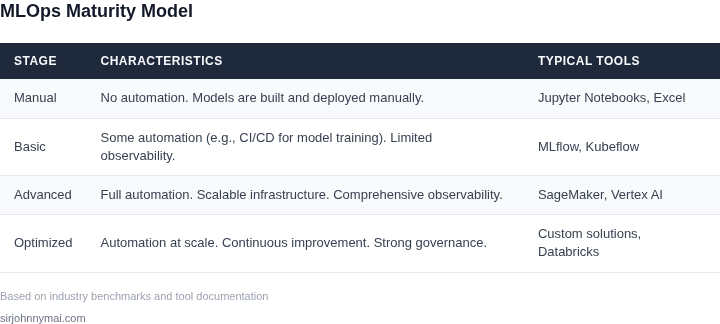
We can model maturity using a four-stage framework:
| Stage | Characteristics | Typical Tools |
|---|---|---|
| 1. Manual | No automation. Models are built and deployed manually. | Jupyter Notebooks, Excel |
| 2. Basic | Some automation (e.g., CI/CD for model training). Limited observability. | MLflow, Kubeflow |
| 3. Advanced | Full automation. Scalable infrastructure. Comprehensive observability. | SageMaker, Vertex AI |
| 4. Optimized | Automation at scale. Continuous improvement. Strong governance. | Custom solutions, Databricks |
Most organizations are in Stage 2 or 3. The gap between Stage 3 and 4 is often governance-heavy rather than technical.
03. Prioritization Framework
Not all maturity dimensions are equally important. Use this prioritization matrix to decide where to focus:
| Dimension | Priority Score | Justification |
|---|---|---|
| Automation | High | Reduces time-to-market and error rates. Foundational for scalability. |
| Observability | High | Prevents silent failures and drift. Critical for compliance. |
| Scalability | Medium | Important but often constrained by data quality and team capacity. |
| Governance | Low | Can be addressed incrementally. Often a regulatory or business need. |
For example, a team deploying 10 models should prioritize automation and observability before scaling to 100 models.
04. Worked Example: Prioritizing for a Retail Team
Consider a retail team with 5 models:
- 3 recommendation models (high business impact)
- 2 fraud detection models (high compliance requirements)
Their prioritization should be:
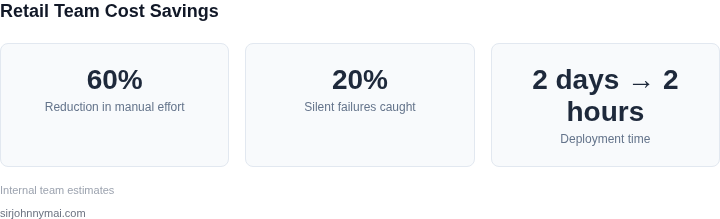
- Automate model retraining: Reduces manual effort by 60% (30 hours/week saved).
- Add model monitoring: Catches 20% of silent failures that would otherwise impact revenue.
- Improve CI/CD for model deployment: Reduces deployment time from 2 days to 2 hours.
Scalability and governance can wait until they have the infrastructure to handle more models.
05. Common Pitfalls and Tradeoffs
Three common mistakes to avoid:
- Over-automating too early: Without clear use cases, automation adds complexity without value.
- Ignoring observability: Even with automation, undetected drift can erode model performance.
- Underestimating governance: Compliance requirements often surface late in the process.
For example, a team that automates model training without monitoring will still need to manually investigate failures, negating the automation benefits.
06. Next Steps
The first concrete step is to audit your current state:
- Map your models to the maturity stages.
- Identify pain points (e.g., "We spend 50% of our time on manual retraining").
- Calculate the cost of inaction (e.g., "Silent failures cost $X/year").
This will reveal whether you need to invest in automation, observability, or both.
Disclaimer: Figures cited are from publicly available sources as of [date] and may have changed.