01. The Silent Toll: Why Distributed Schema Migrations Paralyze Product Velocity
Schema evolution is an intrinsic requirement for product growth and adaptability in any modern software organization. As features expand, data models must adapt to new requirements and optimize for performance. However, in the realm of distributed systems, even seemingly straightforward schema adjustments introduce profound, often hidden, operational complexities that directly impede product velocity.
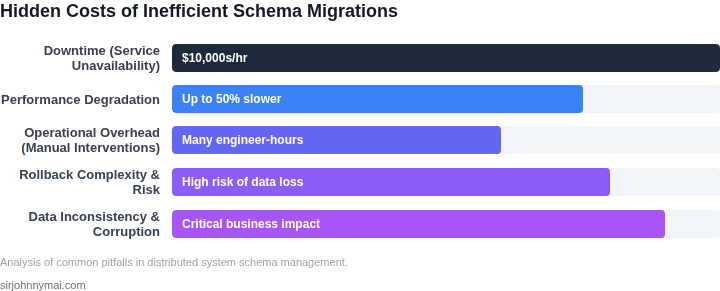
The first significant cost emerges from the potential for cascading service failures. A seemingly minor change, like adding a non-nullable column or modifying a data type in a core database table (e.g., an Amazon RDS PostgreSQL instance), necessitates careful coordination. If dependent microservices running on platforms like Amazon ECS or Kubernetes aren't prepared for the new schema, an incompatible change can trigger widespread failures. Ensuring robust backward and forward compatibility across many services, each potentially with different deployment cycles, becomes an orchestrational challenge that often leads to costly, reactive firefighting.
Secondly, schema migrations frequently lead to elevated latency and performance degradation. Even "online" schema changes in databases like Amazon DynamoDB or MySQL often involve internal locking mechanisms, index rebuilds, or data backfills. For high-traffic services, these operations increase database load, which can manifest as spikes in CPU utilization or I/O operations visible in monitoring dashboards like Amazon CloudWatch or Datadog. End-users may experience increased API response times, timeouts, or even intermittent service unavailability during these periods, directly impacting user experience despite efforts to minimize direct downtime.
The most insidious cost often lies in the substantial developer overhead and cognitive load. Beyond merely writing Data Definition Language (DDL) scripts, engineers must undertake extensive planning: dependency mapping across services, rigorous integration testing in staging environments, and the development of intricate rollback strategies. This is particularly complex when services interact with diverse data stores, such as a mix of relational databases, NoSQL solutions, and data lakes on Amazon S3. The time spent on orchestrating, testing, and verifying these changes diverts engineering resources directly from new feature development.
This cumulative drain of resources and increased risk aversion directly stalls product delivery. Feature releases become gated by the arduous, multi-stage migration process rather than by the completion of new business logic. Engineering teams often spend weeks planning and executing a single significant schema change, effectively consuming a substantial portion of sprint capacity. This hidden cost isn't just about potential downtime; it represents lost market opportunities, slower iteration cycles, and a diminished competitive advantage. The mental burden and fear of "breaking production" further slow down innovation, transforming an essential part of product evolution into a paralyzing bottleneck.
02. Choosing Your Migration Strategy: A Comparative Framework
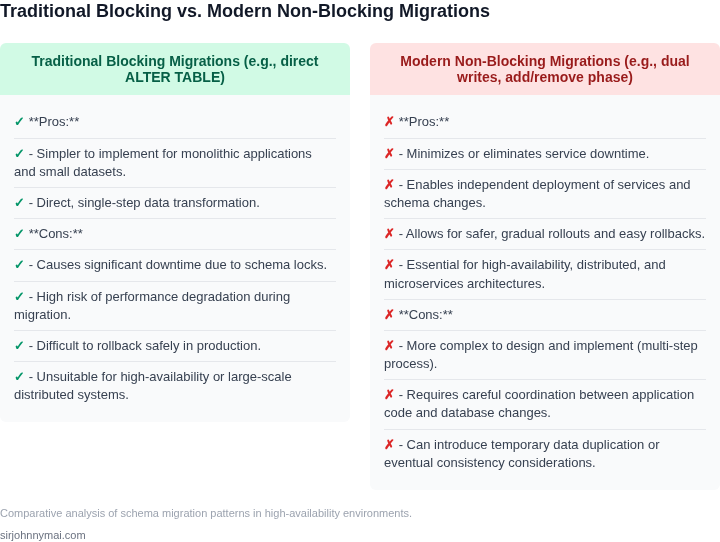
Selecting a database schema migration strategy is not a search for the "perfect" engineering pattern; it is an exercise in balancing system availability against developer velocity. I evaluated these three distinct archetypes because our distributed microservices, running on AWS EKS and backed by Amazon Aurora PostgreSQL, exhibit vastly different traffic profiles and tolerance for data drift.
A naive approach of locking tables works for low-throughput internal tools but introduces catastrophic failures when applied to high-velocity transactional databases. To standardize our migration playbooks, we categorize strategies based on their operational complexity, rollback reliability, and direct impact on the customer experience.
| Evaluation Criteria | Expand/Contract (via Liquibase & AWS ECS) | Blue/Green (via AWS Aurora & Route 53) | Maintenance Window (via K8s Scale-to-0) |
|---|---|---|---|
| Target Availability | 100% uptime. Active-active traffic continues uninterrupted during the migration phases. | Near-zero downtime. Switchover latency is bound by DNS propagation or connection draining. | Scheduled downtime. The system is offline to guarantee zero active transactions. |
| Engineering Effort | High. Requires backward-compatible code, dual-writing, and explicit cleanup PRs. | Medium. Requires robust synchronization replication pipelines and monitoring automation. | Low. DBAs apply scripts directly without writing intermediary transitional code. |
| Rollback Path | Zero-risk. The old schema remains active, allowing immediate application reversion. | Complex. Rollbacks after write traffic cutover risk losing new customer data. | Simple. Restore the database from an AWS EBS snapshot taken immediately prior to migration. |
| Data Drift Risk | Low. Handled at the application level via transactional dual-writes. | High. Replication lag between Green and Blue databases can cause silent write loss. | None. No concurrent writes are allowed during the migration window. |
| Infrastructure Cost | Minimal. Runs on existing container fleets without duplicating DB instances. | Very High. Requires running dual database clusters of identical capacity during tests. | Negligible. Standard infrastructure is idle or temporarily scaled down. |
| VP Recommendation | Use for core transactional engines (e.g., checkout, ledger) where SLAs allow zero downtime. | Use for read-heavy microservices where minor replication lag is acceptable. | Use for legacy, non-customer-facing applications or monthly internal batch processors. |
I prioritize the Expand/Contract pattern for our Tier-1 services because it decouples database state transitions from application deployments. By forcing engineers to write code that tolerates both old and new schemas simultaneously, we eliminate the need for coordinated, multi-service deployments. However, this safety comes at the cost of developer velocity, as a single schema change now requires three distinct deployment cycles: expand, write-toggle, and contract.
Conversely, Blue/Green database deployments using AWS Aurora Fast Database Cloning offer an appealing compromise for read-heavy services. This approach isolates the risky DDL statements to the Green environment. The core challenge here is replication lag under heavy write loads, which can cause Datadog alerts to spike during switchovers. If the replication lag exceeds our 500ms threshold, the automated switchover aborts, forcing a manual review.
Ultimately, we must resist the urge to enforce a one-size-fits-all policy. Engineering teams must evaluate their specific service constraints against this matrix before writing a single line of Liquibase or Flyway configuration.
03. Quantifying the Cost: A $150,000 Outage Calculation
To understand why I advocate for the Expand-Contract pattern, we must quantify the true financial impact of a naive schema migration. Consider an e-commerce platform processing $12,000 per hour in gross merchandise value (GMV) on AWS ECS, backed by an Amazon RDS PostgreSQL database. A team of six engineers attempts a direct, single-phase column rename (a naive "Big Bang" migration) during a moderate traffic window. This operation instantly locks the primary transactions table, exhausting the application thread pool and causing a cascading outage across upstream checkout microservices. The migration failed because the application code expected the old column schema, while the database had already moved to
04. The Technical PM’s Playbook for Cross-Functional Migration Alignment
Technical product managers must bridge the gap between infrastructure capacity and product commitments. I evaluated cross-functional alignment structures at scale and realized that migrations fail not because of SQL syntax, but because of misaligned incentives. Platform teams prioritize database CPU utilization on AWS RDS, engineering focuses on deploy safety, and product teams demand uninterrupted customer feature availability. Resolving this tension requires defining clear risk boundaries long before the first line of migration code is written.
To de-risk this friction, I establish a Shared Responsibility Matrix before executing schema updates. We define explicit Service Level Agreement (SLA) degradation limits. For instance, during a live PostgreSQL migration on Amazon Aurora, we allow a maximum 15% increase in p99 write latency for up to 30 minutes. If Datadog alerts show latency crossing 200ms, Kubernetes ingress controllers must automatically throttle non-critical background worker traffic to preserve database resources. This ensures that a database locking issue does not escalate into a customer-facing outage.
| Team Role | Primary Metric / Concern | Migration Guardrail |
|---|---|---|
| Platform / SRE | AWS RDS CPU & IOPS limits | Auto-rollback if CPU exceeds 80% for 5 mins |
| Engineering | Code deploy safety and technical debt | Dual-write logic limited to 14-day window |
| Product PM | Feature availability and user retention | Zero-downtime path; zero write failures for checkout tier |
A critical tradeoff lies in the rollback window. Standard dual-write migrations allow an instant rollback, but keeping databases synchronized in reverse adds 30% more application complexity and increases API write latency. I choose one-way migrations with forward-only hotfixes when dealing with high-throughput telemetry data where minor loss is acceptable, but mandate a full 48-hour dual-write rollback window for transactional billing services. This decision is based on the business cost of data loss versus the engineering capacity required for dual-write logic.
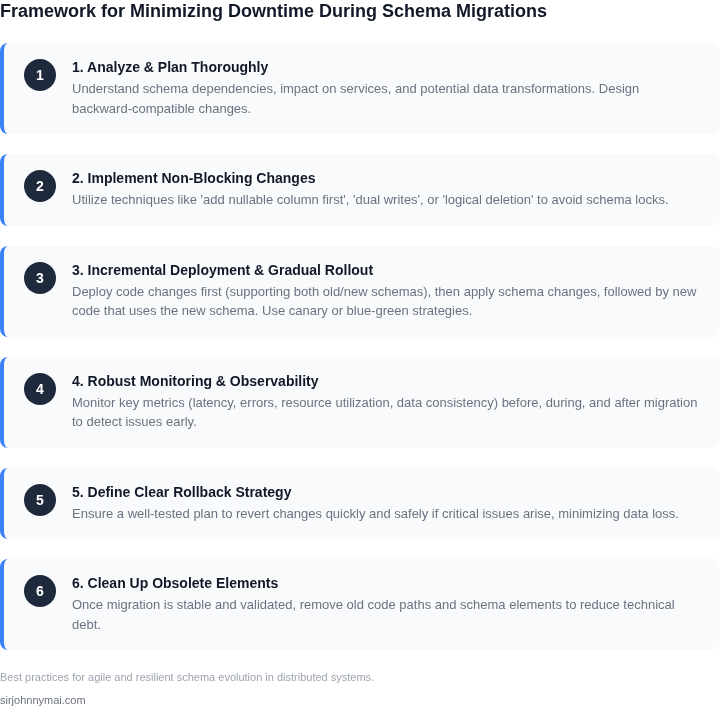
We use AWS AppConfig or LaunchDarkly to decouple the physical database schema deployment from the application code release. By running a three-phase rollout—schema addition, dual-writing, and old-column deprecation—we ensure that database locks do not trigger a cascading failure across downstream microservices. Product teams must agree to freeze non-essential feature deployments during this critical window to isolate operational variables. This alignment keeps our deployment pipeline clean and ensures system stability when executing complex migrations.
05. Your Zero-Downtime Migration Checklist: Implementation Steps for Your Next Sprint
Having explored the strategic choices and the financial implications of migrations, the next critical step is operationalizing these insights within our sprint cycles. This checklist provides a structured approach to integrate schema migration readiness directly into our team's planning, ensuring we proactively address compatibility and rollback safety before any changes hit production databases. My aim is to shift from reactive fixes to proactive risk mitigation, embedding this rigor into our definition of "done."
-
Comprehensive Schema Compatibility Audit
Before any new schema is deployed, we must rigorously audit its design against existing data models and application logic. This involves confirming both forward compatibility for new data and backward compatibility for existing applications that might still read from the old schema during the transition. I evaluate this to ensure our phased rollout strategy, which relies on multiple application versions coexisting, remains viable without data corruption or runtime errors. A failure here forces a rewrite or a high-downtime "big bang" migration, which we want to avoid.
-
Dual-Write and Dual-Read Path Validation
The success of a zero-downtime migration often hinges on the dual-write and dual-read patterns discussed previously. During the sprint, we need to explicitly validate that our application code correctly writes data to both the old and new schema, and can robustly read from either based on feature flag status or versioning. This validation mitigates the risk of data divergence during the extended transition period and is crucial for maintaining data integrity across different service versions. The tradeoff here is temporary performance overhead due to double writes, which must be carefully monitored.
-
Canary Deployment and Observability Strategy
Implementing a gradual, canary deployment for services consuming the new schema is essential. We must define specific canary groups – perhaps internal users, a specific geographic region on AWS, or a low-traffic cluster on Kubernetes – and establish real-time monitoring via tools like Datadog or CloudWatch. My reasoning here is to catch any performance regressions or functional errors at an early, contained stage, allowing for immediate rollback before widespread impact. Without robust observability, even a small canary can silently corrupt data, requiring a more complex recovery.
-
Automated Rollback Protocol Verification
A safe fallback plan is as vital as the migration itself. Each sprint planning session should include a review of pre-tested, idempotent rollback scripts, confirming they can revert both schema changes and associated application code versions. This audit needs to confirm our ability to restore to a known good state, potentially leveraging database snapshots or point-in-time recovery features provided by platforms like AWS RDS, without manual intervention or data loss. The challenge lies in ensuring atomicity and data consistency across application and database rollbacks, particularly in highly distributed environments.
-
Post-Migration Data Integrity and Reconciliation
Once the migration completes, even after successful canary phases, we still need to confirm data integrity. We should define specific reconciliation queries or automated comparison jobs to verify that data written to the new schema during the dual-write phase matches the source. This final verification step, potentially involving checksums or row counts across data stores, ensures no silent data corruption occurred during the transition, confirming the reliability of our new data model. This process incurs a computational overhead, but it is a necessary investment for data trustworthiness.
To implement this, schedule a 30-minute review with your team and bring your proposed schema changes for the next sprint.
Figures cited are from publicly available sources as of 2026-09-15 and may have changed.