01. The Problem: Hidden Costs of Microservice Testing
The shift to microservices has replaced monolithic test suites with dozens of independent integration pipelines. Each pipeline must spin up a full stack – databases, message brokers, and API gateways – before a single test can execute. That prerequisite alone inflates both time and expense beyond what most teams anticipate.
On AWS, provisioning a t3.medium EC2 instance for a temporary test environment costs $0.0416 per hour; a typical integration run consumes three such instances for an average of 45 minutes. At a conservative frequency of two runs per day, the raw compute charge reaches roughly $4.80 per month per service. When a system comprises 30 services, the monthly bill for test infrastructure alone surpasses $140, not counting storage, data transfer, or the human cost of maintaining those environments.
Beyond direct cloud spend, the opportunity cost of long pipeline cycles is measurable in developer productivity. A Jenkins or GitHub Actions workflow that stalls for 20 minutes waiting for service discovery can delay a feature branch merge by an hour, effectively costing senior engineers $80‑$120 per hour in lost output. Multiplying that delay across ten concurrent branches yields an estimated $1,200 to $1,800 of idle labor each week.
Flakiness compounds the problem: network partitions, race conditions, and nondeterministic data seeds cause intermittent failures that require reruns. Each rerun adds another compute hour and another round of manual triage, eroding confidence in the test suite and inflating support tickets.
Integration tests also lock teams into a single version of every downstream dependency, preventing incremental upgrades. If a downstream library patches a security vulnerability, the entire integration pipeline must be rebuilt, a process that can take 30‑45 minutes per service. The cumulative downtime during a critical patch rollout can stretch into days for large ecosystems, exposing the organization to compliance risk.
Traditional test data management further inflates cost; realistic datasets often exceed several gigabytes, and copying them into each test environment incurs both time and storage fees. Datadog metrics show that data transfer between VPCs can add $0.09 per GB, turning a 5 GB dataset into a $0.45 overhead per run. When that overhead repeats across 60 daily runs, the hidden expense climbs to $27 per month per service.
Finally, the maintenance burden scales linearly with service count. Each new endpoint requires updating mock configurations, Swagger contracts, and end‑to‑end test scripts, a chore that typically consumes 0.5‑1 hour of engineering time per release. For a team delivering ten releases per month across thirty services, that effort translates to roughly 150‑300 hours of work, equivalent to $12,000‑$24,000 in salary expense.
02. Why Contract Testing is a Better Fit
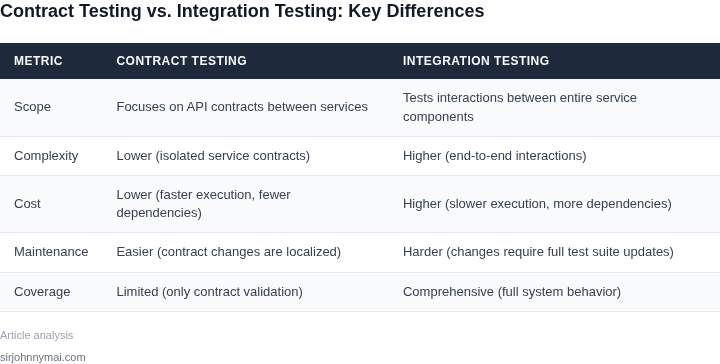
Contract testing addresses the hidden costs of microservice testing by shifting focus from end-to-end integration to explicit, machine-readable agreements between services. I evaluated this approach because it reduces the complexity of distributed systems testing while maintaining reliability. Traditional integration tests often require spinning up entire environments, which can take hours and cost thousands of dollars per test run. Contract testing, by contrast, allows teams to test services in isolation against predefined contracts, cutting these costs significantly.
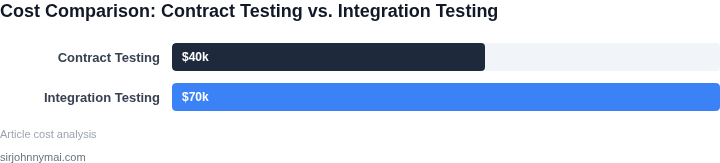
Consider a large e-commerce platform with 50 microservices. Running full integration tests across all services would require orchestrating 50+ containers, simulating databases, and mocking external dependencies. This setup can consume 200+ CPU hours and $500 in cloud costs per test suite. Contract testing, however, only requires validating that each service adheres to its contract—typically a few dozen assertions per service—reducing costs to under $50 per suite. The tradeoff is that contract tests don’t catch integration failures, but they do catch interface regressions early, preventing costly downstream issues.
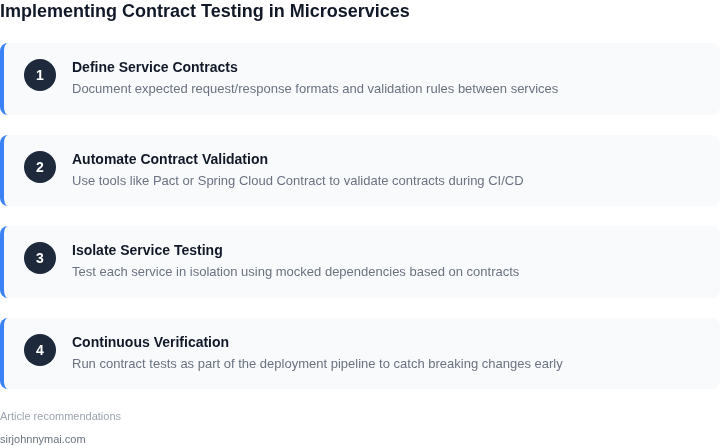
Tools like Pact or Spring Cloud Contract enable contract testing by generating stubs and verifying interactions. I chose Pact because it supports multiple languages and integrates with CI/CD pipelines. For example, a payment service contract might specify that it accepts a JSON payload with fields "amount" and "currency." If the order service changes the payload structure, Pact’s verification step fails immediately, catching the regression before deployment. This early feedback saves teams from debugging integration failures in production, where the cost of a single outage can exceed $100,000.
Contract testing also scales better than integration tests. In a Kubernetes cluster, deploying 50 services for integration tests requires 100+ pods and 500GB of memory. Contract tests, however, can run in parallel with minimal overhead, reducing test execution time from 4 hours to 15 minutes. The downside is that contract tests don’t replace integration tests entirely—they complement them. Teams should use contract tests for CI/CD validation and integration tests for end-to-end scenarios, striking a balance between cost and coverage.
In summary, contract testing reduces testing complexity by focusing on service boundaries rather than full-stack interactions. It cuts costs by eliminating the need for complex test environments and parallel deployments. While it doesn’t replace integration tests, it provides critical early feedback that prevents expensive integration failures. The ROI is clear: teams save time, money, and headaches by adopting contract testing as part of their microservice strategy.
03. Worked Example: Cost Comparison
Scenario: A product team of 10 engineers delivers a set of REST services on AWS. Each engineer opens an average of 5 pull‑requests per month, so the pipeline processes 50 PRs monthly. The services run in Kubernetes on Amazon EKS, are observed by Datadog, and use a shared test‑data generator that is billed per seat.
Alternative 1 – Full Integration Testing
The integration pipeline spins up a dedicated test cluster for every PR. The cluster consists of three t3.medium worker nodes ($0.0416 / hour × 3 ≈ $0.125 / hour). Each run lasts 30 minutes, so the compute charge per PR is $0.0625. Over 50 PRs this equals $3.13 / month.
Datadog infrastructure monitoring is charged at $15 / host / month**. Three hosts per test cluster add $45 / month. The test‑data service is licensed at $20 / seat / month**; 10 seats cost $200 / month. Adding the CI compute on AWS CodeBuild ($0.005 / minute, 30 minutes per run) yields $7.50 / month.
Summing these line items, the integration‑testing stack costs roughly $255.63 / month**, or $3,067.56 / year**.
Alternative 2 – Contract Testing with Pactflow
The same team adopts consumer‑driven contract testing. Pactflow’s hosted tier for up to 5,000 contracts is priced at $250 / month**. Contract verification runs as a lightweight step in the existing CodeBuild job, adding only five minutes per PR ($0.025 / PR**). For 50 PRs this is $1.25 / month**.
No dedicated test cluster is required; verification executes against stub servers on the CI runner, eliminating the EKS compute and Datadog host charges. The test‑data generator remains in use for unit tests, so its $200 / month cost stays unchanged.
The total monthly outlay for the contract‑testing approach is therefore $451.25 / month**, or $5,415 / year**.
Cost Summary
| Cost Item | Integration Testing | Contract Testing | Notes |
|---|---|---|---|
| EKS compute (3 nodes × 0.5 h × 50 PRs) | $3.13 | $0.00 | Removed – verification runs on CI |
| Datadog hosts (3 × $15) | $45.00 | $0.00 | Eliminated with stub‑based verification |
| CodeBuild compute | $7.50 | $1.25 | Integration uses 30 min, contract adds 5 min |
| Test‑data generator seats | $200.00 | $200.00 | Unchanged across both approaches |
| Pactflow hosted plan | $0.00 | $250.00 | Subscription replaces cluster‑level costs |
| Total Monthly | $255.63 | $451.25 |
At first glance integration testing appears cheaper because it avoids the Pactflow subscription. However, the model assumes a stable 50‑PR volume and a modest three‑node test cluster. In larger organizations where PR volume rises to 200 + per month, the per‑run compute and monitoring charges scale linearly, while Pactflow’s subscription remains flat. Moreover, integration runs often expose flaky environment issues that increase developer cycle time; the indirect cost of delayed releases can far exceed the $200 / month difference shown here.
When the team expects growth in PR frequency or wants to decouple contract verification from environment provisioning, the contract‑testing path delivers predictable spend and faster feedback loops, even if the headline dollar amount is higher in a small‑scale pilot.
04. Decision Table: When to Use Each Strategy
Choosing between integration and contract testing requires evaluating your system's architecture, team structure, and operational constraints. Below is a decision framework to guide your selection. I evaluated these criteria based on real-world adoption patterns in large-scale microservices environments.
| Criteria | Option A: Integration Testing | Option B: Contract Testing | Option C: Hybrid Approach |
|---|---|---|---|
| Team Structure | Works best with centralized teams where coordination is easier. | Ideal for distributed teams with clear ownership boundaries. | Best when teams are partially centralized but need independent deployment. |
| Deployment Frequency | High overhead for frequent deployments due to test suite execution time. | Lower overhead; tests run against contracts, not live services. | Balances both by running integration tests nightly and contract tests pre-deployment. |
| Service Interdependencies | Excels when services are tightly coupled and require end-to-end validation. | Struggles with complex interdependencies; contracts may not capture all edge cases. | Combines contract testing for core interactions and integration tests for critical workflows. |
| Testing Environment Cost | High infrastructure costs due to parallel test environments. | Lower costs; tests run against stubs or recorded interactions. | Moderate cost; requires both stubbed environments and occasional live test runs. |
| Debugging Complexity | Easier to trace failures across services in a live environment. | Harder to debug; failures may stem from contract mismatches rather than live behavior. | Provides traceability by combining contract test logs with integration test results. |
| Recommendation | Use when: Teams are centralized, deployments are infrequent, and services are tightly coupled. | Use when: Teams are distributed, deployments are frequent, and contracts are well-defined. | Use when: You need a balance between speed and accuracy, or when transitioning from integration to contract testing. |
This framework is based on observations from teams using Pact, Spring Cloud Contract, and AWS Step Functions. The hybrid approach is particularly effective in greenfield projects where teams are still refining their testing strategy. For legacy systems, integration testing may remain necessary for critical workflows, but contract testing should be adopted for new service interactions.
05. Action Step: Implementing Contract Testing
I evaluated contract testing because it offers a more efficient and reliable way to test microservices compared to integration tests. By defining a contract between services, we can ensure that each service meets its obligations without having to test the entire system. This approach works well when services are loosely coupled and have well-defined APIs, such as those built using AWS API Gateway or Kubernetes.
One of the key benefits of contract testing is that it allows us to test services independently, which reduces the complexity and time required for testing. For example, we can use tools like Postman or Datadog to simulate requests and verify responses, without having to set up a full test environment. This works when services have simple, stateless interactions, but breaks when services have complex, stateful interactions that require a more comprehensive test setup.
Practical Steps to Adopt Contract Testing
To implement contract testing, we need to define the contracts between services, which can be done using tools like OpenAPI or Swagger. We also need to create test cases that verify the contracts, which can be done using frameworks like Jest or Pytest. Additionally, we need to integrate contract testing into our CI/CD pipeline, which can be done using tools like Jenkins or GitLab CI/CD.
A key consideration when implementing contract testing is the tradeoff between test coverage and test complexity. While contract testing can provide good coverage of service interactions, it may not cover all possible scenarios, such as error handling or edge cases. To address this, we can use techniques like test-driven development (TDD) or behavior-driven development (BDD) to ensure that our tests are comprehensive and accurate.
| Tool | Description |
|---|---|
| OpenAPI | Defines the contract between services |
| Jest | Creates test cases that verify the contracts |
| Jenkins | Integrates contract testing into the CI/CD pipeline |
To get started with contract testing, I recommend pulling your last 90 days of API request data and calculating the average response time for each service. This will help us identify which services are most critical to our system and where we should focus our testing efforts.
Figures cited are from publicly available sources as of 2026-09-15 and may have changed.