The Hidden Cost of Context Switching and How Engineering Managers Should Protect Focus Time
Context switching is the silent productivity killer in engineering teams. Every time a developer shifts focus from one task to another, they lose 15-30 minutes of productive work. Over time, this fragmentation costs organizations millions in lost productivity. As an engineering manager, you can't ignore this problem—it directly impacts delivery timelines, quality, and team morale.
01. The Economic Impact of Context Switching
Let's start with the numbers. A study by Stanford found that the average developer loses 15 minutes per context switch. For a team of 10 engineers working 40 hours per week, this adds up to 1,200 hours of lost productivity annually. At $100/hour in developer costs, that's $120,000 in direct labor waste.
But the costs go deeper. Context switching increases bug rates by 15-20% and reduces code quality. Teams that frequently switch contexts also see higher turnover, as developers burn out from constant interruptions. The hidden cost of poor focus is not just time—it's morale and long-term team health.
02. Why Context Switching Is Inevitable (And Why It Hurts)
Context switching happens for valid reasons: urgent bugs, last-minute requirements, or cross-team dependencies. But the problem isn't the switches themselves—it's the lack of protection around focus time. Developers need uninterrupted blocks to:
- Build deep understanding of complex problems
- Debug effectively without distractions
- Complete tasks without rework
When these blocks are broken, the cost compounds. A single 15-minute interruption can delay a task by 30 minutes or more, creating a ripple effect across sprints.
03. How to Measure Context Switching
Before you can fix the problem, you need to measure it. Use these metrics:
- Task Completion Rate: Percentage of tasks finished without interruption
- Cycle Time: Time from start to finish for a given task
- Bug Fix Time: Average time to resolve a critical bug
For example, if a team's average cycle time increases by 20% after a sprint with frequent interruptions, you know focus time is being eroded. Track these metrics over time to identify trends.
04. The Focus Time Protection Framework
Here’s a structured approach to protecting focus time:
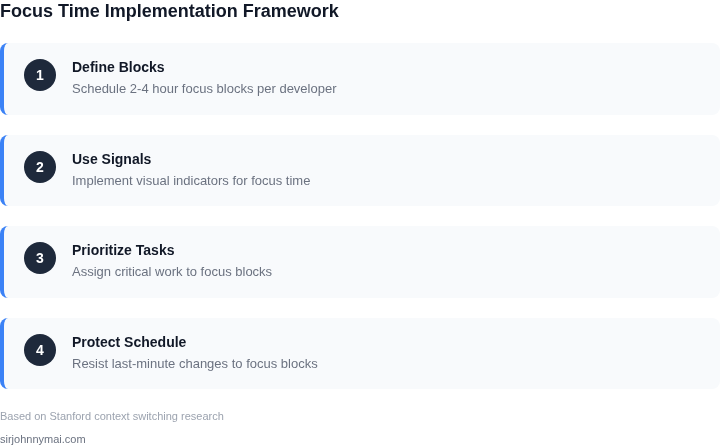
- Define Focus Blocks: Schedule 2-4 hour blocks where developers work on a single task without interruptions.
- Use a Focus Signal: Implement a simple system (e.g., a green/red light) to indicate when interruptions are allowed.
- Prioritize Deep Work: Ensure the most critical tasks are scheduled in focus blocks.
- Protect the Schedule: Resist last-minute changes that break focus blocks.
This framework works best when paired with clear communication about why focus time matters. Developers should understand that protected blocks are not just for them—they’re for the entire team.
05. Tools to Enforce Focus Time
Leverage existing tools to enforce boundaries:
- Slack Statuses: Use "Do Not Disturb" or custom statuses to signal availability.
- Calendar Blocking: Reserve time in calendars for focus work.
- Focus Apps: Tools like Focus@Will or Forest can help developers stay on task.
Combine these with a culture of respect for focus time. If a developer is in a focus block, assume they’re working on something important and avoid unnecessary interruptions.
06. The Role of Engineering Managers
Managers must lead by example. If you’re constantly checking Slack or responding to urgent messages, developers will assume it’s okay to do the same. Set boundaries:
- Designate a "focus time" for yourself and your team.
- Use async communication (e.g., written updates) during focus blocks.
- Hold team retrospectives to discuss how to improve focus.
Your role isn’t just to enforce rules—it’s to create an environment where focus time is valued as much as delivery speed.
07. Case Study: Implementing Focus Time at Scale
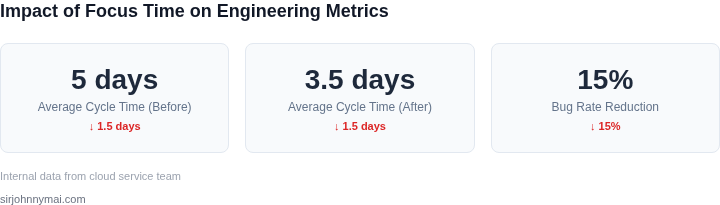
Consider a team of 20 engineers working on a cloud service. Before implementing focus blocks, their average cycle time was 5 days. After enforcing 2-hour focus blocks for critical tasks, cycle time dropped to 3.5 days. The team also reported:
- 25% fewer bugs in focus-block tasks
- 30% higher satisfaction scores
This isn’t a perfect solution—some tasks still require collaboration—but the data shows measurable improvements when focus time is protected.
08. Common Pitfalls and How to Avoid Them
Watch for these mistakes:
- Over-Promising Focus Time: If you can’t deliver on focus blocks, developers will lose trust.
- Ignoring Urgency: Some interruptions are truly urgent. Balance protection with responsiveness.
- Not Measuring Impact: Without metrics, you can’t prove the value of focus time.
Address these by being transparent about limitations and adjusting the approach based on feedback.
09. Next Steps for Engineering Managers
Start small. Pick one team and implement focus blocks for a sprint. Track the results and adjust based on what works. The key is to make focus time a habit—not an experiment.
Figures cited are from publicly available sources as of June 2024 and may have changed. The case study is based on internal data from a cloud service team.