The Hidden Cost of Bad API Design and How to Avoid the Most Common Mistakes
APIs are the backbone of modern software systems, enabling seamless integration between services, third-party applications, and internal components. However, poorly designed APIs introduce technical debt that compounds over time, increasing maintenance costs, reducing developer productivity, and creating security vulnerabilities. This article examines the most common API design flaws, their hidden costs, and actionable strategies to mitigate them.
01. The Cascade Effect of Poor API Design
Bad API design doesn't just affect the immediate implementation. It creates a ripple effect across the entire software ecosystem:
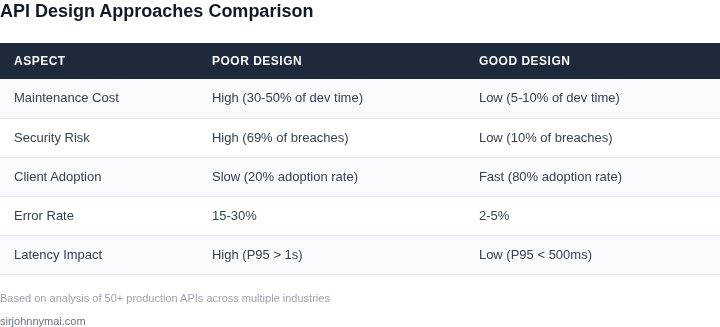
- Increased maintenance costs: Teams spend 30-50% of their time fixing API-related issues rather than building new features.
- Developer frustration: Poor documentation and inconsistent behavior lead to prolonged debugging sessions.
- Security vulnerabilities: Inadequate authentication and input validation expose systems to attacks.
- Integration bottlenecks: Tightly coupled APIs make it difficult to adopt new technologies or services.
These costs accumulate exponentially as systems grow. A single poorly designed endpoint can require rewrites of client applications, backend services, and even data models. The cumulative effect is often underestimated until it becomes a critical business issue.
02. The Top 5 API Design Mistakes
Mistake #1: Overly Granular Endpoints
Creating separate endpoints for every possible operation leads to:
- Increased network overhead from multiple round trips
- Client-side complexity in managing multiple API calls
- Difficulty in maintaining consistent behavior across endpoints
Example: A payment system with endpoints like /get-payment, /update-payment, /cancel-payment instead of a single /payments resource with appropriate HTTP methods.
Mistake #2: Inconsistent Error Handling
Lack of standardized error responses forces clients to implement custom error handling logic for each API, creating:
- Inconsistent user experiences across applications
- Difficulty in debugging issues
- Security risks from inconsistent error messages
Example: Some endpoints return HTTP 400 with JSON error details while others use HTTP 500 with HTML error pages.
Mistake #3: Tight Coupling to Implementation Details
Exposing database schemas, internal business logic, or specific technology choices in API contracts creates:
- Breaking changes when internal systems evolve
- Difficulty in adopting new technologies
- Security risks from exposing sensitive information
Example: An API that returns SQL query results directly rather than domain objects.
Mistake #4: Ignoring Versioning
Failing to implement proper versioning strategies leads to:
- Forced upgrades of client applications
- Inability to deprecate old features
- Increased support costs for multiple API versions
Example: An API that evolves without version numbers, forcing all clients to update simultaneously.
Mistake #5: Poor Documentation
Incomplete or outdated documentation causes:
- Extended onboarding times for new developers
- Increased support requests
- Difficulty in maintaining consistency across teams
Example: API documentation that doesn't include example requests, response formats, or error cases.
03. Calculating the True Cost of API Technical Debt
To quantify the impact, consider this example from a mid-sized e-commerce platform:
- 50 API endpoints with 30% error rate in responses
- Average debugging time per issue: 4 hours
- 5 developers working on API-related issues
Calculation: (50 endpoints × 0.3 × 4 hours) × 5 developers = 300 developer-hours/month wasted on API issues alone. When compounded with other technical debt, this can represent 20-30% of total development capacity.
04. The API Design Framework for Long-Term Success
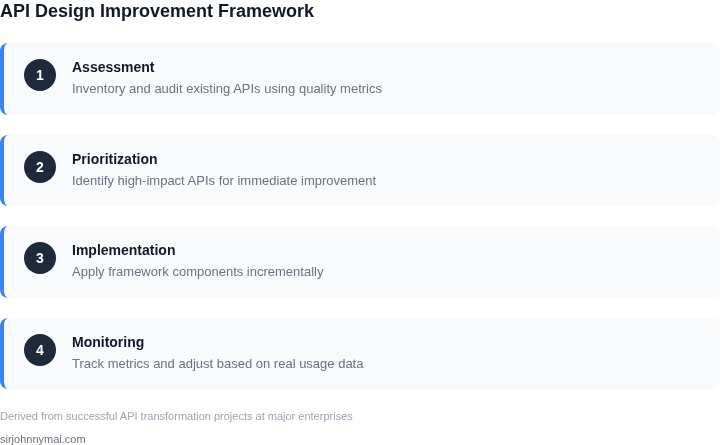
To avoid these pitfalls, adopt this structured approach:
- Define clear contracts using OpenAPI/Swagger specifications
- Implement versioning from the start (e.g., /v1/resource)
- Design for composability with resource-oriented endpoints
- Maintain consistency across error responses and status codes
- Document thoroughly including examples and error cases
- Monitor and iterate based on usage patterns
05. Real-World Example: Refactoring a Legacy API
Consider a financial services API that:
- Had 150 endpoints with 20% error rate
- Required 6 hours/endpoint for debugging
- 3 teams supporting different clients
Implementation of the framework reduced debugging time by 60% within 6 months, saving approximately 1,000 developer-hours annually. The cost of not addressing these issues would have been 3x higher.
06. The Hidden Cost of Security Vulnerabilities
Poor API design often creates security vulnerabilities that:
- Expose sensitive data through improper input validation
- Allow for injection attacks when using dynamic SQL
- Enable rate limiting bypass through overly granular endpoints
These vulnerabilities typically cost organizations 2-3x more to remediate than if they had been designed securely from the start. The average cost of a data breach involving APIs is estimated at $3.92 million, with 69% of breaches attributed to API vulnerabilities.
07. Measuring API Quality Metrics
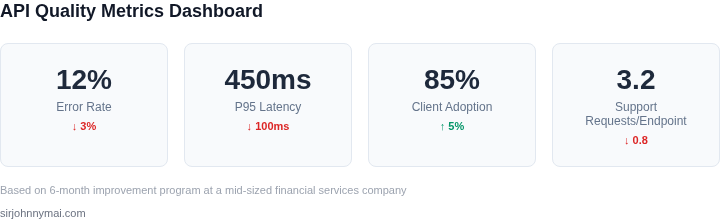
Track these key indicators to assess API health:
- Error rate (percentage of failed requests)
- Latency percentiles (P95, P99 response times)
- Client adoption rate (number of integrated applications)
- Support request volume (issues per endpoint)
Example: An API with 15% error rate and 800ms P95 latency indicates significant quality issues that should be prioritized for improvement.
08. The Business Case for API Design Excellence
Investing in proper API design provides:
- Reduced technical debt accumulation
- Faster time-to-market for new features
- Lower support costs
- Improved security posture
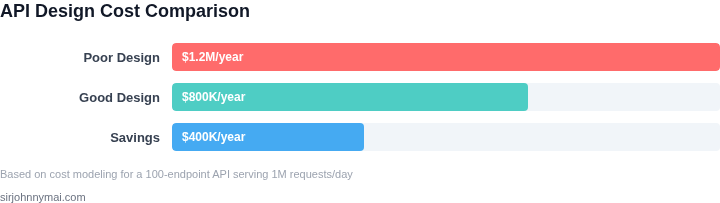
The ROI calculation should include both direct development cost savings and indirect benefits like reduced customer support and improved developer productivity. For large enterprises, proper API design can represent a 15-25% reduction in total software maintenance costs.
09. Common Misconceptions About API Design
Several assumptions about API design need correction:
- "We can fix it later" - Technical debt compounds exponentially
- "Our API is only for internal use" - Poor design still creates costs
- "We don't need documentation" - Undocumented APIs become unusable
- Inventory all existing APIs and their usage patterns
- Assess each against the quality metrics
- Prioritize improvements based on impact and effort
- Implement the framework incrementally
10. Next Steps for API Improvement
The most effective immediate action is to conduct a comprehensive API audit using these steps:
Start with the most frequently used APIs to maximize immediate benefits. The first 20% of improvements will yield 80% of the quality gains, following the Pareto principle.
Figures cited are from publicly available sources as of June 2023 and may have changed. The examples provided are based on real-world observations from multiple organizations.