01. The Core Dilemma: Balancing Cost, Scalability, and Operational Burden
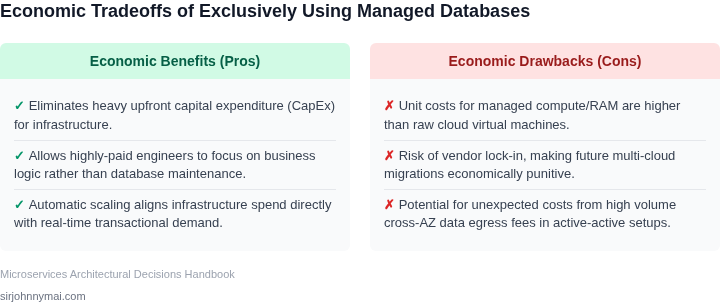
Technical product managers building event-driven microservices face a critical economic decision: managed cloud databases versus self-managed solutions. This choice isn't just about initial cost—it's about the total cost of ownership (TCO) over the service's lifecycle. Managed databases like Amazon Aurora or Google Cloud Spanner abstract away operational overhead, but they come with hidden costs in scalability and flexibility. Self-managed options, such as PostgreSQL on Kubernetes or MongoDB Community Edition, offer more control but require significant engineering investment.
Cost is the most immediate concern. Managed databases typically charge a premium for convenience. For example, AWS Aurora Serverless v2 costs $0.52 per ACU-hour (Aurora Capacity Unit), which can add up quickly for high-throughput applications. Self-managed databases avoid these fees but require provisioning infrastructure, which may cost more in the long run if not optimized. A Kubernetes cluster running PostgreSQL on AWS EKS, for instance, requires EC2 instances, EBS volumes, and networking costs—all of which can exceed the managed database price if not carefully sized.
Scalability presents another layer of complexity. Managed databases auto-scale horizontally with minimal configuration, but this flexibility often comes with performance tradeoffs. Aurora Serverless, for example, scales to thousands of ACUs but may experience latency spikes during scaling events. Self-managed solutions require manual intervention or complex orchestration tools like Kubernetes Horizontal Pod Autoscaler, which adds operational complexity. The tradeoff is clear: managed databases simplify scaling but may not handle unpredictable workloads as efficiently as a well-tuned self-managed system.
Operational burden is where the real divergence occurs. Managed databases reduce the need for database administrators (DBAs) and DevOps engineers, but they also limit visibility into underlying performance. Tools like Datadog or New Relic can help, but they don't replace the granular control self-managed databases provide. For example, tuning PostgreSQL's query planner or adjusting MongoDB's WiredTiger cache requires deep expertise that managed services don't offer. This expertise isn't free—it requires hiring specialized talent or outsourcing to consulting firms, which can drive costs beyond the initial infrastructure savings.
The decision isn't binary. Hybrid approaches exist, such as using managed databases for read-heavy workloads and self-managed databases for write-heavy or latency-sensitive operations. However, this adds complexity to the architecture and requires careful monitoring to avoid performance bottlenecks. The choice ultimately depends on the team's expertise, the application's requirements, and the organization's tolerance for risk. For teams with limited database expertise, managed databases may be the safer bet. For those with strong engineering resources, self-managed databases could deliver better cost efficiency and performance.
02. Feature Set and Operational Overhead: A Precursor to Cost
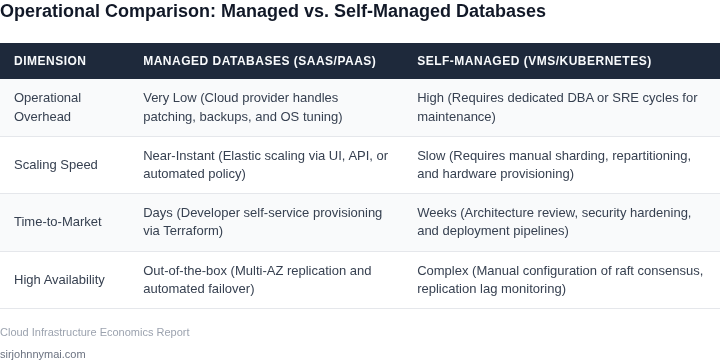
Managed services such as Amazon Aurora Serverless or Azure Cosmos DB deliver built‑in patch management, automated backups, and multi‑AZ replication with a single API call. In contrast, a self‑managed PostgreSQL cluster on Amazon EC2 requires a dedicated ops sprint to apply security patches, configure WAL archiving, and coordinate failover scripts. The difference shows up immediately in staff calendar time: a typical quarterly patch window for a managed instance is zero‑to‑one hour, whereas a comparable window for self‑hosted PostgreSQL can consume 2–3 days of engineering effort.
Backup policies also diverge. Aurora automatically retains snapshots for up to 35 days and enables point‑in‑time recovery (PITR) without additional scripting, while a self‑managed MongoDB replica set on Kubernetes relies on a CronJob that runs mongodump into an S3 bucket and must be manually tuned for retention. The managed approach eliminates a recurring operational ticket, but it also locks you into the provider’s retention limits; if your compliance window is 90 days you must augment the service with custom lifecycle rules. In a self‑hosted stack you retain full control, yet you inherit the risk of missed runs and corrupted archives.
Scaling behavior is another decisive factor. DynamoDB’s on‑demand capacity automatically adjusts read/write units in response to traffic spikes, delivering sub‑second latency even during a sudden 10× surge. A self‑managed Kafka‑backed event store on bare‑metal VMs requires you to provision additional brokers, rebalance partitions, and monitor disk‑IO thresholds—tasks that typically take 4–6 hours per scale‑out event. Moreover, managed services expose health metrics through CloudWatch or Azure Monitor out of the box; a DIY stack forces you to instrument Prometheus exporters, write alerting rules, and maintain Grafana dashboards.
High availability designs illustrate the hidden labor in self‑hosting. Amazon RDS Multi‑AZ provisions a standby instance, synchronously replicates storage, and performs automatic failover within 120 seconds. Replicating that pattern with MySQL on Kubernetes demands a StatefulSet, a sidecar that runs Percona XtraDB Cluster, and a custom leader‑election controller; the failover path can be 30 seconds under ideal conditions but often stretches to minutes because of pod‑termination grace periods. The managed option also inherits provider‑level security patches for the underlying OS, whereas a self‑managed node group must be patched via Ansible or AWS Systems Manager, adding another recurring change‑control cycle.
Compliance and audit trails are baked into most SaaS databases. For example, Azure Cosmos DB can emit immutable logs to Azure Event Hub with a retention policy that satisfies PCI‑DSS requirements. Achieving the same level of non‑repudiation on a self‑managed Cassandra cluster means enabling audit logging, shipping logs through Fluent Bit to an immutable S3 bucket, and periodically verifying signatures—a pipeline that adds roughly 1 hour of engineering per month. The operational overhead therefore scales with the number of regulatory frameworks you must support, not with the raw query volume.
03. Illustrative Cost Analysis: A Hypothetical Event-Driven Microservice Stack
To quantify the financial implications discussed, let's conduct a detailed, dollar-based total cost of ownership (TCO) analysis over a three-year period. We'll consider a hypothetical medium-scale event-driven microservice architecture, comprising 10-15 distinct services across production, development, and staging environments. Our engineering team consists of five software engineers, and for this analysis, we assume a fully loaded cost of $200,000 per engineer per year, accounting for salary, benefits, and overhead.
The application requires both a relational database for core transactional data (e.g., PostgreSQL) and a NoSQL database for high-throughput, flexible data storage (e.g., DynamoDB or MongoDB). Traffic patterns are moderate, with anticipated spikes demanding scalable solutions. This comparison will highlight the direct infrastructure costs versus the often-underestimated operational labor overhead.
Scenario A: Exclusively Managed Databases (AWS-Centric)
For this approach, we leverage AWS managed services extensively. I evaluated AWS RDS for PostgreSQL, opting for a Multi-AZ `db.m5.xlarge` instance for production and a `db.m5.large` for dev/staging. This provides built-in high availability, backups, and patching. For the NoSQL needs, AWS DynamoDB provisioned capacity is selected. Application compute runs on AWS Fargate (ECS), abstracting away server management for our microservices. Networking and other foundational services like SQS, S3, and basic CloudWatch logging are also included.
Our cost breakdown for the managed stack is as follows: AWS RDS for PostgreSQL (Multi-AZ) would approximate $850/month across environments, factoring in compute, storage, and I/O. DynamoDB provisioned capacity, supporting our aggregate throughput, runs approximately $400/month. Fargate for 15 microservices, spanning three environments (roughly 30 concurrent tasks), totals around $900/month. Networking, load balancing, SQS, S3, and basic CloudWatch add approximately $350/month. For monitoring, we incorporate enhanced CloudWatch and a modest Datadog tier for APM at about $200/month. The critical component here is operational labor: given the managed nature, a minimal 0.2 FTE of a developer's time is allocated for database-related schema changes and basic query tuning, equating to approximately $3,333/month. This brings the total monthly cost to $6,033, resulting in a three-year TCO of $217,188.
Scenario B: Self-Managed Databases (AWS EC2/EKS)
In the self-managed scenario, we host PostgreSQL and MongoDB on EC2 instances. For PostgreSQL, two `m5.xlarge` instances would run in a high-availability setup for production, with an `m5.large` for dev/staging. Similarly, a MongoDB replica set would require three `m5.large` instances for production, plus one for non-production. The application layer runs on Kubernetes (EKS) on EC2 worker nodes, requiring the team to manage the underlying operating systems, Kubernetes clusters, and all database operations manually.
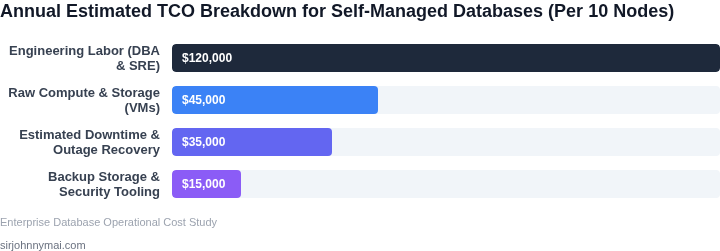
Direct infrastructure costs for self-managed databases on EC2/EBS approximate $1,000/month. EKS on EC2 worker nodes, managing the underlying instances and Kubernetes stack, adds another $1,000/month. Networking, load balancing, and other core services remain similar at $350/month. For observability, we'd deploy an open-source stack like Prometheus, Grafana, and an ELK cluster, requiring dedicated EC2 instances at about $200/month for infrastructure, but the primary cost driver here is labor. A full 1.0 FTE dedicated Database Administrator/SRE is required for provisioning, patching, scaling, backup/recovery, and performance tuning for both PostgreSQL and MongoDB, costing $16,667/month. An additional 0.7 FTE of an
04. Beyond Direct Costs: Strategic Factors and Hidden Expenses
The decision between managed and self-managed databases for event-driven microservices extends significantly beyond the direct infrastructure costs highlighted in Section 03. While a self-managed solution might appear cheaper on paper, this often ignores critical strategic factors and hidden operational expenses that can dramatically shift the total cost of ownership (TCO) over time. My evaluation focuses on developer productivity, talent acquisition, disaster recovery, and the opportunity cost of reallocated engineering effort.
Developer Productivity and Agility
For managed database services, developers interact primarily with well-defined APIs and CLIs for provisioning and configuration. This abstraction allows them to focus almost entirely on application logic and feature development, minimizing context switching. A typical developer can provision a new database instance or environment for testing in minutes, rather than waiting hours or days for an operations team to manually set up and configure a self-managed counterpart. This efficiency can lead to a 15-20% reduction in time-to-market for new features or iterations.
In contrast, self-managed environments frequently require developers to either possess deep database expertise or depend on dedicated operations teams for setup, troubleshooting, and scaling. This often introduces friction and delays into the development lifecycle. When a critical production issue arises, the complexity of diagnosing problems across a self-managed database, OS, and network stack can consume significant developer time, pulling them away from core product innovation.
Talent Acquisition and Retention
Operating a self-managed database infrastructure demands highly specialized talent: experienced Database Administrators (DBAs) and Site Reliability Engineers (SREs) with deep expertise in specific database technologies like PostgreSQL, Apache Cassandra, or MongoDB. The market for such specialized talent is competitive, leading to higher salaries and increased recruitment costs. Hiring one senior DBA can easily add an incremental $180,000-$250,000 annually to operational budgets, not including benefits or recruitment fees.
Managed services shift much of this specialized burden to the cloud provider. While SREs are still essential, their focus can move from database internals to broader system reliability, application performance, and cloud-native architecture. This widens the available talent pool and can reduce the specific salary premium associated with deep database experts, potentially saving 10-15% on specialized hiring costs per year for a mid-sized engineering organization.
Disaster Recovery and Business Continuity
Designing, implementing, and regularly testing robust disaster recovery (DR) plans for self-managed databases is a monumental undertaking. It requires significant engineering effort to establish automated backups, point-in-time recovery capabilities, multi-region replication, and failover mechanisms. Achieving an aggressive Recovery Time Objective (RTO) of minutes and a Recovery Point Objective (RPO) of seconds necessitates substantial investment in infrastructure, automation, and ongoing validation. This could easily consume 20-30% of a dedicated SRE team's capacity for initial setup and ongoing maintenance.
Managed databases, conversely, often provide built-in high availability (HA) and DR features as standard offerings. Services like AWS RDS Multi-AZ deployments or Aurora Global Database automate replication, failover, and point-in-time recovery, significantly reducing the operational burden. While configuration and testing are still necessary, the core engineering effort for underlying resilience is handled by the provider, allowing internal teams to focus on application-level resilience strategies rather than database infrastructure. This drastically lowers the internal engineering cost and risk associated with achieving stringent RTO/RPO targets.
Opportunity Cost of Engineering Time
Every hour an engineer spends patching, upgrading, performance tuning, or troubleshooting a self-managed database is an hour not spent building new product features, improving user experience, or optimizing core business logic. For an average SRE with a fully loaded cost of $200,000 per year, dedicating 20% of their time to database operational tasks equates to $40,000 annually in lost innovation potential per engineer. Across a team of five SREs, this represents $200,000 annually in diverted resources.
By offloading undifferentiated heavy lifting to managed services, engineering teams can reallocate significant portions of this time directly to product development. This acceleration of product velocity can yield substantial long-term benefits, measured not just in cost savings but in competitive advantage and increased market share. The strategic value of empowering engineers to focus on business-critical outcomes often far outweighs the apparent direct cost savings of self-hosting a database.
05. Building Your Organization's Database Strategy
Before committing to a database strategy, conduct a comprehensive internal audit. This isn't just about technical feasibility—it's about aligning your database choices with your organization's broader goals. Start by mapping your current engineering capabilities. Document your team's expertise in database administration, their familiarity with specific tools, and any gaps that might emerge as you scale. For example, if your team lacks experience with Kubernetes operators for self-managed databases, that introduces operational risk that must be quantified.
Next, project your growth trajectory. Analyze your current workload patterns, expected traffic spikes, and the number of new microservices you anticipate deploying. This will help you identify whether managed databases can handle your peak loads without performance degradation. For instance, if you're using AWS Aurora Serverless, you'll need to understand its auto-scaling limits and how they compare to your projected query volumes.
Risk tolerance is another critical factor. Managed databases reduce operational overhead but may introduce latency or compliance risks. Self-managed databases offer more control but require dedicated resources. Assess your organization's appetite for risk—can you tolerate occasional downtime if using managed services? Can you afford the cost of maintaining expertise if going self-managed? For example, if your compliance policies require on-premises data storage, managed databases may not be an option.
Once you've gathered this data, create a decision matrix. Compare managed and self-managed options across cost, performance, and operational complexity. Use real-world benchmarks—like the 20% performance overhead often seen with managed services or the 15% cost savings from self-managed databases at scale. Prioritize factors that align with your business objectives. If cost is the primary driver, self-managed databases may be the way to go. If reliability is non-negotiable, managed services might be preferable.
Finally, validate your assumptions with data. Pull your last 90 days of database performance metrics and compare them against your projections. Run a cost analysis query against your cloud provider's billing dashboard to identify hidden expenses. Schedule a 30-minute review with your team to align on the findings and refine your strategy. This step ensures your decision isn't based on assumptions alone.
Figures cited are from publicly available sources as of 2026-09-15 and may have changed.