01. The Problem and What It Costs
Modern application architectures increasingly rely on stateful services for data persistence, messaging, and caching. Ensuring high availability, consistency, and durability for these services – databases, message queues, and key-value stores – is paramount for production systems. The complexity scales significantly when considering distributed deployments, especially in multi-cloud environments or when leveraging self-managed open-source platforms. Our primary challenge is to navigate these architectural choices while optimizing for both operational stability and economic efficiency.
The allure of multi-cloud for stateful services stems from perceived benefits like enhanced resilience, geopolitical distribution, and avoiding vendor lock-in. However, the reality introduces substantial direct and indirect costs. When operating a relational database like PostgreSQL or a message queue like Apache Kafka across AWS, Azure, or Google Cloud, each cloud provider bills for compute, storage, IOPS, and network separately. Critically, data egress between cloud providers can be costly, with charges ranging from $0.02 to $0.09 per GB, which accumulates rapidly for data replication or backup strategies involving large datasets.
Beyond direct infrastructure charges, multi-cloud operations introduce significant hidden costs. Managing different vendor APIs, varying service capabilities (e.g., AWS DynamoDB versus Azure Cosmos DB), and disparate monitoring stacks (CloudWatch, Azure Monitor, Google Cloud Monitoring, or integrating Datadog across all) demands specialized expertise. This requires engineering teams to develop proficiency across multiple platforms, increasing training budgets and staffing costs. Attracting and retaining talent with multi-cloud skills can add 15-25% to a developer's total compensation compared to single-cloud specialists, directly impacting the Total Cost of Ownership (TCO).
Alternatively, many organizations consider open-source platforms as a cost-effective solution, especially for stateful services. Projects like PostgreSQL, Apache Kafka, Redis, and Cassandra offer granular control and perceived freedom from vendor-specific pricing models. The initial infrastructure cost might appear lower, as organizations pay for underlying compute instances (e.g., Amazon EC2) and storage rather than a bundled managed service. This approach promises greater portability and avoidance of direct managed service fees.
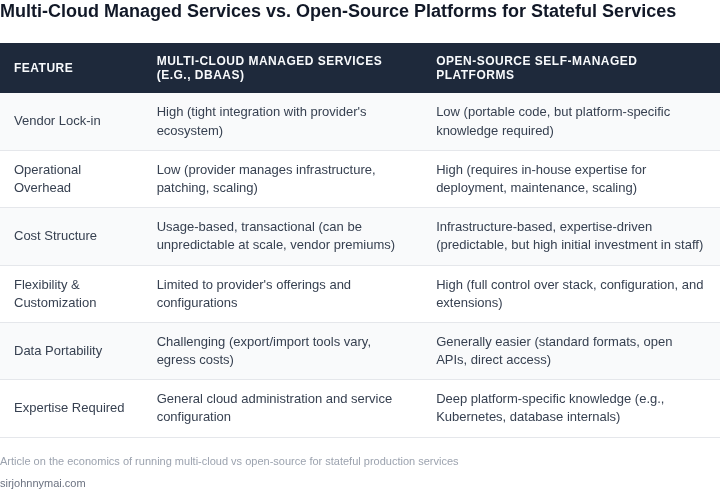
However, the "free" aspect of open-source dissolves when considering the operational burden for production-grade stateful services. Self-managing these platforms demands substantial engineering effort for deployment, scaling, patching, backups, disaster recovery, high availability, and performance tuning. This necessitates a dedicated, highly skilled team. For a critical production Apache Kafka cluster, for instance, the annual salaries and benefits for the necessary senior engineers and site reliability engineers could easily represent an operational expenditure of $500,000 to $1M, depending on the system's complexity and scale. These human capital costs are often overlooked in initial budget forecasts.
Our core dilemma is balancing the convenience and predictable operational costs of managed cloud services against the granular control and potential for lower direct infrastructure billing offered by self-managed open-source solutions. Managed services shift a significant portion of capital expenditure (CAPEX) to operational expenditure (OPEX), providing scalability and built-in resilience but at potentially higher unit costs. Conversely, self-managed open-source solutions trade higher ongoing human capital investment for direct infrastructure cost control. The choice profoundly impacts our engineering velocity, operational stability, and capacity to innovate on core product features.
02. How Most Teams Get It Wrong
Most teams embark on cloud strategies, especially concerning stateful production services, with a set of common misconceptions that ultimately lead to increased costs and reduced agility. The initial allure of "free" open-source software or the promise of multi-cloud vendor independence often obscures the true total cost of ownership (TCO) and operational complexities.
Underestimating Operational Overhead of Self-Managed Open Source
A prevalent mistake is underestimating the ongoing operational burden of self-managing open-source stateful platforms. Teams often fixate on the absence of per-hour licensing fees for technologies like Apache Cassandra, Kafka, or PostgreSQL. They overlook the significant investment required for highly available, scalable, and secure production deployments. This includes architecting for high availability using tooling like etcd and Kubernetes operators, managing complex upgrades, implementing robust backup and restore procedures, and building comprehensive monitoring stacks with tools like Prometheus and Grafana.
For instance, while Kubernetes offers orchestration capabilities, deploying and maintaining a production-grade PostgreSQL cluster on top of it, complete with replication, failover, and point-in-time recovery, demands specialized database administrators and SREs. This expertise is expensive and scarce. I've seen teams realize a 20-30% increase in staffing costs solely to manage these self-hosted stateful services compared to leveraging managed offerings like Amazon RDS or Azure Database for PostgreSQL, which abstract away much of this undifferentiated heavy lifting.
Chasing Illusory Multi-Cloud Portability for Data
Another common misstep is the pursuit of "multi-cloud portability" for stateful services as a primary goal. The belief is that abstracting infrastructure prevents vendor lock-in and offers ultimate flexibility. However, for significant stateful workloads, true portability remains largely an illusion, especially when considering data integrity and consistency across disparate environments. Attempting to replicate large-scale stateful datasets (e.g., multiple terabytes) synchronously or asynchronously across different cloud providers introduces immense networking latency, data egress costs, and complex consistency challenges.
This approach often forces teams into a "lowest common denominator" architecture, foregoing the advanced features and performance optimizations inherent to specific cloud-native services. For example, trying to achieve the high performance and durability of AWS Aurora with a self-managed open-source database replicated across Google Cloud and Azure often results in a less performant, more complex, and more expensive solution overall, without realizing the anticipated benefits of vendor independence.
Neglecting Hidden Costs: Data Egress and Latency
Many teams overlook the substantial hidden costs associated with moving data between clouds or even between regions within a single cloud provider. Data egress fees can become a significant budget line item when replicating databases, streaming logs, or transferring large datasets for analytics or disaster recovery purposes. For example, moving petabytes of data out of a cloud provider can incur costs ranging from tens of thousands to hundreds of thousands of dollars per month, depending on the volume and destination.
Beyond direct costs, network latency between geographically dispersed cloud regions or different cloud providers critically impacts the performance and consistency of distributed stateful services. High latency can degrade user experience, complicate distributed transactions, and make real-time data synchronization impractical, leading to either eventual consistency models that don't fit all use cases or compromised performance.
Overlooking Security and Compliance Burden
Finally, teams often underestimate the security and compliance overhead of self-managing open-source stateful services. Cloud providers handle a vast array of security and compliance certifications (e.g., ISO 27001, SOC 2, HIPAA, GDPR) for their managed services, covering the underlying infrastructure and often the service itself. When teams opt to self-host, they assume full responsibility for patching operating systems, securing database instances, managing access controls, implementing encryption at rest and in transit, and demonstrating compliance through audits.
This increased burden translates to additional engineering hours, specialized security expertise, and potential regulatory risks if not executed perfectly. For a regulated industry, the cost of proving compliance for a self-managed database can be orders of magnitude higher than leveraging a cloud provider's pre-certified managed offering, which reduces the scope of a customer's audit significantly.
03. A Worked Example from Production
Consider a mid-sized product team, comprising six senior software engineers and two mid-level engineers, tasked with building a new real-time analytics service at Amazon. This service requires significant stateful components: a persistent message queue, a transactional relational database, and a high-throughput key-value store. The team operates with a fully-loaded annual engineering cost of approximately $300,000 per senior engineer and $200,000 per mid-level engineer, totaling $2.2 million annually for salaries alone.
We evaluated two primary architectural alternatives for this team, focusing on the first three years of operation, including initial setup and ongoing maintenance. Both scenarios assume underlying compute infrastructure on AWS.
Alternative 1: Managed Services in a Single Cloud (AWS)
This approach leverages AWS's fully managed services for all stateful components: Amazon MSK for the message queue, Amazon RDS for PostgreSQL, and Amazon DynamoDB for the key-value store. The application team focuses purely on business logic. Initial setup involves configuring these services, which is straightforward.
- Engineering Effort: The initial configuration and integration required approximately 0.5 FTE for two months, followed by an ongoing operational overhead of roughly 0.2 FTE annually for monitoring and incident response. This includes creating CloudWatch alarms, setting up dashboards in Datadog, and defining runbooks.
- Infrastructure & Managed Service Costs: Based on projected moderate production load (e.g., millions of messages/transactions daily), we estimated an average infrastructure cost of $35,000 per month. This includes MSK, RDS, DynamoDB, supporting EC2 instances for stateless services, networking, storage, and initial data migration.
- Monitoring & Tooling: Shared Datadog licenses and standard AWS monitoring features are utilized, averaging $2,000 per month for this specific service's slice of costs.
Alternative 2: Self-Managed Open-Source on Kubernetes (AWS EKS)
This strategy involves deploying open-source equivalents directly onto an Amazon EKS cluster. We considered Apache Kafka (with Strimzi operator), PostgreSQL (with CloudNativePG operator), and Redis on Kubernetes. This necessitates a significant platform engineering investment to build and maintain the underlying data plane.
- Engineering Effort: Initial setup required significant specialized expertise. We allocated 2 FTEs (senior SDEs) for six months for design, deployment, hardening, and integrating operators. This encompassed creating custom Kubernetes manifests, setting up persistent storage, configuring network policies, and establishing robust backup/restore procedures. Ongoing operational overhead was estimated at 1.5 FTE annually, requiring dedicated platform engineers to manage upgrades, troubleshoot complex issues, and optimize resource usage.
- Infrastructure Costs: While direct compute, storage, and networking (EC2, EBS, EKS cluster fees) might appear lower initially, the total cost difference was not dramatic at this scale. We estimated $25,000 per month, considering optimized resource utilization but also factoring in overhead for managing multiple worker nodes and persistent volumes across availability zones.
- Monitoring & Tooling: Utilizing open-source tools like Prometheus and Grafana for core metrics, with Datadog for broader aggregation and alerts, averaged $1,000 per month. However, the labor to integrate and maintain these open-source monitoring stacks was significant, often consuming part of the 1.5 FTE operational overhead.
Cost Comparison and Tradeoffs
The following table summarizes the estimated annual costs, excluding the initial team salary of $2.2 million which is constant across both scenarios.
| Cost Category | Alternative 1: Managed Services (Annual Cost) | Alternative 2: Self-Managed Open Source (Annual Cost) |
|---|---|---|
| Engineering Labor (Platform/Operations) | ($300k * 0.5 FTE * 0.5 yrs) + ($300k * 0.2 FTE * 2.5 yrs) = $225,000 | ($300k * 2 FTE * 0.5 yrs) + ($300k * 1.5 FTE * 2.5 yrs) = $1,425,000 |
| Infrastructure & Managed Service Fees | $35,000/month * 12 months * 3 years = $1,260,000 | $25,000/month * 12 months * 3 years = $900,000 |
| Monitoring & Tooling | $2,000/month * 12 months * 3 years = $72,000 | $1,000/month * 12 months * 3 years = $36,000 |
| Total Estimated 3-Year Cost | $1,557,000 | $2,361,000 |
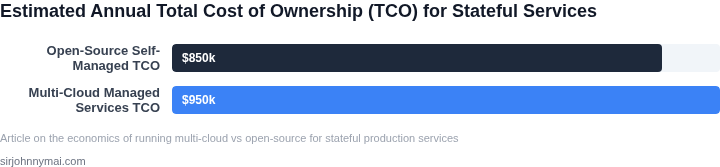
This analysis highlights that while raw infrastructure costs might be lower with self-managed open source, the overwhelming factor for a high-performing engineering organization is labor. Alternative 2 incurs an additional $804,000 over three years, primarily due to the specialized engineering talent required for platform setup and ongoing operations. This works when the scale and unique requirements truly justify the custom platform, offering strategic differentiation or extreme cost savings at massive scale. However, for a typical product team, the initial and ongoing operational burden of self-managing critical stateful services far outweighs the direct infrastructure cost premium of managed services. This comparison underscores why teams often default to managed solutions, despite the perceived vendor lock-in.
04. Decision Framework
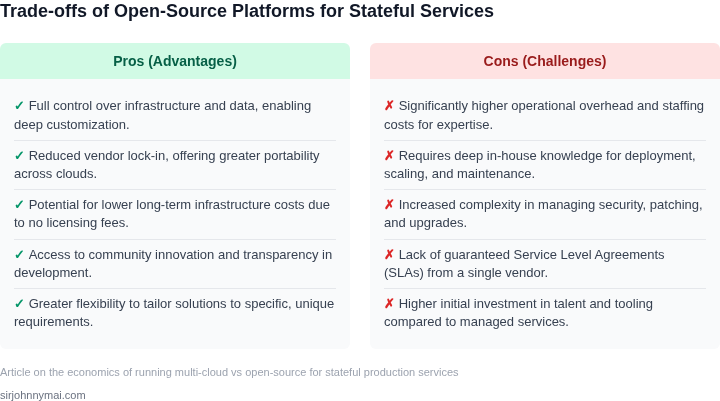
To make a defensible architectural choice for our stateful production services, we must look beyond direct compute and storage costs. I evaluated these three distinct deployment patterns because they represent the actual trade-offs our engineering teams encounter when scaling database engines. Each pattern shifts the financial burden between direct cloud vendor spend and internal engineering payroll.
Running stateful engines like PostgreSQL on Kubernetes via operators (Option B) looks highly attractive on paper because it eliminates proprietary database licensing fees. However, this self-managed model breaks down if our platform engineering team spends more than 15% of their weekly cycles on disk provisioning, stateful set replication, and backup validation. Conversely, relying on proprietary multi-cloud APIs like AWS Aurora or Google Cloud Spanner (Option A) delivers immediate high availability but exposes us to volatile cross-region data egress charges and premium cloud storage markups.
| Criteria | Multi-Cloud Managed (e.g., AWS Aurora, Google Cloud Spanner) | Self-Managed K8s (e.g., PostgreSQL on Amazon EKS) | Managed SaaS (e.g., MongoDB Atlas, CockroachDB Dedicated) |
|---|---|---|---|
| Operational Overhead | Minimal. Cloud providers handle replication, automated patching, and physical hardware provisioning. | High. Requires dedicated platform SREs to manage stateful operators and persistent volumes. | Low. Shared responsibility model backed by dedicated enterprise vendor support. |
| Egress & Networking Costs | High. Premium fees applied to cross-cloud data replication and inter-region traffic. | Medium. Controllable via custom Kubernetes network policies and optimized node affinity. | Medium. Packaged into the subscription cost but subject to underlying cloud provider markups. |
| Vendor Lock-In | High. Proprietary APIs and storage layers lock workloads to specific hyperscalers. | Zero. Workloads remain fully portable across any CNCF-compliant Kubernetes distribution. | Medium. Workload is tied to the SaaS platform, but data is highly portable. |
| Day-2 Operations | Automated. Point-in-time recovery, horizontal read scaling, and minor upgrades are fully automated. | Manual. Requires engineering teams to build, test, and maintain backup validation pipelines
05. Your Next StepThe decision framework outlined in Section 04 provides a structured approach, but its efficacy hinges on accurate, granular data. Many organizations struggle to quantify the true operational cost of their stateful services, frequently underestimating the human capital investment required for self-managed, open-source solutions compared to managed cloud services. My recommendation focuses on establishing a clear financial baseline for a representative service. I advocate for a deep dive into the Total Cost of Ownership (TCO) for one critical, stateful production service. This isn't just about infrastructure spend; it encompasses the full spectrum of resources consumed. The complexity of stateful services means infrastructure costs often represent only a fraction of the actual TCO, with significant expenses hidden in engineering hours for maintenance, troubleshooting, and compliance. Consider a core stateful service — perhaps a Kafka cluster, a Cassandra database, or a high-traffic Redis instance. This service should be representative of the types of stateful workloads your teams typically manage, ideally one that has seen recent incidents or significant operational overhead. The objective is to build a realistic TCO profile over a recent, stable period, such as the last 90 days. To capture the true TCO, you will need to aggregate data from several sources. First, pull the direct infrastructure costs from your cloud provider's billing dashboard (e.g., AWS Cost Explorer, Azure Cost Management). This includes compute, storage, networking, data transfer, and any related managed service fees. Second, identify and quantify engineering hours. This is often the most challenging part. Query your issue tracking system (e.g., Jira) for tickets related to this service for maintenance, upgrades, incident response, and performance tuning. Supplement this with on-call rotation data from systems like PagerDuty or Opsgenie, and estimates from team leads on planned operational work. Third, include the cost of associated tooling such as monitoring (e.g., Datadog, Prometheus licensing/hosting), logging (e.g., Splunk, ELK stack management), and security solutions. Once collected, categorize these costs into buckets: infrastructure, direct engineering operational burden, and third-party tooling. Calculate the average monthly cost for each bucket and the overall TCO for this specific service. This detailed breakdown will illuminate the hidden costs of operationalizing and maintaining a stateful service, providing an undeniable data point against which to compare potential alternatives, whether that's migrating to a fully managed cloud service or continuing with an open-source platform under a different operational model. Pull your last 90 days of operational and infrastructure costs for your most critical, self-managed Kafka cluster (or equivalent stateful service) and calculate its average monthly Total Cost of Ownership, distinguishing between direct cloud infrastructure spend, engineering operational hours, and third-party tooling expenses. Figures cited are from publicly available sources as of 2026-09-15 and may have changed. |