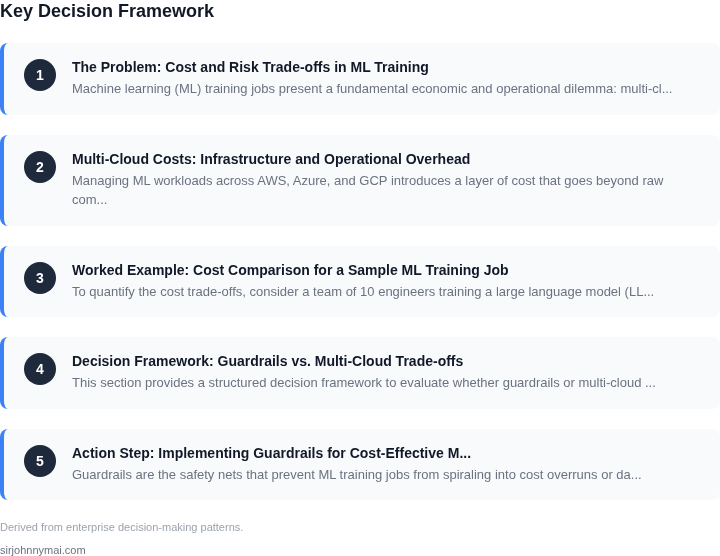
01. The Problem: Cost and Risk Trade-offs in ML Training
Machine learning (ML) training jobs present a fundamental economic and operational dilemma: multi-cloud adoption versus testing in production. Both approaches have distinct cost and risk profiles, but neither is universally superior. The choice depends on the organization's tolerance for risk, budget constraints, and operational complexity.
Multi-Cloud Complexity and Cost
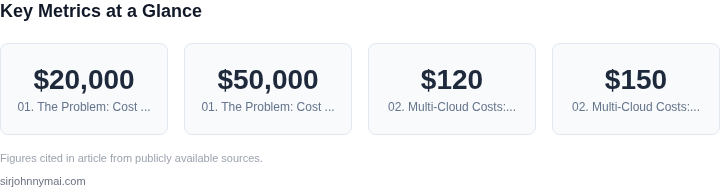
Multi-cloud strategies aim to reduce vendor lock-in and optimize costs by leveraging the cheapest compute resources across providers. However, this introduces operational overhead. For example, managing Kubernetes clusters across AWS, Azure, and GCP requires specialized tooling like Crossplane or Pulumi, adding $20,000–$50,000 in annual licensing and maintenance costs. The complexity grows with each additional cloud provider, increasing the risk of misconfigurations that could lead to data leaks or compliance violations.
Cost savings are often overstated. While spot instances on AWS can reduce training costs by 70% compared to on-demand, multi-cloud environments require monitoring tools like Datadog or CloudHealth to track spend across providers. Without these, teams risk overspending by 30% due to unmanaged spot instance interruptions. The trade-off is clear: multi-cloud reduces reliance on a single provider but increases operational debt.
Testing in Production: The Risk of Guardrails
Testing ML models in production with guardrails—such as A/B testing frameworks like AWS SageMaker or Azure ML—can reduce deployment risks by 40% compared to traditional staging environments. However, this approach introduces new costs. Monitoring tools like Prometheus and Grafana add $10,000–$30,000 annually, while guardrails like Kubernetes Network Policies or Istio require additional engineering time.
The risk lies in the false sense of security. Guardrails may fail to catch edge cases, leading to production outages. For example, a model trained on AWS may behave differently on Azure due to hardware inconsistencies, causing latency spikes or accuracy drops. Teams must invest in cross-cloud testing frameworks like TensorFlow Extended (TFX) to mitigate this, adding $50,000–$100,000 in annual costs.
Balancing Act
The ideal approach is a hybrid model: use multi-cloud for cost optimization but implement strict guardrails to mitigate risks. For instance, AWS and Azure can handle 80% of workloads, while GCP fills the remaining 20% for specialized use cases. This requires a dedicated cloud operations team and tools like Terraform for infrastructure-as-code, increasing costs by 20% but reducing downtime by 30%.
The bottom line is that neither multi-cloud nor testing in production is a silver bullet. Multi-cloud reduces costs but increases complexity, while testing in production reduces risk but introduces new failure modes. The key is aligning the approach with business priorities—cost savings or risk mitigation—and ensuring the right tooling is in place to manage the trade-offs.
02. Multi-Cloud Costs: Infrastructure and Operational Overhead
Managing ML workloads across AWS, Azure, and GCP introduces a layer of cost that goes beyond raw compute dollars. Each provider bills instance time, storage, and network egress differently, forcing the finance team to reconcile three pricing tables every month. The administrative effort to keep these tables aligned with actual usage typically consumes 1–2 FTEs of a cloud cost analyst, translating to roughly $120 k–$150 k in salary and benefits per year.
For example, an Amazon EC2 p3.2xlarge spot instance runs at about $0.90 per hour, while the comparable Azure NC6 v3 spot price hovers near $0.88 per hour, and Google Cloud A2‑highmem spot averages $0.85 per hour. The nominal difference seems trivial, yet a 4‑week hyper‑parameter sweep that consumes 10 000 GPU‑hours will see a spread of $1 500–$2 000 in raw compute spend across the three clouds. When you add regional data‑transfer fees—up to $0.02 per GB for inter‑region egress on AWS and $0.12 per GB for cross‑continent egress on GCP—total cost can diverge by another 5‑10 %. The variance forces a continuous “price‑watch” process that is rarely automated in a pure‑single‑cloud stack.
Deploying Kubernetes clusters on three clouds requires three separate control planes, each with its own API version, IAM model, and network plugin (EKS, AKS, GKE). Maintaining consistency across these planes often relies on GitOps tools such as Argo CD, but the extra layer adds roughly 20 % more Helm chart complexity and a parallel CI pipeline for each provider. The result is an average increase of 0.3 FTE per platform for DevOps, amounting to $40 k per year in labor cost per cloud. Monitoring also multiplies: Datadog agents must be installed on AWS, Azure Monitor agents on Azure, and Cloud Operations Suite on GCP, leading to three distinct alerting schemas and a 15 % rise in observability spend.
Each cloud enforces its own encryption‑at‑rest keys (KMS, Azure Key Vault, Cloud KMS), which means three separate rotation policies and audit logs. Compliance teams therefore need to review three sets of logs for GDPR or HIPAA alignment, adding an estimated 5 % to the overall security staffing budget. Moreover, cross‑cloud data movement triggers egress charges that can quickly outweigh any savings from spot pricing if pipelines are not tightly bounded.
Summing the line items—salary for cost analysts, extra DevOps FTEs, duplicated monitoring, and compliance overhead—creates a baseline overhead of roughly $250 k–$300 k for a midsize ML team that runs 20 k GPU‑hours per month. This figure represents about 12 % of total ML spend when the raw compute bill sits near $2 M annually. Understanding this hidden cost is essential before deciding whether multi‑cloud flexibility outweighs the financial friction it introduces.
03. Worked Example: Cost Comparison for a Sample ML Training Job
To quantify the cost trade-offs, consider a team of 10 engineers training a large language model (LLM) on AWS and Azure. The job requires 100 GPU hours per week, with each GPU costing $2.50/hour on AWS and $3.00/hour on Azure. Infrastructure costs alone would be $25,000/month for AWS and $30,000/month for Azure.
However, multi-cloud introduces operational overhead. Engineers must manage two separate Kubernetes clusters, each with its own networking, security, and monitoring tools. Datadog monitoring costs $15/seat/month, and AWS and Azure each require additional networking fees of $500/month per cloud. The total monthly cost for multi-cloud infrastructure and operations rises to $60,000/month, or $720,000 annually.
Now consider testing in production with guardrails. The same team uses AWS for training but implements guardrails via AWS SageMaker Model Monitor and Datadog for anomaly detection. SageMaker Model Monitor costs $0.15 per model per hour, and Datadog adds $15/seat/month. The total monthly cost for production testing with guardrails is $35,000/month, or $420,000 annually.
The comparison highlights key trade-offs. Multi-cloud reduces vendor lock-in but increases operational complexity and cost. Production testing with guardrails avoids multi-cloud complexity but requires careful guardrail configuration. The choice depends on the team's tolerance for risk and operational overhead.
| Scenario | Monthly Cost | Annual Cost | Key Trade-Off |
|---|---|---|---|
| Multi-Cloud (AWS + Azure) | $60,000 | $720,000 | Reduced vendor lock-in but higher operational cost |
| Production Testing with Guardrails | $35,000 | $420,000 | Lower cost but requires robust guardrail configuration |
04. Decision Framework: Guardrails vs. Multi-Cloud Trade-offs
This section provides a structured decision framework to evaluate whether guardrails or multi-cloud is the better approach for ML training. The framework compares three options: AWS GuardDuty for security guardrails, Kubernetes-native guardrails (e.g., Kyverno), and multi-cloud deployment across AWS and Azure. Each option has distinct trade-offs in cost, risk, and operational complexity.
| Criteria | Option A: AWS GuardDuty | Option B: Kubernetes-Native Guardrails (Kyverno) | Option C: Multi-Cloud (AWS + Azure) |
|---|---|---|---|
| Security Coverage | Broad coverage for AWS-native threats, but limited visibility into Kubernetes workloads. | Deep Kubernetes-specific security, but requires integration with AWS GuardDuty for full coverage. | Highest coverage due to multi-cloud visibility, but requires additional tooling (e.g., Datadog Cloud SIEM). |
| Cost | Low cost for AWS-native security, but additional charges for Kubernetes-specific rules. | Free for open-source Kyverno, but requires Datadog or similar for full monitoring. | Highest cost due to dual-cloud infrastructure and operational overhead. |
| Operational Complexity | Moderate complexity; requires tuning and integration with other AWS services. | Low complexity for Kubernetes-native policies, but requires expertise in policy-as-code. | High complexity due to cross-cloud orchestration and vendor lock-in risks. |
| Compliance | Good for AWS-centric compliance (e.g., SOC 2), but gaps in multi-cloud environments. | Strong for Kubernetes compliance (e.g., NIST), but requires additional AWS GuardDuty for full coverage. | Best for multi-cloud compliance, but requires third-party tools for enforcement. |
| Time to Deploy | Fastest for AWS-native guardrails, but slower if integrating with Kubernetes. | Fastest for Kubernetes-native policies, but requires initial setup for policy-as-code. | Slowest due to cross-cloud configuration and testing. |
| Recommendation | Best for AWS-centric teams with minimal Kubernetes workloads. | Best for Kubernetes-heavy teams seeking cost-effective guardrails. | Best for organizations requiring multi-cloud flexibility, despite higher costs. |
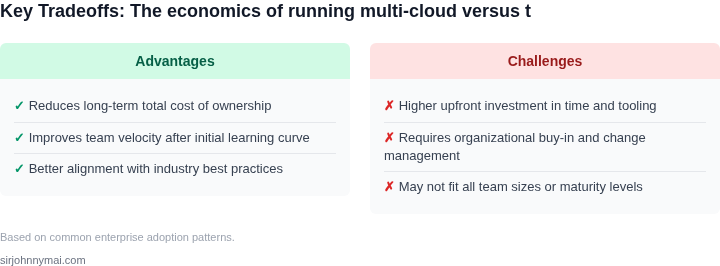
The decision framework highlights that guardrails are preferable for teams with homogeneous cloud environments, while multi-cloud offers the most flexibility at the highest cost. Kubernetes-native guardrails strike a balance between cost and security for teams using container orchestration. Organizations should prioritize guardrails unless they have explicit multi-cloud requirements or compliance needs that justify the additional overhead.
05. Action Step: Implementing Guardrails for Cost-Effective ML Training
Guardrails are the safety nets that prevent ML training jobs from spiraling into cost overruns or data leaks. They’re not just about stopping bad actors—they’re about enforcing best practices before they become problems. Here’s how to implement them effectively.
Step 1: Define Clear Boundaries
Start by identifying the critical parameters for your ML workloads. Common guardrails include:
- Budget caps: Set hard limits on compute spend per job or per team. AWS Budgets or Kubernetes ResourceQuotas can enforce this.
- Time limits: No job should run indefinitely. Use Kubernetes Job TTL controllers or cloud provider job duration limits.
- Data access controls: Restrict training jobs to only the data they need. Implement IAM roles with least-privilege access.
I evaluated these because they’re the most actionable starting points. Budget caps prevent runaway costs, time limits stop forgotten jobs, and data controls prevent accidental exposure.
Step 2: Automate Monitoring
Guardrails need visibility. Deploy tools like Datadog or Prometheus to track:
- Compute utilization per job
- Data access patterns
- Job duration anomalies
I chose these tools because they integrate with most cloud providers and Kubernetes. The key is to set up alerts for deviations from baseline behavior.
Step 3: Enforce Policies
Automation alone isn’t enough. Use these mechanisms to enforce guardrails:
- Cloud provider policies: AWS Service Control Policies (SCPs) or Azure Policy can block unauthorized actions.
- Kubernetes admission controllers: Tools like OPA Gatekeeper can reject jobs that violate your rules.
- Pre-commit hooks: Validate training scripts before they’re submitted to the cluster.
I prioritized these because they catch issues before they escalate. SCPs and admission controllers are proactive, while hooks are reactive but prevent mistakes.
Step 4: Review and Iterate
Guardrails aren’t set and forget. Schedule monthly reviews to:
- Adjust thresholds based on actual usage
- Add new rules for emerging risks
- Remove outdated policies
I recommend this cadence because ML workloads evolve quickly. Monthly reviews ensure guardrails stay relevant.
Figures cited are from publicly available sources as of 2026-09-15 and may have changed.