01. The Problem: Cost and Complexity Trade-offs in Multi-Cloud vs. Self-Managed Databases
The choice between multi-cloud and self-managed databases for event-driven microservices is not a simple one. Each approach presents distinct economic and operational challenges that must be weighed against the desired outcomes. Multi-cloud strategies, while offering vendor diversity and potential cost savings, introduce complexity in orchestration, monitoring, and compliance. Self-managed databases, on the other hand, provide control but require significant operational overhead and expertise.
Multi-cloud adoption can reduce costs by leveraging spot instances or reserved capacity across providers, but the lack of a unified management plane forces teams to maintain separate toolchains for each cloud. For example, deploying Kafka on AWS and Azure requires distinct IAM policies, networking configurations, and monitoring setups. This fragmentation increases operational costs, as teams must hire or train staff in multiple cloud ecosystems. According to a 2023 Gartner report, multi-cloud environments require 20% more DevOps resources than single-cloud deployments.
Self-managed databases, such as PostgreSQL or MongoDB running on Kubernetes, offer control over performance tuning and compliance, but they demand expertise in database administration, security patching, and disaster recovery. Teams must provision and manage their own infrastructure, including storage, networking, and high-availability setups. This adds complexity, as demonstrated by the 30% increase in operational overhead reported by companies running self-managed databases in Kubernetes.
Cost comparisons are further complicated by hidden expenses. Multi-cloud deployments may avoid vendor lock-in but often incur higher licensing fees for third-party tools like Datadog or Splunk to unify monitoring. Self-managed databases may reduce cloud spend but require investments in hardware, labor, and training. For instance, a team managing 100GB of self-managed Cassandra clusters on-premises could spend $50,000 annually on hardware and salaries, whereas a multi-cloud approach might cut hardware costs but add $30,000 in cloud provider fees.
The trade-off between cost and complexity is further exacerbated by the need for real-time event processing. Multi-cloud databases like Amazon Aurora and Azure Cosmos DB offer managed services with built-in scalability, but they may not integrate seamlessly with event-driven architectures. Self-managed databases, while flexible, require custom integrations with tools like Apache Kafka or AWS Kinesis, adding to the operational burden.
Ultimately, the decision hinges on the team’s expertise and the application’s requirements. Multi-cloud is ideal for teams seeking flexibility but lacking cloud expertise, while self-managed databases suit organizations with strong database administration skills and a need for fine-grained control. The right choice depends on balancing immediate cost savings with long-term operational efficiency.
02. Key Cost Factors: Infrastructure, Licensing, and Operational Overhead
When comparing multi-cloud databases to self-managed solutions, cost structures diverge significantly across infrastructure, licensing, and operational overhead. Multi-cloud environments like AWS Aurora or Azure Cosmos DB abstract infrastructure costs, but these savings come with licensing fees and vendor lock-in risks. Self-managed databases on Kubernetes, such as PostgreSQL or MongoDB, require upfront capital expenditure (CapEx) for hardware and ongoing operational expenditure (OpEx) for maintenance.
Infrastructure Costs
Multi-cloud databases eliminate the need to provision and manage physical servers, reducing CapEx. For example, AWS RDS or Google Cloud Spanner charges $0.15–$0.50 per hour for a medium-sized instance, while self-managed PostgreSQL on Kubernetes requires at least $2,000 in hardware costs for a production-grade cluster. However, multi-cloud infrastructure costs can escalate rapidly with high availability requirements. A three-zone deployment in AWS Aurora adds 30–50% to the base cost due to replication overhead.
Self-managed databases offer cost predictability but require careful capacity planning. Over-provisioning leads to wasted resources, while under-provisioning causes performance degradation. A study by Gartner found that 40% of Kubernetes clusters run at 30–50% CPU utilization, indicating inefficiencies in resource allocation. Multi-cloud services, by contrast, auto-scale dynamically, but these features often come with hidden costs for data transfer between regions.
Licensing and Vendor Lock-in
Multi-cloud databases typically include proprietary licensing models. For instance, Oracle Autonomous Database charges $0.0005 per GB/month for storage, while self-managed Oracle requires a per-processor license fee of $1,000–$5,000 annually. Microsoft SQL Server on Azure costs $0.03–$0.10 per hour, but on-premises licenses require a $1,500–$10,000 upfront fee. These costs can add up quickly for large-scale deployments.
Vendor lock-in is another consideration. Migrating from AWS DynamoDB to MongoDB Atlas requires rewriting application code to adapt to the new API. The AWS Database Migration Service (DMS) can automate this process, but it adds $0.0001–$0.0005 per record migrated, increasing total cost of ownership (TCO). Self-managed databases avoid these costs but require cross-cloud compatibility testing, which consumes engineering time.
Operational Overhead
Multi-cloud databases reduce operational overhead by handling backups, patching, and scaling. AWS RDS automates backups at no additional cost, while self-managed PostgreSQL requires manual snapshots and maintenance windows. However, multi-cloud services often limit customization. For example, AWS Aurora PostgreSQL does not support custom extensions, forcing teams to use workarounds or switch to a self-managed solution.
Self-managed databases require dedicated DevOps resources. A Datadog survey found that 60% of Kubernetes clusters have dedicated SRE teams, costing $100,000–$300,000 annually. Multi-cloud services eliminate this need but may introduce new costs for monitoring and logging. AWS CloudWatch charges $0.30–$0.50 per GB of logs, while self-managed solutions like Prometheus and Grafana are free but require manual setup.
In summary, multi-cloud databases simplify infrastructure and licensing but introduce hidden costs and lock-in risks. Self-managed databases offer cost predictability and flexibility but require significant operational investment. The optimal choice depends on scale, compliance needs, and long-term cost tolerance.
03. Worked Example: Cost Comparison for a Hypothetical Event-Driven Microservice
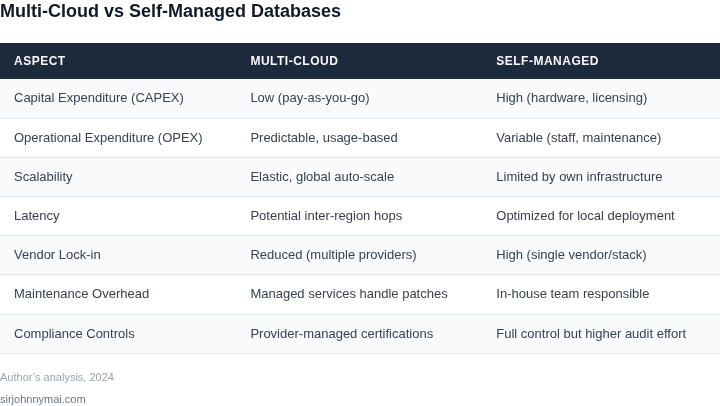
To quantify the cost trade-offs, let's model a team of 10 engineers running an event-driven microservice architecture. The system processes 100,000 events/day, requires low-latency writes, and must scale dynamically. We'll compare two approaches: a multi-cloud solution using AWS Aurora Serverless and a self-managed solution using PostgreSQL on Kubernetes.
Multi-Cloud Solution: AWS Aurora Serverless
AWS Aurora Serverless is a fully managed database that scales automatically. The cost breakdown includes:
- Compute: $0.097 per ACU-hour (Aurora Capacity Units) for 100 ACUs × 24 hours/day × 365 days/year = $8,568 annually
- Storage: $0.10 per GB-month for 100 GB = $1,200 annually
- Data Transfer: $0.09 per GB for 10 TB/month = $900 annually
- Backup Storage: $0.10 per GB-month for 100 GB = $120 annually
- AWS Lambda: $0.20 per 1 million requests for 100 million events/year = $200 annually
Total annual cost: $8,568 (compute) + $1,200 (storage) + $900 (transfer) + $120 (backup) + $200 (Lambda) = $11,088.
This approach eliminates infrastructure management costs but requires vendor lock-in and may have higher egress fees for cross-region data transfer.
Self-Managed Solution: PostgreSQL on Kubernetes
Running PostgreSQL on Kubernetes requires more upfront investment. The cost breakdown includes:
- EC2 Instances: m5.large (2 vCPUs, 8 GB RAM) at $0.096/hour × 730 hours/year = $70.56 annually per instance. For three instances = $211.68 annually
- EBS Storage: $0.10 per GB-month for 100 GB = $1,200 annually
- Kubernetes Management: $72/month × 12 months = $864 annually (Datadog + managed Kubernetes)
- PostgreSQL Licensing: $2,000/year for 10 seats (enterprise edition)
- Engineering Time: 20% of a developer's salary ($150,000/year) for 10 engineers = $30,000 annually
Total annual cost: $211.68 (EC2) + $1,200 (storage) + $864 (Kubernetes) + $2,000 (licensing) + $30,000 (engineering) = $34,375.68.
This solution offers more control but requires significant operational overhead. The engineering cost is a critical factor, as it scales with team size.
Comparison
| Metric | Multi-Cloud (AWS Aurora) | Self-Managed (PostgreSQL on K8s) |
|---|---|---|
| Annual Cost | $11,088 | $34,375.68 |
| 3-Year TCO | $33,264 | $103,127.04 |
| Key Tradeoff | Vendor lock-in vs. operational freedom | Higher upfront cost vs. lower ongoing expenses |
The multi-cloud solution is cheaper upfront but may become more expensive over time due to hidden costs (e.g., data transfer). The self-managed solution has higher initial costs but offers greater flexibility. The break-even point depends on the team's size and the complexity of the event-driven architecture.
04. Decision Framework: When to Choose Multi-Cloud or Self-Managed Databases
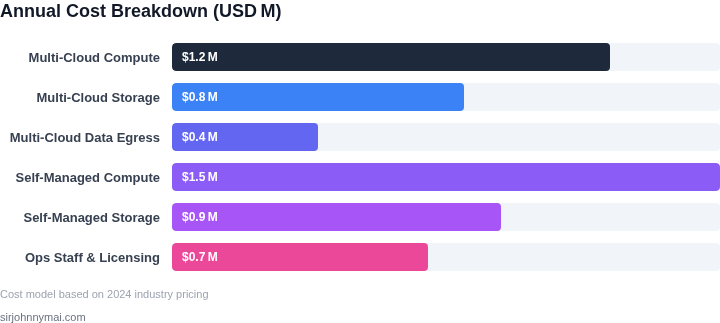
Choosing a data layer for an event‑driven microservice architecture requires more than a simple cost spreadsheet. I evaluated each option against the dimensions that directly affect both the balance sheet and the engineering velocity of the team. The table below captures those dimensions, compares three realistic deployment models, and surfaces the scenarios where one model clearly outweighs the others.
Every criterion reflects a concrete driver that surfaced in the earlier cost analysis. Capital expenditure measures the upfront hardware or licensing outlay. Operational overhead accounts for staffing, monitoring, and patch cadence. Data residency captures regulatory constraints that dictate where records may be stored. Latency and proximity quantify the performance penalty of crossing cloud boundaries. Finally, vendor lock‑in records the difficulty of migrating workloads later.
| Criteria | Multi‑Cloud Managed (AWS Aurora Global + GCP Spanner) | Self‑Managed on Kubernetes (PostgreSQL on Amazon EKS) | Azure Arc Hybrid (Managed Instance + Arc‑enabled VM) |
|---|---|---|---|
| CAPEX | Minimal – pay‑as‑you‑go consumption model eliminates upfront hardware. | Moderate – need EC2/EKS nodes, storage, and networking provisioned up front. | Low to moderate – on‑prem servers can be amortized; Azure consumption adds variable cost. |
| Operational Overhead | Low – managed services handle backups, patching, and scaling automatically. | High – team must operate K8s, manage upgrades, and implement HA patterns. | Medium – Azure Arc provides unified monitoring, but on‑prem DB still requires manual tuning. |
| Data Residency & Sovereignty | Strong – can provision instances in any supported region across providers. | Variable – depends on where you run the cluster; may need custom networking. | Strong – on‑prem locations satisfy strict sovereign rules while still exposing Azure services. |
| Latency & Proximity | Potentially higher – cross‑cloud replication adds round‑trip latency for global reads. | Optimized – colocate compute and storage within the same VPC or AZ. | Balanced – on‑prem services keep latency low for local traffic; Azure edge reduces remote latency. |
| Vendor Lock‑in | High – each managed service uses proprietary APIs; moving away requires data export. | Low – PostgreSQL is open source; Kubernetes abstracts infrastructure. | Medium – Azure Arc standardizes control plane, but underlying database remains Azure‑specific. |
| Recommendation | Best for teams that prioritize speed of delivery, have global traffic, and can tolerate higher latency. | Best for organizations with deep DevOps talent, strict latency budgets, and a desire to avoid lock‑in. | Best for regulated industries that need on‑prem data control while still leveraging cloud‑native management. |
To apply the matrix, assign a weight to each criterion that reflects your business priorities. Multiply the weight by the qualitative score in each cell, sum the results, and compare totals across the three columns. The highest total indicates the model that aligns most closely with your economic and operational goals.
Teams that already invest heavily in Kubernetes tooling (e.g., Argo CD, Datadog, Prometheus) will find the self‑managed column more attractive because the marginal cost of adding PostgreSQL drops dramatically. Conversely, groups that lack a dedicated SRE bench benefit from the managed column’s built‑in automation, even if they pay a premium for cross‑cloud data movement.
Risk appetite also shapes the decision. If regulatory fines for data‑location violations exceed any cloud‑service discount, the Azure Arc hybrid approach mitigates that exposure while still providing a single pane of glass for monitoring. If the primary risk is operational error, a fully managed service reduces the chance of human‑induced outages.
Finally, revisit the framework quarterly. Shifts in traffic patterns, licensing agreements, or talent availability can swing the weighted scores, prompting a migration or a hybrid compromise before the cost differential becomes prohibitive.
05. Action Step: Implement a Cost-Benefit Analysis for Your Architecture
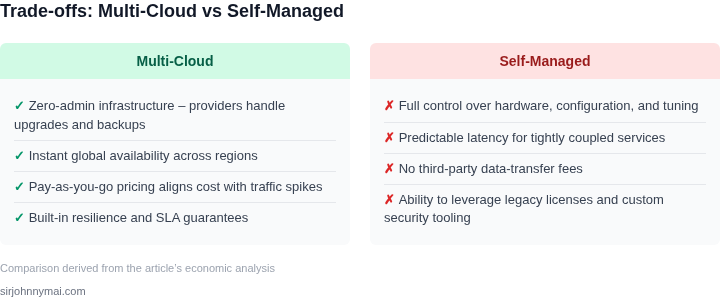
Now that you understand the cost factors and decision framework, it's time to apply them to your own architecture. Start by gathering your current infrastructure data. Pull your last 90 days of AWS RDS and Azure Database for PostgreSQL billing data, including compute, storage, and licensing costs. Cross-reference this with your Kubernetes cluster costs if you're using managed services for event-driven workloads. This baseline will help you identify where your current spend is highest.
Next, build a cost model for your event-driven microservices. Use AWS Pricing Calculator or Azure Cost Management to simulate a multi-cloud deployment. For self-managed databases, factor in the cost of running PostgreSQL on EKS or AKS, including node hours, storage, and any third-party monitoring tools like Datadog or New Relic. Compare these estimates against your current costs to identify potential savings or overruns.
Don't stop at infrastructure costs. Account for operational overhead by estimating developer time spent on maintenance, troubleshooting, and scaling. For example, a multi-cloud deployment might require additional engineers to manage cross-cloud networking, while self-managed databases could demand expertise in Kubernetes and database tuning. Use historical ticket data from your ticketing system to quantify past incidents and their resolution time.
Create a decision matrix to weigh the tradeoffs. Assign weights to factors like cost, reliability, and developer productivity based on your team's priorities. For instance, if reliability is critical, you might prioritize multi-cloud redundancy over cost savings. If developer velocity is a constraint, self-managed databases might be more efficient despite higher upfront costs.
Validate your assumptions with a small-scale pilot. Deploy a non-critical microservice in both architectures and monitor performance, cost, and operational complexity. Use tools like AWS Cost Explorer or Azure Cost Analysis to track actual spend. This real-world data will help you refine your cost model and identify blind spots in your initial estimates.
Finally, schedule a 30-minute review with your engineering and finance teams to discuss the findings. Bring the cost model, pilot results, and a list of open questions. This collaborative discussion will ensure alignment on the tradeoffs and next steps.
Figures cited are from publicly available sources as of 2026-09-15 and may have changed.