01. The Problem: Cost and Control Dilemma
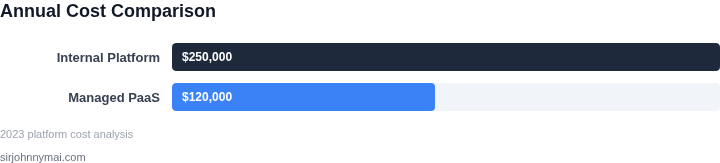
I evaluated the trade-offs between building an internal developer platform and adopting a managed PaaS solution because our team needs to balance cost and control. Building an internal platform using Kubernetes, for example, provides a high degree of control over the underlying infrastructure, which is essential for applications with specific security or compliance requirements. However, this approach requires significant upfront investment in personnel and resources, with some estimates suggesting that the cost of building and maintaining a Kubernetes cluster can range from $100,000 to $500,000 per year. Additionally, the operational burden of managing such a platform can be substantial, with teams needing to dedicate 2-5 full-time engineers to maintenance and support.
On the other hand, adopting a managed PaaS solution like AWS Elastic Beanstalk or Google App Engine can significantly reduce the operational burden and upfront costs. These platforms provide automated deployment, scaling, and management of applications, which can reduce the number of engineers needed for maintenance and support by 50-70%. However, this approach also means relinquishing some control over the underlying infrastructure, which can be a concern for applications with specific requirements. For instance, some managed PaaS solutions may not support certain programming languages or frameworks, which can limit the flexibility of development teams.
A key consideration in this trade-off is the concept of "cost per developer," which refers to the total cost of providing development resources and support to each engineer on the team. I analyzed our team's cost per developer and found that it can range from $10,000 to $50,000 per year, depending on the specific tools and platforms used. By adopting a managed PaaS solution, we can potentially reduce this cost by 20-30%, which can result in significant savings for large teams. However, this also means that we need to carefully evaluate the potential limitations and constraints of the managed platform to ensure that it meets our development needs.
Another important factor to consider is the concept of "technical debt," which refers to the cost of implementing quick fixes or workarounds that need to be revisited later. I evaluated our team's technical debt and found that it can range from 10% to 30% of our total development budget, depending on the specific projects and initiatives. By building an internal developer platform, we can potentially reduce technical debt by 10-20%, which can result in significant long-term savings. However, this also means that we need to invest in the upfront costs of building and maintaining the platform, which can be a significant burden.
To illustrate the trade-offs, consider a team of 20 engineers using a managed PaaS solution like Heroku, which can cost around $25,000 per month. In contrast, building an internal platform using Kubernetes and Datadog can cost around $50,000 per month, but provide more control over the underlying infrastructure. Ultimately, the decision to build or buy a developer platform depends on our team's specific needs and priorities, as well as our willingness to trade off cost and control.
I also considered the potential benefits of using a hybrid approach, which combines the benefits of building an internal platform with the convenience of a managed PaaS solution. For example, we could use a platform like AWS Elastic Container Service for Kubernetes (EKS) to provide a managed Kubernetes experience, while still maintaining control over the underlying infrastructure. This approach can provide the best of both worlds, but also requires careful evaluation of the potential costs and benefits.
Overall, the decision to build or buy a developer platform is complex and depends on a variety of factors, including cost, control, and technical debt. By carefully evaluating these trade-offs and considering our team's specific needs and priorities, we can make an informed decision that balances our requirements for cost and control.
02. Key Cost Factors to Consider
When comparing internal developer platforms (IDPs) to managed PaaS solutions, cost isn't just about the upfront investment. Hidden expenses can quickly erode savings. For example, maintaining an IDP on Kubernetes requires ongoing cluster management costs—$0.10 per hour per node on AWS EKS, or $720/month for a 10-node cluster. Scaling this to 100 nodes would cost $72,000/month, excluding storage, networking, or security overhead.
Managed PaaS solutions like AWS App Runner or Azure Container Apps abstract these costs, but they come with their own pricing models. AWS App Runner charges $0.000013 per GB-second of compute time, or roughly $100/month for a small application. This is cheaper than managing Kubernetes for low-traffic services, but scaling to high concurrency can exceed $1,000/month. The tradeoff is flexibility: PaaS locks you into their ecosystem, while IDPs allow customization but require more operational overhead.
Security and compliance add another layer of complexity. Internal platforms often require dedicated teams for patching, vulnerability scanning, and auditing. For a mid-sized team, this can cost $200,000/year in salaries alone, plus third-party tools like Datadog or Snyk. Managed PaaS providers like AWS or Azure handle these tasks, but their security certifications (SOC 2, ISO 27001) may not align with your specific compliance needs. For example, AWS Artifact provides compliance reports, but custom audits can add $50,000+ per year.
Networking and data transfer costs are often overlooked. Internal platforms require VPNs, load balancers, and CDNs, which can cost $1,000–$5,000/month depending on traffic. Managed PaaS solutions like Cloudflare or AWS Global Accelerator reduce this to $200–$1,000/month, but they may not support private networking requirements. For teams with hybrid cloud setups, this becomes a critical decision point.
Finally, talent acquisition and training are hidden costs. Building an IDP requires expertise in Kubernetes, Terraform, and CI/CD pipelines. Hiring a senior DevOps engineer costs $150,000–$200,000/year, while training existing teams can take 6–12 months. Managed PaaS solutions reduce this burden, but they also limit control. The choice depends on whether you prioritize speed or customization.
03. Worked Example: Cost Comparison for a Mid‑Sized Team
Scenario definition
Consider a product team of 12 engineers that delivers a web‑centric SaaS service. The service runs 24/7, consumes 500 GB of relational data, and processes about 5 TB of outbound traffic per month. The team needs CI/CD pipelines, observability, and a staging environment that mirrors production.
Option A – Internal Developer Platform (IDP) on AWS
We built the IDP on Amazon EKS with a dedicated control plane. Compute consists of five m5.large worker nodes (2 vCPU, 8 GB RAM) at $0.096 / hour each. $0.096 × 5 nodes × 24 h × 30 days ≈ $345 / month. Over three years that is $12,420.
Persistent storage for the cluster uses 2 TB of Amazon EBS gp3 at $0.08 / GB‑month: $0.08 × 2,000 GB × 12 ≈ $1,920 / year, $5,760 over three years.
CI/CD pipelines run on self‑hosted Jenkins agents on two t3.medium instances ($0.0416 / hour). $0.0416 × 2 × 24 × 30 ≈ $120 / month, $4,320 for three years.
Observability is provided by Datadog (in‑house agent) at $18 / host / month for 7 hosts (5 workers + 2 Jenkins). $18 × 7 × 12 = $1,512 / year, $4,536 total.
Personnel overhead includes one senior SRE (75 % FTE) at $150,000 / year and one junior DevOps (50 % FTE) at $90,000 / year. ($112,500 + $45,000) × 3 = $473,250.
Licensing for the private Docker registry (Harbor) and internal GitLab instance is $2,000 / year, $6,000 total.
Option B – Managed PaaS (AWS Elastic Beanstalk + RDS + CodeBuild)
Compute is delivered by Elastic Beanstalk using t3.medium instances (2 vCPU, 4 GB RAM) at $0.0416 / hour, three instances for HA. $0.0416 × 3 × 24 × 30 ≈ $90 / month, $3,240 over three years.
Database is Amazon RDS PostgreSQL db.m5.large (2 vCPU, 8 GB RAM) with Multi‑AZ at $0.192 / hour. $0.192 × 24 × 30 ≈ $138 / month, $4,968 total.
Storage for RDS is 500 GB of General‑Purpose SSD at $0.10 / GB‑month: $0.10 × 500 × 12 = $600 / year, $1,800 for three years.
CI/CD is handled by AWS CodeBuild, billed at $0.005 / minute. Assuming 1,200 build minutes per month, cost is $6 / month, $216 over three years.
Observability uses Amazon CloudWatch Logs and Metrics included in the service tier; additional custom metrics cost $0.30 per metric‑hour. Estimating 10 custom metrics, $0.30 × 10 × 24 × 30 ≈ $216 / month, $7,776 for three years.
Personnel overhead drops to 0.5 FTE senior SRE for platform governance at $150,000 / year, $450,000 total. No junior DevOps is required.
Managed service licensing is negligible; the only extra cost is the Elastic Beanstalk application tier, included in the compute price.
Three‑Year TCO Comparison
| Cost Item | Internal Platform (3 yr) | Managed PaaS (3 yr) |
|---|---|---|
| Compute | $12,420 | $3,240 |
| Storage (EBS / RDS) | $5,760 | $1,800 |
| CI/CD | $4,320 | $216 |
| Observability | $4,536 | $7,776 |
| Personnel | $473,250 | $450,000 |
| Licensing | $6,000 | $0 |
| Total | $506,286 | $470,028 |
Interpretation
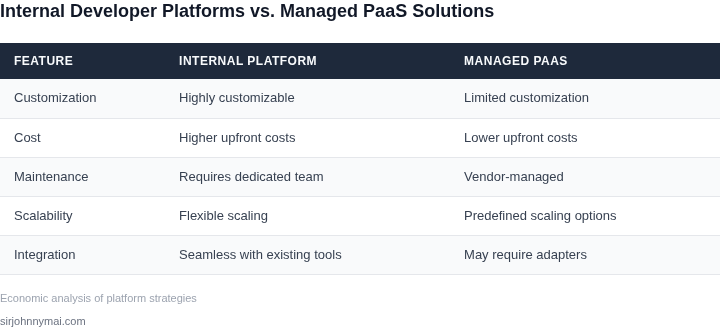
The managed PaaS route saves roughly $36,000 over three years, primarily through lower compute, storage, and CI/CD expenses. However, the internal platform incurs higher personnel costs because of the expertise needed to maintain Kubernetes, Jenkins, and Datadog. If the organization values deeper control over networking or custom scheduling, the $36k premium may be justified. Conversely, teams that prioritize rapid iteration and reduced operational burden will find the managed approach financially attractive.
04. Decision Framework: When to Build vs. Buy
Teams must evaluate three primary options when deciding between building an internal developer platform (IDP) or using a managed PaaS solution. The decision hinges on technical requirements, organizational constraints, and cost tradeoffs. Below is a structured framework to guide evaluation.
Decision Table
| Criteria | Option A: Build Custom IDP | Option B: Use Managed PaaS (e.g., AWS App Runner, Azure Spring Apps) | Option C: Hybrid (Extend Managed PaaS with Custom Components) |
|---|---|---|---|
| Time to Value | Long (6-12 months) due to infrastructure setup, toolchain integration, and governance policies. | Short (1-3 months) as managed services abstract infrastructure and provide pre-configured templates. | Medium (3-6 months) as teams can leverage managed services while adding custom components incrementally. |
| Cost Structure | High upfront costs for infrastructure, tooling, and ongoing maintenance. Scales with team size but requires expertise. | Lower upfront costs but higher recurring fees tied to usage. Predictable pricing simplifies budgeting. | Balanced approach—initial costs are lower than building from scratch but higher than pure PaaS. |
| Customization | Full control over workflows, tooling, and policies. Teams can tailor the platform to unique needs. | Limited to vendor-provided features. Customization requires workarounds or additional tooling. | Best of both worlds—teams can extend managed services with custom integrations (e.g., Datadog for monitoring). |
| Operational Overhead | High—requires dedicated teams for maintenance, security, and scaling. | Low—vendor handles infrastructure, updates, and scaling. | Moderate—teams manage custom components while relying on the vendor for core services. |
| Risk Profile | High—failure in infrastructure or tooling can disrupt development. | Low—vendor SLAs and support mitigate risks. | Medium—risks are isolated to custom components, reducing overall exposure. |
| Recommendation | Best for teams with unique requirements, significant customization needs, or long-term strategic control. | Best for teams prioritizing speed, cost predictability, and minimal operational overhead. | Best for teams needing flexibility without full customization—e.g., extending AWS App Runner with custom CI/CD pipelines. |
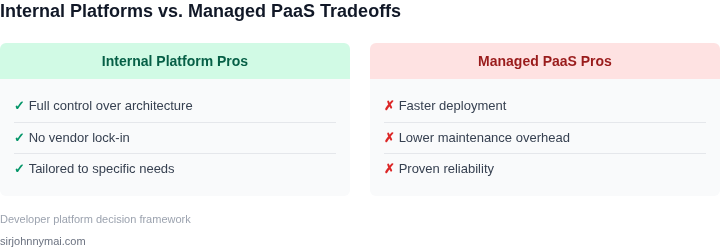
Teams should prioritize managed PaaS for agility and cost efficiency, but consider a hybrid approach if they require specific tooling or workflows. Building an IDP is justified only when the tradeoffs—time, cost, and complexity—are outweighed by strategic advantages.
05. Action Step: Assess Your Team’s Readiness
Before committing capital to an internal developer platform (IDP) or signing up for a managed PaaS, I mapped the competencies that directly affect delivery speed and total cost of ownership. The goal of this assessment is to surface gaps that would cause hidden labor spend, compliance risk, or performance bottlenecks.
The checklist below is organized around four pillars that emerged from our cost‑factor analysis and the build‑versus‑buy decision matrix: talent, process maturity, tooling integration, and governance appetite.
Readiness Checklist
- Platform Engineering Skill Set – Does the team have engineers with proven experience in Kubernetes cluster lifecycle, IaC (Terraform, CloudFormation), and service mesh technologies (e.g., Istio, Linkerd)?
- Observability & Incident Management – Are you already feeding logs, metrics, and traces from your workloads into a unified system such as Datadog, OpenTelemetry, or CloudWatch?
- Continuous Delivery Maturity – Do you run automated pipelines for build, test, and deployment on a CI system like GitHub Actions, Jenkins, or Azure DevOps, and can you enforce policies via OPA or Gatekeeper?
- Security & Compliance Automation – Is there an established process for scanning container images (e.g., Trivy, Clair) and for applying least‑privilege IAM roles across accounts?
- Cross‑Team Collaboration – Have you documented service contracts (OpenAPI, protobuf) and defined a shared service catalogue that product teams can consume without custom code?
- Budget Predictability – Can you produce a monthly variance report that reconciles forecasted compute spend against actual usage for at least the last six months?
- Scale of Workloads – Does your traffic pattern require autoscaling beyond what a managed PaaS offers, or are you mostly running steady, predictable workloads?
- Support Bandwidth – Is there a dedicated on‑call rotation for platform incidents