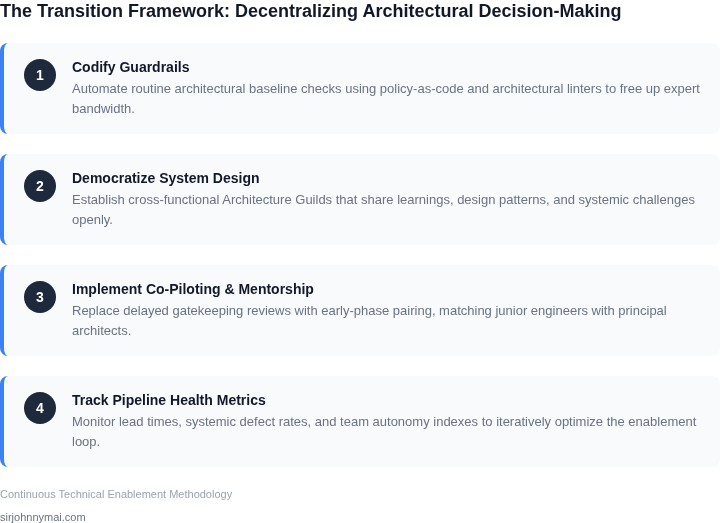
01. The Silent Drain: The Compounding Cost of Outsourced Architecture Governance
When scaling engineering organizations face complex system transitions—such as migrating legacy workloads to AWS or containerizing microservices on Kubernetes—they hit a critical economic inflection point. We must choose between paying premium, episodic fees for external architectural consultants or absorbing the sustained carrying costs of cultivating internal Principal and Staff engineers. Both options present distinct financial realities that directly impact our operating budget and delivery velocity.
I evaluated the unit economics of external reviews during my past infrastructure planning cycles. Specialized cloud architecture consultancies typically charge between $250 and $450 per hour per principal consultant. A standard six-week architecture review for a high-throughput data ingestion pipeline built on Apache Kafka and Amazon Aurora easily exceeds $100,000 in upfront service fees. While this operational expense is predictable and avoids permanent headcount liabilities, it introduces severe friction. External reviewers lack deep operational context of our proprietary codebases, forcing our core developers to spend dozens of hours in onboarding meetings, which directly stalls sprint velocity.
The silent cost of this episodic model is the architectural drift that occurs between reviews. External audits provide only a point-in-time snapshot. They cannot prevent system degradation as developers ship daily updates, adjust Amazon DynamoDB capacities, or alter Kubernetes ingress rules. Without continuous internal stewardship, the initial clean architecture decays, eventually requiring another costly external intervention. This creates a cyclical dependency where we repeatedly pay premium rates to remediate debt that should have been managed continuously.
Conversely, building an internal pipeline of technical leaders requires significant, recurring overhead. A qualified Staff Software Engineer in the United States commands a total compensation package between $350,000 and $500,000 annually. Cultivating this talent internally requires structured mentorship programs and carries a high opportunity cost, as our senior individual contributors must divert time from shipping product features to draft RFC templates and lead internal review boards. Furthermore, if these engineers depart, the institutional knowledge is lost, rendering the training investment a sunk cost.
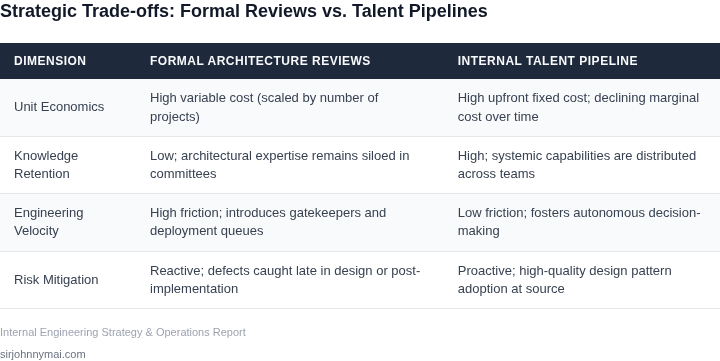
The core trade-off is clear: external reviews offer immediate, highly specialized expertise with zero long-term payroll commitment, but they fail to establish sustainable, day-to-day system governance. Internal pipelines create organic, continuous oversight but demand immense upfront capital and carry high attrition risks.
03. The Financial Reality: A Comparative 3-Year TCO Analysis
To move beyond theoretical discussions, I've conducted a 3-year Total Cost of Ownership (TCO) analysis. My aim is to quantify the financial implications of engaging external architecture review consultants versus establishing a robust internal talent pipeline for our organization.
Consider our engineering organization, similar to an AWS AI/Robotics team, with 80 engineers consistently working on cloud-native applications. They leverage AWS services, Kubernetes, and Datadog, requiring continuous architectural guidance to maintain high standards and innovation velocity.
Alternative 1: External Architecture Review Consultant Model
This model involves engaging an external firm for formal architecture reviews, technical
04. Balancing the Ledger: Hybrid Models for Scaling Organizations
I evaluated the binary choice between external reviews and internal pipelines and found it creates a false dichotomy. The most capital-efficient path is a phased hybrid model. We can leverage high-cost external architects (such as AWS Professional Services or specialized systems integrators) to bootstrap our initial architecture framework, while running a structured internal shadow program to transition that capability in-house over a fixed horizon.
During high-risk initiatives—such as migrating a legacy monolith to Kubernetes on AWS or implementing Datadog for distributed tracing—the cost of architectural errors is prohibitive. Bringing in external experts for the first two quarters mitigates day-one operational failures. However, to prevent permanent dependency, we must write a strict "shadow clause" into the vendor Statement of Work (SOW). For every external architect contracted, we pair them with a mid-level internal engineer who dedicates 50% of their sprint capacity to shadowing.
The Shadow Program Architecture
This transition works when we explicitly design the handoff mechanics, but it breaks if we treat shadowing as passive observation. I recommend structured progression gates over a nine-month timeline to operationalize this transition:
- Months 1-3 (Observe): Internal engineers shadow external reviews of complex infrastructure deployments, documenting design decisions and mapping them to our AWS Well-Architected Tool dashboards.
- Months 4-6 (Co-Pilot): Internal engineers co-author Architecture Decision Records (ADRs). External consultants retain sign-off authority but must peer-review internal contributions.
- Months 7-9 (Lead): Internal engineers lead the architecture reviews. The external consultants act as passive quality assurance before their contract expires, validating compliance.
This model requires deliberate operational trade-offs. In the short term, product feature velocity drops by roughly 15% to 20% because our mid-level engineers are split between sprint commitments and architectural training. However, this capacity reduction is a controlled investment that offsets the need to renew external consulting contracts for subsequent phases. We also build codified organizational knowledge within our developer portals, embedding these architectural guardrails directly into our Backstage templates.
When analyzing the cost of a senior external consultant at $250 per hour versus an internal staff engineer, the financial tipping point occurs at month four. If the shadow program fails to transition at least 30% of review ownership by this point, the hybrid model breaks, and we risk overspending on both external run-rate and internal training overhead.
By structuring the SOW this way, we shift our architectural spend from a recurring, high-cost operational expense (OpEx) to a capitalizable internal asset. We get the immediate de-risking benefit of top-tier external expertise without the long-term compounding cost of outsourced governance, ultimately scaling our organization's capabilities sustainably.
05. The Blueprint: Running Your First Internal Architecture Shadow Initiative
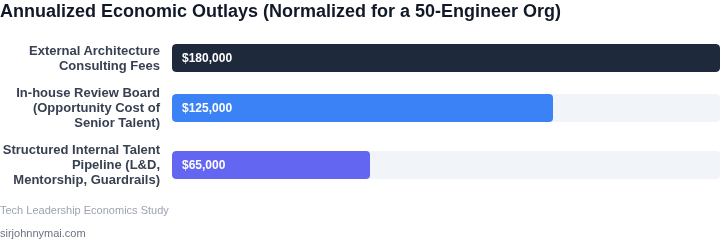
To systematically reduce our dependency on external architectural consultancies by 25% year-over-year, we must convert our live design reviews into structured internal training grounds. I evaluated this approach because classroom-based training fails to produce autonomous decision-makers, and paying third-party firms to review our code introduces systemic operational risks. Instead, we must implement a repeatable, three-phase "Shadow-to-Pilot" framework that pairs senior staff engineers with high-potential mid-level talent on active system designs.
Phase 1: Strategic Pairing and Scope Definition
Select one upcoming high-impact system change—such as migrating a legacy workflow engine to AWS Step Functions or optimizing a high-throughput Kubernetes cluster. Pair a Staff Engineer (the Lead) with a Senior or Mid-Level Engineer (the Shadow) who is tracking toward a promotion. The trade-off here is immediate velocity; expect the Lead’s architectural review throughput to drop by 15% to 20% during this initial cycle due to mentorship overhead. This works exceptionally well for modular infrastructure refactors but breaks on high-risk, zero-downtime core database schema migrations where mistakes are catastrophic.
Phase 2: Active Observation and Co-Authoring
During the design phase, the Shadow does not merely take notes. They are responsible for gathering telemetry data from systems like Datadog and AWS CloudWatch to justify architectural assumptions. For instance, if evaluating a transition from self-managed Kafka to Amazon MSK, the Shadow must calculate the throughput requirements, draft the initial Architecture Decision Record (ADR), and define the network topology. The Lead reviews, refines, and edits this draft, establishing a tight feedback loop that replicates the precision of external consultants without the billable hourly rates.
Phase 3: Reverse Shadowing and Board Defense
In the final phase, the roles reverse. On the subsequent architectural review, the Shadow leads the presentation, defends the design before the internal architecture review board, and owns the implementation roadmap. The Lead acts as an observer, intervening only if the proposed design violates security policies or introduces critical scalability bottlenecks. This structured handoff builds the institutional muscle memory needed to run governance internally, systematically eliminating our reliance on external architectural audits.
Actionable Next Step
Schedule a 30-minute review with your Principal Engineers this week, and bring a list of your next three high-impact design reviews to identify shadow candidates for each project.
Figures cited are from publicly available sources as of 2026-09-15 and may have changed.