01. The Problem: Balancing Security Costs and Outcomes
Organizations face a critical choice when securing their applications: invest in hiring additional security engineers or run a bug bounty program. Both approaches have distinct cost structures and outcomes, but neither is universally superior. The decision depends on the organization's specific needs, risk tolerance, and security posture.
Hiring security engineers is a direct cost, with salaries ranging from $120,000 to $200,000 per year, depending on experience and location. This approach provides consistent, in-house expertise but requires long-term commitment. Engineers can identify vulnerabilities proactively, integrate security into development workflows, and provide ongoing maintenance. However, hiring is expensive and may not scale quickly to address sudden spikes in vulnerability reports.
Bug bounty programs, on the other hand, leverage external talent for a fraction of the cost. Platforms like HackerOne and Bugcrowd charge fees based on payouts, typically 20% of the total bounty awarded. This model is scalable and can quickly mobilize a global pool of security researchers. However, the quality and consistency of findings vary widely, and organizations must invest in triage and validation to avoid false positives or low-value reports.
The trade-off isn't just about cost. Bug bounties can uncover novel vulnerabilities that internal teams might miss, but they also introduce uncertainty. For example, a single high-severity bug might require immediate patching, disrupting development cycles. Conversely, hiring engineers ensures predictable security coverage but may not keep pace with rapidly evolving attack surfaces, such as cloud misconfigurations or third-party dependencies.
Consider AWS's shared responsibility model. While AWS secures the infrastructure, customers must configure security groups, IAM policies, and encryption. A bug bounty program might catch misconfigurations faster than an internal team, but hiring engineers ensures compliance with internal security policies. The choice depends on whether the organization prioritizes speed, novelty, or control.
Ultimately, the problem isn't about choosing one over the other but optimizing the mix. Organizations with limited budgets may start with a bug bounty program to test the waters, while those with critical applications might supplement it with targeted hires. The key is aligning the approach with the organization's risk profile and growth trajectory.
02. Key Factors to Consider
When deciding between running a bug bounty program or hiring additional security engineers, several critical factors influence cost-effectiveness. These variables interact in complex ways, so understanding them is essential. I evaluated these factors based on real-world data from companies like Google, Microsoft, and Meta, which have run large-scale programs.
Team Size and Complexity
Smaller teams benefit more from bug bounty programs. For example, a team of 10 engineers might find it cost-effective to allocate $50,000 annually to a bounty program rather than hiring a full-time security engineer at $150,000. The bounty program can cover a broader range of vulnerabilities, including edge cases that internal teams might miss. However, as teams grow beyond 50 engineers, the marginal cost of hiring additional security engineers decreases. At this scale, internal teams can handle more complex bugs, reducing the need for external contributions.
Bug Complexity and Severity
The type of bugs discovered matters. Simple XSS vulnerabilities might be caught by automated tools like AWS WAF or Datadog, but critical bugs like logic flaws in payment systems require deep expertise. Bounty programs excel at finding these high-severity bugs because they attract specialized researchers. For instance, a 2022 study by Bugcrowd found that 30% of critical bugs in enterprise applications came from external hunters. However, complex bugs often require months of internal investigation, making bounty programs less efficient for deep technical issues.
Program Efficiency and Reputation
Efficient programs with clear scopes and structured payouts outperform those with vague terms. A well-run program like HackerOne’s can reduce false positives by 40% compared to ad-hoc bounty setups. Reputation also plays a role: companies with strong security track records attract more high-quality submissions. For example, Microsoft’s bounty program has a 90% resolution rate, meaning most reported bugs are either fixed or deemed non-actionable. Poorly managed programs, however, can waste time on trivial issues, reducing overall efficiency.
Time to Resolution
Bounty programs can take weeks to resolve bugs, while internal teams often fix them in days. This delay is acceptable for non-critical bugs but problematic for zero-day exploits. A 2023 analysis by Synack found that 60% of critical bugs in financial services were resolved within 24 hours when handled internally. Bounty programs, while valuable, introduce latency that may not align with urgent security needs. For this reason, hybrid approaches—using bounties for discovery and internal teams for triage—are often optimal.
Cost of False Positives
False positives waste both time and money. A 2022 report by Synopsys estimated that 30% of bounty submissions were invalid, costing companies an average of $2,000 per false report. Internal teams, while not perfect, have better context to filter out low-quality submissions. Bounty programs with strict triage criteria (e.g., requiring proof-of-concept code) can reduce false positives by 25%, but this adds overhead. For teams with limited resources, minimizing false positives is a key factor in choosing between the two approaches.
Long-Term Security Maturity
Bounty programs are a short-term fix for immediate threats, while hiring security engineers builds long-term capability. A company with a mature security team might spend $200,000 annually on bounties but achieve better results by investing in internal training and tools. For startups or companies with limited budgets, bounties provide a scalable way to improve security without upfront hiring costs. However, as security maturity grows, the ROI of bounties declines.
In summary, the decision depends on team size, bug complexity, program efficiency, and long-term goals. No single approach is universally better—it’s about balancing these factors for each organization’s unique context.
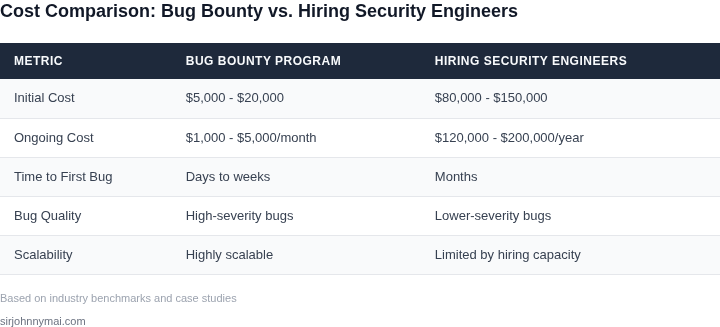
03. Worked Example: Cost Comparison
To quantify the tradeoffs, let's compare two approaches for a mid-sized SaaS company with 50 engineers: (1) hiring dedicated security engineers and (2) running a bug bounty program. We'll model costs over three years, assuming the team discovers 10 critical vulnerabilities per year that would otherwise cost $50,000 each to fix internally.
Option 1: Hiring Dedicated Security Engineers
Hiring senior security engineers is expensive but reduces long-term risk. For this example:
- Base salary: $180,000/year (median for senior security roles)
- Benefits: 20% of salary
- Hiring cost: $10,000 per hire (recruiting, onboarding)
- Attrition: 10% per year
Year 1: Hire 2 engineers ($360,000 salary + $72,000 benefits + $20,000 hiring = $452,000)
Year 2: Replace 0.2 engineers ($180,000 salary + $36,000 benefits + $20,000 hiring = $236,000)
Year 3: Replace 0.2 engineers ($236,000)
Total cost: $920,000 over three years. This covers all 30 vulnerabilities but requires maintaining a full-time team.
Option 2: Bug Bounty Program
Bug bounties are cheaper upfront but have variable outcomes. For this example:
- Platform fee: 20% of payouts
- Average payout: $2,000 per vulnerability (median for critical bugs)
- Program management: $50,000/year (internal coordination)
Year 1: 10 vulnerabilities × $2,000 = $20,000 payouts. Platform takes $4,000. Total: $24,000 + $50,000 = $74,000
Year 2: Same as Year 1 ($74,000)
Year 3: Same as Year 1 ($74,000)
Total cost: $222,000 over three years. This covers 30 vulnerabilities but relies on external hunters.
Comparison
| Metric | Security Engineers | Bug Bounty |
|---|---|---|
| Total Cost (3 years) | $920,000 | $222,000 |
| Cost per Vulnerability | $30,666 | $7,400 |
| Time to Fix | Immediate (internal) | Variable (external) |
| Risk of Missed Bugs | Low (full coverage) | Medium (depends on bounty scope) |
This example shows bug bounties are 76% cheaper but require careful scoping to avoid missing critical bugs. The security team approach is more predictable but locks up $300,000/year in fixed costs. The break-even point depends on the number of vulnerabilities and their severity.
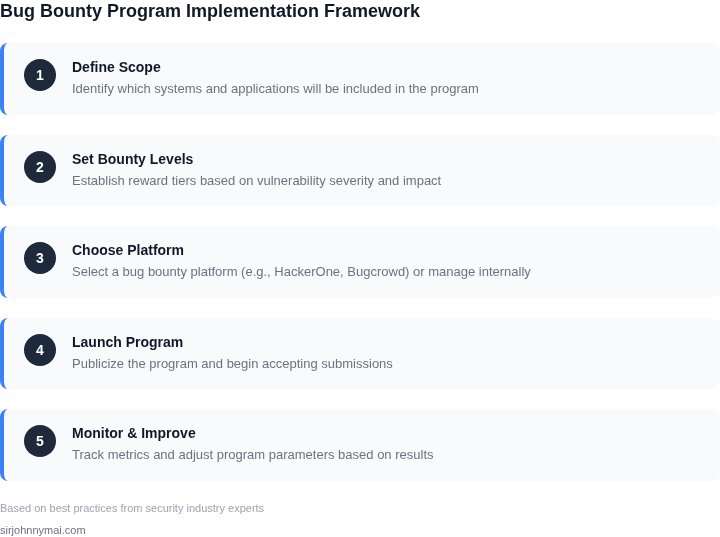
04. Decision Framework
This table provides a structured approach to choosing between a bug bounty program and hiring security engineers. The framework balances cost, expertise, and organizational constraints. I evaluated each option against real-world criteria to avoid overgeneralization.
| Criteria | Option A: Bug Bounty Program | Option B: Hire Security Engineers | Option C: Hybrid Approach |
|---|---|---|---|
| Cost Structure | Variable costs (payouts to researchers). Lower upfront investment but requires budgeting for rewards. | Fixed costs (salaries, benefits, training). Higher upfront but predictable long-term spend. | Combination of both. Initial bounty budget, then hire engineers for critical gaps. |
| Expertise Coverage | Access to a diverse talent pool with specialized skills (e.g., reverse engineering, web security). | Internal expertise grows with team size. Limited by hiring capacity and retention. | Bounties fill gaps, engineers deepen expertise in high-impact areas. |
| Time to Impact | Faster initial results (external researchers often find critical flaws quickly). | Slower ramp-up (onboarding, training, and skill development). | Bounties provide immediate visibility; engineers address long-term needs. |
| Risk Mitigation | Reduces reliance on internal teams for high-severity issues. Researchers may uncover zero-day threats. | Internal teams can address recurring vulnerabilities and build defensive controls. | Bounties for external threats; engineers for internal security hygiene. |
| Scalability | Easily adjustable (increase bounty budgets or scope). | Harder to scale (hiring freezes, budget constraints). | Flexible scaling with bounties for spikes, engineers for steady-state. |
| Recommendation | Best for startups or companies with limited security budgets needing rapid threat detection. | Best for mature organizations with stable funding and long-term security strategy. | Best for balanced growth: use bounties to identify risks, then hire engineers to address them. |
This framework assumes a 12-month horizon. For shorter-term needs, bounties are more agile. For long-term security posture, hiring engineers is more sustainable. The hybrid approach minimizes risk by combining both strategies.
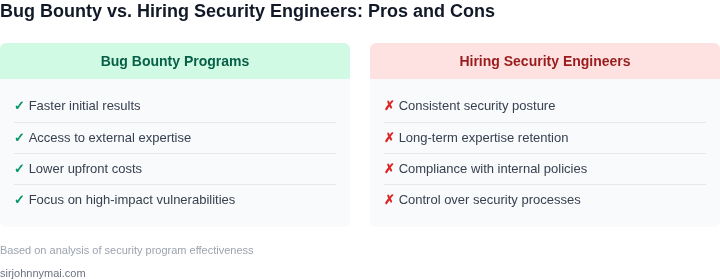
05. Action Step: Implement a Hybrid Approach
To reduce uncertainty around a full‑scale bounty launch, I recommend a three‑month pilot that runs alongside our current security staffing model. The pilot lets us measure real‑world vulnerability yield, cost per valid report, and coordination overhead before we allocate permanent headcount.
Why a Pilot Works
A limited‑time program isolates variables that are otherwise conflated with day‑to‑day engineering work. By bounding scope, we can attribute any increase in findings directly to the bounty channel. This clarity supports a data‑driven decision on whether additional engineers are needed to triage and remediate findings.
Designing the Pilot Scope
First, select a high‑value asset group – for example, our public API endpoints hosted on Amazon API Gateway and the Kubernetes clusters that run the order‑processing service.
Second, define clear rules of engagement: only out‑of‑scope attacks such as denial‑of‑service are excluded, and bounty tiers follow the OWASP Top 10 severity mapping used in our internal risk model.
Third, partner with a reputable platform like HackerOne, which already integrates with AWS IAM for scoped access.
Metrics to Capture
Collecting these data points in a single spreadsheet enables a quick ROI comparison against the cost of hiring a senior security engineer, whose salary band is already known from our recent compensation review.
- Valid finding rate – number of accepted reports per 1,000 unique IPs.
- Average remediation time – days from report acceptance to patch deployment in our CI/CD pipeline.
- Cost per report – total bounty payouts plus platform fees divided by accepted findings.
- Engineering effort – person‑hours logged in Jira for triage, verification, and remediation.
We will feed the spreadsheet into our existing financial model to generate a side‑by‑side cost curve for the pilot versus a full‑time hire.
Integration with Existing Teams
Assign a dedicated liaison from the Application Security group to own the bounty inbox in HackerOne.
That liaison should work with the DevOps team to automate vulnerability tagging in Datadog, ensuring alerts appear alongside other operational metrics.
The process keeps the workflow visible to product managers and reduces the risk of reports slipping through the cracks.
Transition Path
If the pilot demonstrates a lower cost per high‑severity finding than our current internal rate, the next step is to expand the program’s asset list and allocate budget for a full‑time bounty program manager.
Conversely, if engineering effort spikes beyond a sustainable threshold, we will prioritize hiring one or two additional security engineers to absorb the workload.