The strategic decision to deploy workloads across multiple cloud providers or consolidate with a single vendor carries significant long-term economic implications. As an Amazon AI/Robotics Lead PM, my perspective is grounded in evaluating infrastructure choices that directly impact product development, operational efficiency, and ultimately, our bottom line. This article outlines the economic considerations behind single-cloud and multi-cloud strategies, detailing when the inherent complexity of a multi-cloud approach can deliver justifiable returns.
Our focus must extend beyond mere infrastructure costs to encompass operational overhead, talent acquisition, risk mitigation, and strategic flexibility. This isn't just an architectural choice; it's a fundamental business decision that shapes an organization's agility and market position. Understanding these dynamics is crucial for making informed investment decisions in our cloud strategy.
01. Defining the Landscape: Single-Cloud vs. Multi-Cloud
A single-cloud strategy involves deploying all or the vast majority of an organization's applications and data within one public cloud provider's ecosystem. This often means leveraging AWS, Microsoft Azure, or Google Cloud Platform exclusively for compute, storage, networking, and specialized services.
Conversely, a multi-cloud strategy distributes workloads across two or more public cloud providers. This can range from highly integrated applications spanning different clouds to distinct workloads running on separate platforms. The motivations behind such distribution are varied, encompassing cost, resilience, performance, and compliance requirements.
Both approaches present distinct economic profiles, impacting capital expenditure, operational expenditure, and overall business risk. Evaluating these profiles requires a granular understanding of direct and indirect costs, alongside strategic benefits.
02. The Economic Case for a Single-Cloud Strategy
The allure of a single-cloud strategy is its simplicity and potential for cost efficiencies through consolidation. By committing to a single provider, organizations can often unlock significant economic advantages.
One primary benefit is leveraging volume discounts and committed-use contracts. Providers like AWS offer Savings Plans and Reserved Instances, while Azure has Reserved Virtual Machine Instances and Azure Hybrid Benefit, and Google Cloud offers Committed Use Discounts. Consolidating spend with one vendor maximizes the opportunity to achieve higher discount tiers across compute, storage, and other services. This can translate into substantial savings on infrastructure costs, especially for stable, predictable workloads.
Operational overhead is also significantly reduced. A single-cloud environment requires less specialized tooling for monitoring, management, and orchestration. Engineering teams can deepen their expertise in a single platform's APIs, services, and best practices, leading to faster development cycles, more efficient troubleshooting, and reduced training costs. This focused skill set improves productivity and reduces the need for diverse cloud architects and engineers.
Furthermore, single-cloud deployments often simplify governance, security, and compliance. Establishing consistent policies, identity and access management (IAM), and network configurations is more straightforward within a unified ecosystem. This reduces the complexity of audits and ensures a more consistent security posture, which translates into lower compliance costs and reduced risk.
Finally, a single-cloud approach allows for deeper integration with advanced platform-specific services. Features like AWS Outposts, Azure Stack Hub, or Google Cloud Anthos extend cloud capabilities to on-premises environments, offering hybrid solutions tightly integrated with the parent cloud. This enables seamless development and deployment pipelines, leveraging the full breadth of a single provider's innovation.
This approach works best when an organization prioritizes operational simplicity, cost predictability, and deep feature integration, and where the risk of vendor lock-in or regional outages is deemed manageable. Startups or organizations with straightforward regulatory requirements often find this model highly effective for rapid scaling.
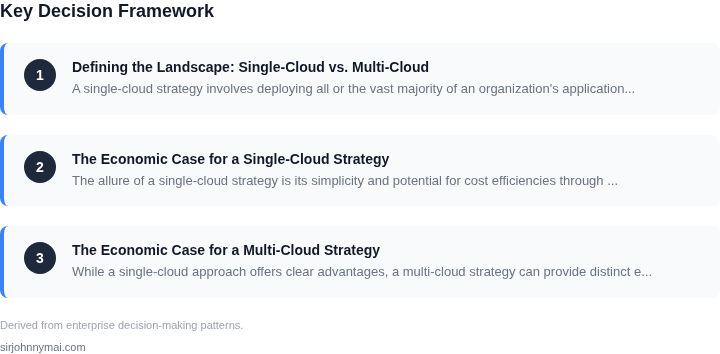
03. The Economic Case for a Multi-Cloud Strategy
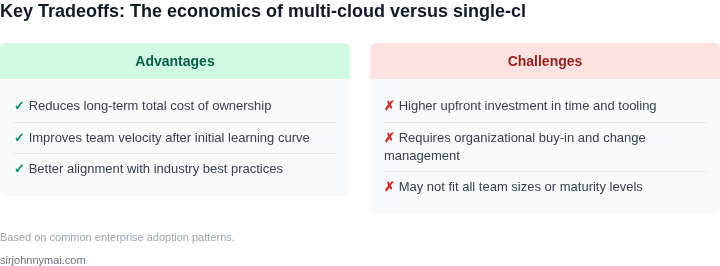
While a single-cloud approach offers clear advantages, a multi-cloud strategy can provide distinct economic benefits, primarily driven by cost optimization, risk reduction, and strategic flexibility. These benefits often justify the increased complexity.
Cost Optimization through Competition and Arbitrage. One of the most compelling arguments for multi-cloud is the ability to arbitrage pricing differences across providers for commodity services. Cloud providers frequently adjust pricing, offer promotions, or have varying cost structures in different regions or for specific service types. By maintaining relationships with multiple vendors, organizations can dynamically shift certain workloads to the most cost-effective provider at any given time.
Consider a scenario for a large-scale batch processing workload, requiring significant compute capacity for a limited duration each week. A company needs to run 200 general-purpose compute instances, each with 4 vCPUs and 16 GiB of RAM, for 24 hours per week, for a full year. Initially, they are using AWS EC2 m5.xlarge instances in the us-east-1 region.
Let's use publicly available on-demand pricing for comparable instance types:
- AWS EC2
m5.xlarge(4 vCPU, 16 GiB) inus-east-1: Approximately $0.192 per hour. - Azure Virtual Machines
D4as_v4(4 vCPU, 16 GiB) ineastus: Approximately $0.180 per hour. - Google Cloud Compute Engine
e2-standard-4(4 vCPU, 16 GiB) inus-central1: Approximately $0.134 per hour.
Annual Cost Calculation (On-Demand, per 200 instances):
- AWS: 200 instances * $0.192/hour/instance * 24 hours/week * 52 weeks/year = $47,808 per year.
- Azure: 200 instances * $0.180/