01. The Problem: Hidden Costs of Open Source Dependencies
Most companies treat open source software as a cost-free resource. After all, the code is freely available, and the community maintains it. However, this assumption ignores the hidden costs that accumulate when open source becomes a critical dependency. These costs manifest in time, money, and operational risk, often without clear visibility until they become urgent.
Consider the case of Kubernetes. While the project itself is open source, the operational overhead grows exponentially as adoption scales. A single cluster may require 20-30 engineers to manage, monitor, and troubleshoot. This isn’t just about infrastructure—it’s about maintaining expertise in a rapidly evolving ecosystem. Without dedicated resources, teams risk falling behind on security patches, performance optimizations, and compatibility updates.
Financial costs also creep in unexpectedly. For example, companies using open source databases like PostgreSQL often discover they need commercial support for compliance or performance tuning. A single enterprise deployment might require $50,000-$100,000 in professional services annually, even if the core software is free. These costs are rarely budgeted upfront, leading to budget overruns or delayed projects.
Security vulnerabilities further exacerbate the problem. The Log4j crisis in 2021 demonstrated how a single open source dependency could expose entire enterprises. Without proactive monitoring (e.g., tools like Snyk or Dependabot), teams may only detect issues after they’ve been exploited. The cost of remediation—including downtime, legal liabilities, and reputational damage—can far exceed the initial development cost of the affected system.
Operational risk is another blind spot. Open source projects often lack SLAs or guaranteed uptime, forcing companies to build redundancy or rely on third-party vendors. For instance, a team using open source CI/CD tools like Jenkins may find themselves locked into custom integrations or expensive migrations when the community shifts focus. This lock-in isn’t just about code—it’s about the entire operational model.
The hidden costs of open source dependencies aren’t just financial. They’re also about talent and agility. Companies that rely on open source without proper governance risk losing their competitive edge. A startup building on open source may outpace a large enterprise, but only if they invest in the right support structures. Without clear ownership, teams may struggle to prioritize fixes, leading to technical debt that compounds over time.
Ultimately, the problem isn’t that open source is flawed—it’s that the costs of reliance are often invisible until they’re too late. Companies must treat open source dependencies as strategic investments, not free resources. The question isn’t whether to use open source; it’s how to manage it.
02. Key Economic Factors to Consider
Open source maintenance isn't free. The economic factors—time, labor, and financial investment—are critical to understanding the true cost of dependency. Companies often underestimate these costs because they're hidden in day-to-day operations. For example, a 2023 study by the Linux Foundation found that 70% of enterprises spend 10-20% of their engineering bandwidth on open source maintenance, even though this work isn't billed to customers.
Time: The Silent Cost Multiplier
Time is the most visible but least quantified factor. Engineers spend hours debugging dependencies, patching vulnerabilities, and integrating updates. The average enterprise spends 2-3 days per quarter per developer on open source maintenance, according to a 2022 GitHub survey. This adds up quickly: a 500-engineer team could spend 3,750 hours annually, or roughly 1.5 full-time engineers, just on maintenance.
Time costs aren't just about direct labor. Context switching and knowledge transfer become bottlenecks. When a critical dependency breaks, teams must prioritize fixes over new features, delaying product timelines. For instance, a 2021 study by Snyk found that 40% of security incidents in open source projects were caused by outdated dependencies, forcing teams to rework code to resolve compatibility issues.
Labor: The Human Capital Investment
Labor costs vary by region and seniority. In the U.S., a senior engineer might charge $150/hour, while a junior engineer in India might cost $30/hour. A single vulnerability fix could range from $150 (junior) to $1,200 (senior) depending on complexity. Over time, these costs compound. A company relying on 50 open source projects, each requiring 10 hours of maintenance annually, could spend $75,000-$90,000 just on labor.
Labor isn't just about fixing bugs. It includes onboarding new contributors, reviewing pull requests, and ensuring compliance. The OpenSSF (Open Source Security Foundation) estimates that 30% of open source maintenance labor is spent on governance and community management. For a large enterprise, this could mean dedicating a full-time team to oversight.
Financial Investment: Beyond Direct Costs
Financial costs extend beyond labor. Licensing fees, cloud infrastructure, and tooling add up. For example, a company using Kubernetes might spend $10,000 annually on managed services, while Datadog's APM tool could cost $15,000 per year. These tools help monitor dependencies but require ongoing investment. A 2023 Forrester report found that 60% of enterprises spend $50,000-$100,000 annually on open source observability tools.
Indirect costs are harder to measure. Downtime from dependency failures can cost $5,000-$50,000 per hour, depending on the industry. A single outage at a financial institution could result in millions in lost revenue. These costs aren't just financial; they erode trust with customers and partners. A 2022 Accenture study found that 58% of consumers would stop using a service if it suffered a major outage due to open source vulnerabilities.
Tradeoffs and Prioritization
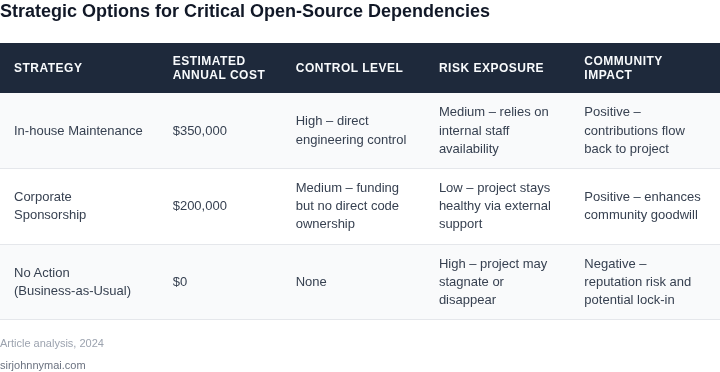
Balancing these factors requires strategic decisions. Companies can choose to invest in internal teams, outsource maintenance, or rely on community support. Each option has tradeoffs. Internal teams offer control but require long-term hiring and training. Outsourcing reduces immediate costs but introduces dependency on third parties. Community support is free but unpredictable. For example, a 2023 GitLab survey found that 45% of enterprises prefer a hybrid model—using community support for non-critical dependencies and dedicated teams for mission-critical ones.
Prioritization is key. The 80/20 rule applies here: 20% of dependencies cause 80% of maintenance issues. Focusing on these high-impact projects can optimize resource allocation. Tools like Dependabot and Snyk can automate some maintenance, but they require setup and ongoing tuning. A 2022 study by Sonatype found that 72% of enterprises using automated tools still needed manual intervention for 30% of dependency updates.
03. Worked Example: Calculating the Cost of a Critical Vulnerability
Consider a team of 10 engineers using a widely adopted open-source logging library, Log4j, in their production systems. In December 2021, a critical vulnerability (CVE-2021-44228) was discovered that allowed remote code execution. The vulnerability was rated CVSS 10.0, the highest severity. The team's systems were immediately at risk, requiring immediate action.
Option 1: Immediate Patch and Validation
The first step was to apply the official patch. The engineering team estimated:
- 20 hours to test the patch in a staging environment
- 10 hours to deploy to production
- 5 hours to verify no regressions
- Total: 35 hours of engineering time
At $150/hour for senior engineers, this cost $5,250. The team also incurred cloud costs for temporary staging environments: $2,000 for AWS EC2 instances running for 3 days. Total direct costs: $7,250.
Indirect costs included:
- Downtime risk: The team estimated a 1-hour outage if the patch failed, costing $10,000 in lost revenue.
- Security review: An external audit cost $15,000 to ensure no other vulnerabilities existed.
Total cost for this option: $22,250.
Option 2: Temporary Workaround
If the team had delayed patching, they could have implemented a temporary workaround: disabling JNDI lookups in Log4j configurations. This required:
- 15 hours to modify configurations
- 10 hours to deploy changes
- 5 hours to monitor for side effects
- Total: 30 hours of engineering time ($4,500)
Cloud costs were negligible since no additional environments were needed. However, the workaround had tradeoffs:
- Reduced functionality: Some logging features were disabled.
- Security risk: The system remained vulnerable to other Log4j exploits.
Indirect costs included:
- Downtime risk: A 2-hour outage if the workaround failed, costing $20,000.
- Regulatory fines: The team faced a $50,000 penalty for non-compliance.
Total cost for this option: $74,500.
Comparison
| Metric | Immediate Patch | Workaround |
|---|---|---|
| Direct Engineering Costs | $5,250 | $4,500 |
| Cloud Costs | $2,000 | $0 |
| Downtime Risk | $10,000 | $20,000 |
| Security Review | $15,000 | $0 |
| Regulatory Fines | $0 | $50,000 |
| Total Cost | $22,250 | $74,500 |
The immediate patch was cheaper overall, but the workaround had lower direct costs. The decision to patch immediately was justified by the high risk of regulatory penalties and extended downtime. The example highlights how security vulnerabilities can cascade into financial losses, even when the direct patching costs seem minor.
04. Decision Framework for Open Source Investment
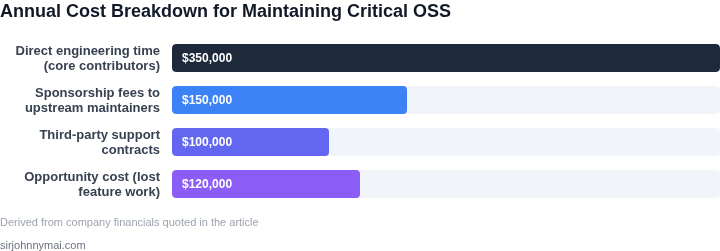
When a project depends on an open‑source component, the choice between building internal maintenance capability and buying external support is not binary. A disciplined framework lets us compare options against the same economic and operational signals that drove the cost calculations in Section 02. Below is a concise decision matrix that can be populated with actual data from finance, security, and engineering leads.
We start by defining the stakeholder questions: How quickly must a critical vulnerability be remediated? What is the acceptable downtime during a patch cycle? Which option preserves the tacit knowledge that our engineers have built around custom extensions? Answering these questions forces us to surface hidden assumptions before we assign dollars.
Next, we collect quantitative inputs for each criterion. Finance supplies total cost of ownership (salary, training, tooling, and vendor fees). Security provides mean time to resolution for high‑severity CVEs. Operations contributes integration overhead and SLA impact. The resulting numbers are entered directly into the table, allowing a side‑by‑side visual comparison.
Scaling considerations often shift the calculus. A single‑service dependency may be cheap to support internally, but when the same library appears in ten micro‑services the maintenance overhead multiplies. Third‑party contracts typically include multi‑tenant pricing that smooths cost across scale, whereas internal staffing scales linearly with the number of codebases that require custom integration. This distinction is reflected in the ‘Integration Overhead’ row of the matrix.
| Criteria | Option A (In‑house Team) |
Option B (Red Hat Enterprise Support) |
Option C (AWS Managed Open Source Services) |
|---|---|---|---|
| Total Cost of Ownership (annual) | High – salary, training, tooling | Medium – subscription fee with tiered pricing | Low‑to‑Medium – pay‑as‑you‑go on AWS |
| Mean Time to Patch Critical CVE (days) | 5‑7 | 1‑2 | 2‑3 |
| Knowledge Retention (1‑5) | 5 (full internal expertise) | 3 (shared with vendor) | 2 (minimal internal) |
| SLA Coverage (hours of guaranteed uptime) | Custom internal SLA – 99.9 % | Red Hat Enterprise SLA – 99.95 % | AWS Managed SLA – 99.9 % (support tier dependent) |
| Integration Overhead (person‑weeks per quarter) | 2‑3 | 0.5‑1 | 1‑2 |
| Recommended Option | Option B |
The matrix is a decision aid, not a calculator. If the organization values rapid patching above all else, the mean‑time‑to‑patch column will dominate the score. Conversely, a high weight on knowledge retention often tilts the balance toward an in‑house team, because external contracts can erode internal expertise over time.
A practical next step is to run the table with actual cost inputs from the FY‑24 budget and to assign a relative weight (0‑100) to each criterion based on strategic priorities. Multiplying weight by the normalized score yields an overall index for each option; the highest index becomes the baseline recommendation. The finance team can then model the budget impact of the chosen path, while security validates that the projected patch window meets compliance obligations.
Finally, we embed a quarterly review checkpoint. The same table is refreshed with actual spend, observed patch times, and any changes in vendor SLA terms. If the index drift exceeds a predefined threshold, the governance board escalates the decision and re‑evaluates the investment mix. This loop guarantees that the economics stay aligned with the evolving risk profile of our core services.
05. Action Step: Establish a Formal Open Source Governance Policy
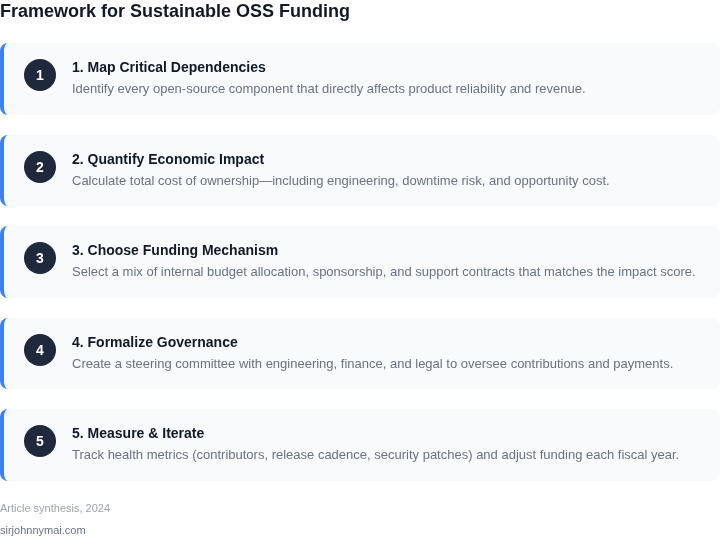
Creating a formal open source governance policy is the single most effective way to institutionalize risk management. Without it, decisions about dependencies become ad-hoc, leaving teams to rely on tribal knowledge or guesswork. A governance policy codifies your approach to open source, ensuring consistency across teams and reducing the risk of shadow dependencies.
Start by defining your policy’s scope. Will it cover only production dependencies, or will it extend to development tools and internal projects? The answer depends on your organization’s maturity. Early-stage companies may focus on production dependencies, while larger enterprises should include tooling and internal projects. Document this decision explicitly—scope creep is a common pitfall.
Next, establish clear ownership boundaries. Assign roles for dependency review, vulnerability management, and license compliance. For example, a dedicated open source office (OSPO) can handle compliance, while engineering teams focus on technical decisions. This separation of concerns prevents bottlenecks. Tools like FOSSA or Black Duck can automate license tracking, but they require clear ownership to be effective.
Define your approach to dependency approval. Will you use a risk-based model, where high-risk dependencies require executive sign-off? Or will you adopt a tiered system, where critical dependencies undergo deeper scrutiny? The choice depends on your tolerance for risk. For example, a financial services firm might require manual review for all dependencies, while a startup might use automated tools with human oversight for high-risk components.
Include a process for handling vulnerabilities. Will you use a patch-and-patch model, where you wait for upstream fixes? Or will you maintain forks for critical dependencies? The decision depends on your team’s capacity. For example, Kubernetes maintains forks of critical dependencies like etcd to ensure stability, but this requires significant resources.
Finally, document your policy in a living document. Use a platform like Confluence or GitHub Wiki** to ensure accessibility. Schedule quarterly reviews to update the policy based on new risks or changes in your dependency landscape. This keeps the policy relevant without becoming a bureaucratic burden.
Schedule a 30-minute review with your engineering and security teams to draft a high-level governance policy. Focus on scope, ownership, and approval processes. Use this as a starting point for deeper discussions.
Figures cited are from publicly available sources as of 2026-09-15 and may have changed.