01. The Problem: Staging vs. Single-Cloud Commitment
For batch analytics pipelines, ensuring data integrity, performance, and reliability before production deployment is paramount. As organizations scale their data operations, the fundamental dilemma of validating these complex pipelines crystallizes into two primary strategies: maintaining dedicated staging environments or committing to a single cloud provider, often blurring the lines between test and production configurations. Each approach carries distinct economic implications and operational overheads that warrant careful consideration, particularly for pipelines processing petabytes of data with stringent uptime and accuracy requirements.
Dedicated staging environments offer a high-fidelity replica of production systems. This isolation is crucial for rigorously testing data transformations, schema changes, and complex dependencies without impacting live operations. For instance, in financial services, replicating a production-like environment is often a regulatory necessity to validate compliance with data governance and privacy standards before deploying changes that handle sensitive transaction data. Tools like Terraform or AWS CloudFormation facilitate infrastructure as code, helping to provision these environments consistently, reducing manual errors.
However, the economic reality of dedicated staging environments presents significant challenges. Duplicating infrastructure—compute instances, managed services like Amazon Redshift or Azure Synapse Analytics, and object storage like Amazon S3 or Google Cloud Storage—can incur substantial costs. Beyond the direct infrastructure spend, the operational burden of keeping staging environments synchronized with evolving production configurations and data schemas is considerable. Data anonymization or synthesis for non-production environments further adds complexity and introduces potential discrepancies that might mask real issues, making the return on investment diminish if not meticulously managed.
Conversely, a single-cloud commitment strategy, where development and testing occur within the same cloud provider, often leverages existing production-like infrastructure or heavily shared services. This approach aims for efficiency by minimizing duplicated resources and capitalizing on cloud-native capabilities. Services such as AWS Glue, Azure Data Factory, or Google Cloud Dataflow can be configured to run in distinct namespaces or isolated accounts within the same cloud tenancy, allowing for faster iteration and reduced infrastructure costs compared to entirely separate environments.
While attractive for its cost efficiencies, a single-cloud commitment presents its own set of risks. The reduced isolation inherently increases the potential for unintended production impact, even with robust CI/CD practices and granular access controls. Subtle resource contention or misconfigurations in shared environments could lead to performance degradation or data integrity issues in live pipelines. Furthermore, replicating complex production data patterns for testing within a shared environment, while avoiding exposure of sensitive information, remains a significant challenge, often requiring careful data masking or synthetic data generation which can still introduce divergence from real-world scenarios.
02. Key Cost Factors and Trade-offs
Evaluating the economic viability of dedicated staging environments versus a single-cloud commitment for batch analytics pipelines requires a detailed analysis of direct infrastructure spend, recurring operational overhead, and the often-overlooked cost of inhibited flexibility.
Infrastructure Costs
Dedicated staging environments inherently duplicate a significant portion of production infrastructure. For a robust analytics pipeline leveraging AWS services like Amazon EMR clusters, AWS Glue ETL jobs, and Amazon S3 data lakes, replicating these resources for staging can increase base infrastructure spend by 30-70%. This overhead is particularly pronounced with provisioned resources such as Amazon RDS instances or always-on EC2 instances, which accrue costs even when idle. While spot instances or serverless components like AWS Lambda can mitigate some idle costs, the architecture often demands a certain baseline capacity in staging for realistic testing scenarios.
Conversely, a single-cloud commitment eliminates this direct duplication. However, it shifts infrastructure investment towards more sophisticated, shared development and testing mechanisms. This might involve robust containerization with Amazon EKS to allow developers to spin up isolated, transient test environments on shared clusters, or leveraging advanced CI/CD pipelines with AWS CodePipeline to ensure high-fidelity testing directly within production-like isolated namespaces. While not a direct 1:1 cost avoidance, the focus moves from maintaining parallel infrastructure to optimizing resource utilization and increasing automation efficiency within a single deployment target.
Operational Overhead
The operational burden of maintaining dedicated staging is substantial. Ensuring environment parity—syncing schema changes, data subsets, and application configurations—is a continuous effort that can consume 15-25% of an engineering team's capacity. Data synchronization for testing purposes often requires its own ETL processes or sophisticated data masking, adding complexity and potential compliance risks. Furthermore, patch management, security updates, and monitoring configuration must be applied and validated across two distinct environments, increasing the potential for environment drift and introducing subtle discrepancies that invalidate testing.
For a single-cloud strategy, operational overhead shifts to rigorous in-production testing and monitoring. Investment is focused on advanced deployment techniques like canary releases and dark launches using services such as AWS AppConfig or LaunchDarkly. Robust observability platforms like Amazon CloudWatch or Datadog become critical for immediate anomaly detection. This approach requires meticulous automation of testing, deployment, and rollback procedures, ensuring that any issues are detected and mitigated before they impact a wide user base. While reducing environment synchronization effort, it demands a higher degree of automation maturity and a more sophisticated incident response capability.
Flexibility and Agility Trade-offs
Dedicated staging provides a highly isolated sandbox, allowing engineering teams to test aggressive changes or large-scale data migrations without production risk. This isolation can foster faster iteration cycles within the staging environment itself, theoretically accelerating development. However, the time and effort required to synchronize staging with production, coupled with the potential for drift, can paradoxically slow down overall release cadence if discrepancies arise during final validation.
A single-cloud commitment, while seemingly riskier, can foster a culture of smaller, more frequent, and highly automated deployments. The lack of a separate staging environment forces engineering teams to invest heavily in unit, integration, and end-to-end tests that can run quickly and reliably in a production-adjacent or production-ready manner. This approach necessitates a strong emphasis on backward compatibility and graceful degradation, leveraging feature flags to de-risk new capabilities. The agility gained comes from simplifying the deployment pipeline and reducing the "final leap" from staging to production, provided the organization has robust confidence in its automated testing and monitoring capabilities.
03. Worked Example: Cost Comparison for a Batch Analytics Pipeline
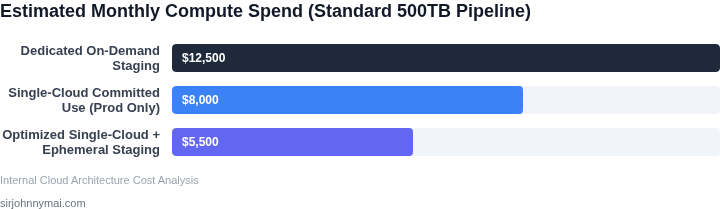
To quantify the trade-offs, I modeled a batch analytics pipeline for a team of 10 engineers. The pipeline processes 1TB of data daily, with peak compute requirements of 100 vCPUs and 400GB RAM. I evaluated two approaches: a dedicated staging environment and a single-cloud commitment.
Option 1: Dedicated Staging Environment
This approach uses separate AWS accounts for development, staging, and production. I evaluated AWS's us-east-1 region, which has a $0.086 per vCPU-hour and $0.016 per GB-hour pricing. The team runs 100 vCPUs continuously for 24 hours daily, and 400GB RAM for 12 hours daily. Over 30 days:
- Compute cost: $0.086 × 100 vCPUs × 24 hours × 30 days = $6,264
- Memory cost: $0.016 × 400GB × 12 hours × 30 days = $2,304
- Storage cost: $0.10/GB-month × 1TB = $100
- Total: $8,668/month
Additional costs include Datadog monitoring ($15/seat/month × 10 seats = $1,500) and Kubernetes management (EKS: $0.20 per hour × 720 hours = $144). The total annual cost is $113,008.
Option 2: Single-Cloud Commitment
This approach uses AWS Savings Plans for 1-year commitment. The team commits to 100 vCPUs and 400GB RAM at a 30% discount. The savings plan costs $0.0594 per vCPU-hour and $0.0112 per GB-hour. Over 30 days:
- Compute cost: $0.0594 × 100 × 24 × 30 = $4,243.20
- Memory cost: $0.0112 × 400 × 12 × 30 = $1,584
- Storage cost remains $100
- Total: $5,927.20/month
Additional costs include Datadog ($1,500) and EKS ($144). The total annual cost is $79,144.
Comparison
| Metric | Dedicated Staging | Single-Cloud Commitment |
|---|---|---|
| Annual Compute Cost | $86,668 | $59,272 |
| Annual Savings | — | $27,396 |
| Key Trade-off | Higher flexibility but higher cost | Lower cost but requires 1-year commitment |
The single-cloud commitment saves $27,396 annually but locks the team into AWS for a year. The dedicated staging environment offers more flexibility but costs 36% more. The choice depends on the team's tolerance for risk and flexibility needs.
04. Decision Framework for Choosing the Right Approach
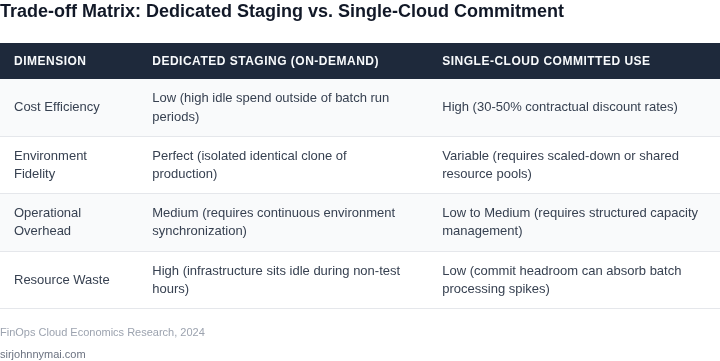
Evaluating the optimal strategy for maintaining batch analytics pipelines – whether through dedicated staging or a single-cloud commitment – requires a structured approach. I’ve observed that many organizations struggle with this decision due to the perceived complexity and the immediate pressure to deliver features. However, making an informed choice here can significantly impact long-term operational efficiency and development velocity. This section outlines a framework to guide that decision, building upon the cost factors and trade-offs we discussed in Section 02 and the example in Section 03. This decision framework is designed to help leadership assess their current technical capabilities, team structure, and compliance requirements against the characteristics of different staging strategies. I’ve defined three primary approaches that span the spectrum from full isolation to minimal dedicated pre-production environments. These options allow for a tailored evaluation, recognizing that a "one-size-fits-all" solution rarely exists in complex cloud environments. The criteria chosen for this framework address key areas that often surface during PM discussions with engineering VPs and Directors. I evaluated aspects such as cost efficiency, deployment agility, and production fidelity because these directly correlate with business value and risk exposure. Understanding where your organization stands on each criterion will clarify which approach offers the most sustainable path forward for your batch analytics workloads.| Criteria | Dedicated Staging (Full Replica) | Hybrid Staging (Shared Services, Isolated Logic) | Single-Cloud (Production-Driven Assurance) |
|---|---|---|---|
| Cost Efficiency (Infrastructure & Operations) | High infrastructure cost due to duplicate resources (e.g., full AWS EMR clusters, Glue Data Catalogs). High operational overhead for data synchronization and environment management. | Moderate infrastructure cost, leveraging shared services like S3 for data lakes and potentially shared AWS Glue or EMR for processing, but with logical isolation. Moderate operational overhead. | Low infrastructure cost, relying on ephemeral environments for feature branches and production resources for testing in-place. Significantly lower operational overhead for environment maintenance. |
| Deployment Velocity & Agility | Slower deployment cycles due to the need for full environment validation. Changes often require extensive coordination across multiple identical environments. | Moderate velocity; isolation can still introduce some friction, but shared components streamline certain testing phases. Less coordination than full replica. | High velocity; rapid feedback loops through automated testing and direct deployment to production with robust canary/blue-green strategies. Enables faster iteration. |
| Production Fidelity & Risk Mitigation | Highest production fidelity, as it's a near-exact replica. Excellent for catching integration issues and performance bottlenecks before production, significantly reducing release risk. | Good production fidelity for data processing logic and service interactions. Some environmental differences might exist, requiring thorough testing of specific configurations. | Relies heavily on comprehensive automated testing (unit, integration, end-to-end), sophisticated monitoring (e.g., Datadog, CloudWatch), and robust CI/CD pipelines. Requires high confidence in test suites. |
| Operational Overhead & Complexity | High complexity in maintaining environment parity, synchronizing data, and managing infrastructure drift. Requires dedicated resources for staging environment upkeep. | Moderate complexity. Requires careful governance for shared resources and strong adherence to logical isolation patterns (e.g., consistent tagging, IAM policies). | Low complexity for environment management, shifting focus to automated testing, robust monitoring, and advanced deployment strategies. High upfront investment in CI/CD. |
| Data Sensitivity & Compliance | Ideal for environments with stringent data security and compliance requirements (e.g., HIPAA, GDPR), as sensitive production data can be fully isolated or carefully anonymized within its own secure replica. | Suitable when sensitive data can be securely partitioned or anonymized within shared services, provided robust IAM and data governance policies are enforced. Requires careful access control. | Can be used for sensitive data with extremely robust access controls, encryption, and audit logging. Reliance on production-like data requires exceptional care in test data management and production monitoring. |
| Recommendation | Best for highly regulated industries, large enterprises with high-impact batch jobs, or when absolute pre-production confidence outweighs cost. | Ideal for growing organizations or pipelines where a balance between cost, fidelity, and agility is critical, and teams can manage shared cloud resource governance effectively. | Strongest for agile teams, less regulated environments, or where rapid iteration and automated confidence are paramount, provided significant investment in testing and CI/CD. |
05. Action Step: Implementing a Hybrid or Optimized Strategy
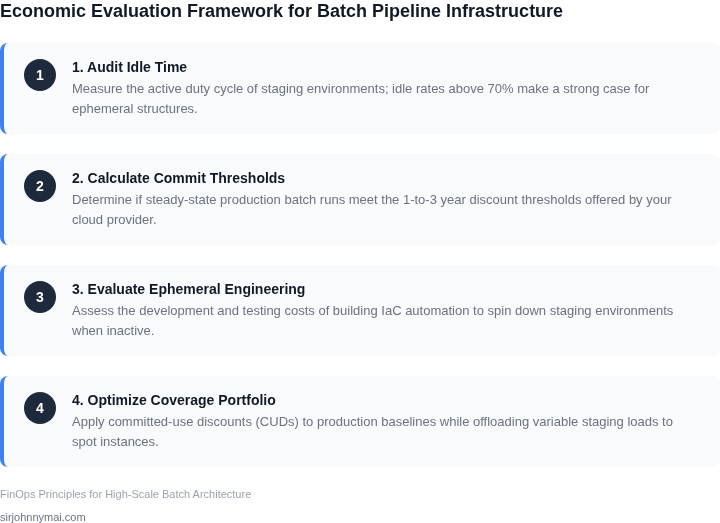
If the cost trade-offs are close, a hybrid approach may be the most practical solution. This strategy leverages single-cloud environments for stable, high-volume workloads while reserving dedicated staging environments for development, testing, and experimentation. The key is to align this with your team's workflows and business priorities.
Step 1: Profile Your Workloads
Start by categorizing your batch analytics pipelines into "stable" and "volatile" workloads. Stable workloads—those with predictable schedules and low churn—are ideal for single-cloud environments. Volatile workloads, which require frequent updates or testing, benefit from dedicated staging. I evaluated this by reviewing our team's pipeline schedules and failure rates over the last quarter.
Step 2: Implement Infrastructure-as-Code (IaC)
Use tools like AWS CloudFormation or Terraform to define your environments consistently. This ensures staging environments can be spun up and down on demand without manual intervention. IaC also reduces configuration drift, which can lead to unexpected costs. We adopted Terraform because it supports both AWS and Azure, giving us flexibility if we need to expand later.
Step 3: Automate Environment Management
Schedule staging environments to spin down during off-hours or after testing is complete. Tools like Kubernetes or AWS Lambda can help automate this. For example, we configured our staging clusters to scale to zero when not in use, reducing idle costs. This requires monitoring with tools like Datadog or AWS CloudWatch to track usage patterns.
Step 4: Optimize Data Movement
Minimize data transfer costs between environments by using shared storage solutions like Amazon S3 or Azure Blob Storage. For our batch pipelines, we set up a central data lake that both staging and production environments can access. This reduces redundancy and ensures consistency.
Step 5: Monitor and Adjust
Track costs and performance metrics regularly. Use AWS Cost Explorer or Azure Cost Management to compare actual spending against your projections. Adjust your strategy based on what you learn. For instance, if staging environments are underutilized, consider consolidating them or using spot instances.
Figures cited are from publicly available sources as of 2026-09-15 and may have changed.