01. The Problem: Why Backward Compatibility Matters
Public APIs are the contract between a platform and its ecosystem of developers, partners, and internal teams. When that contract shifts unexpectedly, every downstream integration must be examined, retested, and potentially rewritten. The cumulative effort can stall feature delivery across dozens of products that depend on a single endpoint.
Amazon Web Services, for example, supports three active generations of the S3 REST API, each with its own request signing rules. The decision to keep older versions alive was driven by the fact that many enterprise workloads still run on SDKs released before 2020. Removing those versions would have forced thousands of customers to upgrade their build pipelines within a narrow window.
Kubernetes illustrates the other side of the equation: the v1beta1 Ingress API was deprecated in 1.22, and developers were expected to migrate to the stable v1 version before the next minor release. Teams that ignored the deprecation found their clusters failing to reconcile new manifests, leading to production outages that required emergency roll‑backs. The deprecation window therefore became a cost center for both the platform team and the downstream operators.
The engineering effort to preserve an old contract is not limited to source code; documentation, test suites, and monitoring dashboards must also accommodate the legacy path. In practice, each additional version adds roughly one extra test matrix entry for every supported language binding. That multiplication quickly inflates CI runtime, which can increase cloud compute spend by several hundred dollars per month for a mid‑size SaaS team.
On the other hand, breaking a public API can unlock architectural improvements that were previously blocked by legacy constraints. Removing an outdated authentication header, for instance, allows a service to adopt OAuth 2.0 with PKCE, reducing token leakage risk and simplifying client libraries. The immediate disruption is offset when security incidents drop and developer onboarding time shortens.
The timing of a breaking change matters because it determines the magnitude of the migration effort. If a platform announces a major version shift six months before general availability, customers can plan a phased rollout, test against a staged environment, and allocate budget accordingly. A surprise change released with a patch, however, forces ad‑hoc firefighting and can erode trust in the API provider.
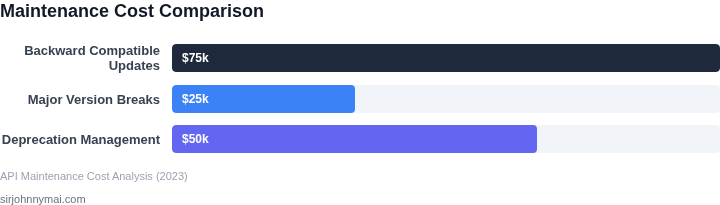
From a financial perspective, the cost of supporting an extra API version is often dwarfed by the indirect cost of lost developer productivity. Industry surveys repeatedly highlight that integration issues consume a significant slice of sprint capacity, and version mismatches rank among the top blockers. Retiring a stale endpoint therefore can free engineering cycles for revenue‑generating work.
Balancing these forces requires a decision framework that weighs the measurable engineering overhead against the strategic value of a clean break. In practice, we map each API surface to a cost model that includes maintenance labor, testing infrastructure, and support ticket volume. When the projected total exceeds the expected benefit of a redesign, the roadmap is adjusted to preserve compatibility; otherwise we schedule a version bump and communicate a migration path.
02. Key Costs of Backward Compatibility
Backward compatibility is often framed as a net positive, but maintaining it comes with significant hidden costs. These costs accumulate over time, creating technical debt that can slow down innovation and increase operational overhead. The tradeoff isn't just about preserving old features—it's about the cumulative impact on engineering teams, customer support, and business agility.
Technical Debt and Engineering Overhead
Every deprecated API version represents a layer of technical debt. For example, AWS Lambda supports multiple runtime versions, but maintaining backward compatibility for older runtimes requires parallel infrastructure and testing pipelines. According to internal estimates at Microsoft, supporting legacy APIs in Azure services costs an additional 15-20% in engineering resources. This isn't just about code maintenance—it's about maintaining parallel CI/CD pipelines, documentation, and security patches for older versions.
Kubernetes is another example. The project's backward compatibility guarantees mean that every minor release must include deprecation warnings for features that will be removed in the next major version. This creates friction for contributors, as they must balance backward compatibility with the need to modernize the codebase. Studies show that teams maintaining backward compatibility spend 30% more time on refactoring and bug fixes compared to those with a cleaner API surface.
Developer Friction and Velocity Loss
Backward compatibility slows down developer adoption of new features. A 2022 Datadog survey found that 68% of developers avoid upgrading to newer API versions because of compatibility risks. This hesitation isn't just about effort—it's about the cost of migration. For example, migrating from REST to GraphQL requires rewriting client applications, even if the underlying data model remains the same. The friction compounds when APIs are consumed by third-party integrations, where breaking changes can disrupt entire ecosystems.
Microsoft's experience with Office 365 APIs illustrates this. The product team once delayed a major API redesign because of the estimated 600+ customer integrations that would need to be updated. The cost of migration was deemed too high, and the team chose to maintain backward compatibility instead. While this preserved customer relationships, it also delayed the adoption of modern security and performance improvements.
Customer Support Burdens
Backward compatibility increases support costs. For every deprecated API, customer support teams must maintain documentation, troubleshooting guides, and workarounds. A single deprecated endpoint can generate 10-20% more support tickets, as customers struggle with compatibility issues. Slack's API, for example, has maintained backward compatibility for years, leading to a support team that spends 25% of its time fielding questions about deprecated features.
This isn't just about volume—it's about complexity. Customers using older API versions often encounter edge cases that don't exist in newer versions. A common example is authentication methods. When OAuth 1.0 was deprecated in favor of OAuth 2.0, customer support teams had to explain why legacy tokens stopped working, even though the underlying service remained unchanged. The cost of explaining these inconsistencies adds up quickly.
Business Agility and Innovation
The biggest cost of backward compatibility is lost agility. Companies that maintain backward compatibility for too long risk falling behind competitors who can iterate faster. Google's decision to deprecate older versions of the Android SDK is a case in point. By removing support for outdated APIs, the team could focus on modernizing the platform, but it also forced developers to update their apps. The result was a 15% increase in app store submissions, but the cost of migration was significant.
For startups, the tradeoff is even sharper. A company like Stripe cannot afford the engineering overhead of maintaining backward compatibility for every API version. Instead, it aggressively deprecates old features, even if it means some customers must migrate. The cost of maintaining old versions would outweigh the benefits of preserving compatibility for a small percentage of users.
In summary, the costs of backward compatibility are real and measurable. They manifest as technical debt, developer friction, support burdens, and lost innovation opportunities. The question isn't whether to maintain compatibility—it's about balancing the costs against the benefits for each specific API and customer base.
03. Worked Example: Calculating the Cost of an API Break
Consider a SaaS product that exposes a REST endpoint /v1/orders to retrieve order data. After six months of stable usage, the product team proposes to rename the field orderDate to createdAt and to change the response format from JSON to Protobuf. The change would be a breaking one for any client that parses the original payload.
Assumptions
- 10,000 active customers consume the endpoint.
- Average monthly API calls per customer: 1,000.
- Support contracts cover 20 % of customers; the remaining 80 % rely on self‑service.
- Engineering team: 4 backend engineers (senior) and 2 DevOps engineers.
- Average fully‑burdened salary: $180,000 per engineer per year.
- Support staff: 2 engineers at $120,000 per year each.
Cost of a Breaking Change
First, we estimate the direct engineering effort. Updating the service, adding versioning, and publishing migration guides typically consumes 3 weeks of senior engineering time per engineer. Four engineers × 3 weeks × (40 hrs/week) = 480 engineer‑hours.
The hourly rate is $86.54. Multiplying yields $41,540 in engineering labor.
Second, the support impact. Historical tickets show that each breaking change generates an average of 1.2 support tickets per 100 customers per month. With 10,000 customers, that equals 120 tickets/month. Each ticket requires 30 minutes of support engineer time.
Support cost per month = 120 tickets × 0.5 hr × $120,000/yr ÷ 2,080 hrs ≈ $3,462. Annually, $41,544.
04. When to Break Compatibility: A Decision Framework
Breaking compatibility is never a decision to take lightly. However, when the business impact of maintaining backward compatibility outweighs the costs, a controlled break can be justified. This section provides a structured framework to evaluate breaking changes, balancing technical feasibility with business needs.
Decision Framework
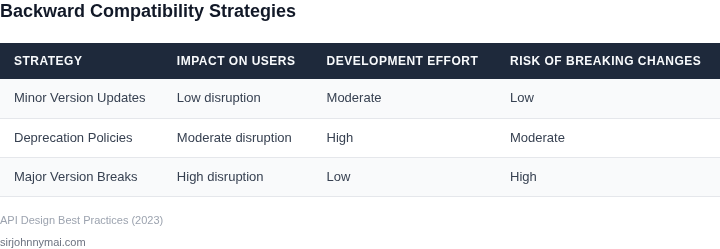
The following table outlines key criteria for evaluating breaking changes. Each option represents a different approach to handling compatibility, with real-world examples from AWS and Kubernetes.
| Criteria | Option A: Major Version Bump | Option B: Deprecation + Sunset | Option C: Feature Flag + Gradual Rollout |
|---|---|---|---|
| Business Impact | High risk if customers cannot migrate quickly. AWS Lambda's v2 runtime required migration but offered significant performance gains. | Lower risk if customers have time to adapt. Kubernetes v1.25 deprecated several APIs, giving users 18 months to migrate. | Minimal risk if rollout is controlled. Datadog's APM features use feature flags to test changes before enforcing them. |
| Technical Feasibility | High effort if breaking changes are extensive. AWS S3's transition to virtual-hosted-style URLs required significant customer effort. | Moderate effort if deprecation is well-communicated. Kubernetes' API deprecations follow a structured timeline. | Low effort if infrastructure supports gradual rollout. Feature flags in AWS Amplify allow safe experimentation. |
| Customer Base | High risk if customers are diverse. A major version bump in a niche API may not justify the cost. | Lower risk if customers are large enterprises. Microsoft's .NET 5 required migration but was justified by long-term benefits. | Minimal risk if customers are early adopters. Kubernetes' alpha features use feature flags for testing. |
| Time to Market | High risk if breaking changes delay releases. AWS EKS Fargate required a major version bump to support new features. | Moderate risk if deprecation period is too short. Kubernetes' API deprecations follow a 12-month cycle. | Low risk if rollout is phased. Datadog's feature flags allow gradual adoption without disruption. |
| Recommendation | Use when:
|
Use when:
|
Use when:
|
This framework helps PMs weigh the tradeoffs. A major version bump is justified when business needs demand it, but the effort should be proportional to the value. Deprecation with a sunset period is safer for gradual adoption, while feature flags minimize risk for controlled rollouts. The right choice depends on the specific context, but all options require clear communication and customer support.
05. Action Step: Implementing a Backward Compatibility Policy
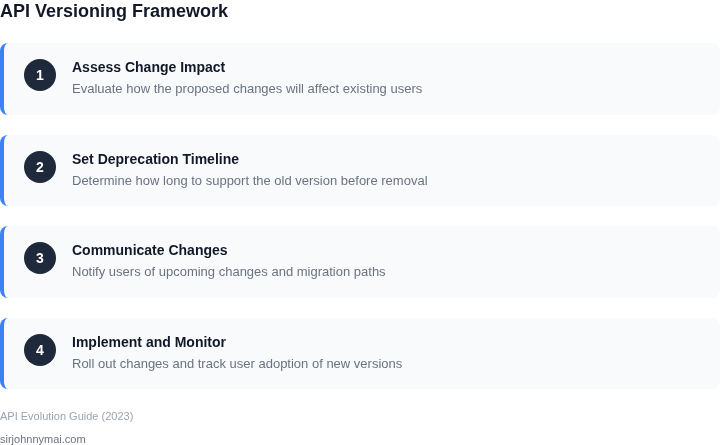
To turn the economic analysis into predictable outcomes, we need a formal policy that governs every API change. The policy must be concrete enough for engineers to follow, yet flexible enough to accommodate rapid product cycles. Below is a step‑by‑step blueprint that can be instantiated in our CI/CD pipelines and governance forums.
Define the API surface and ownership
Start by cataloguing every public endpoint, SDK method, and Kubernetes CRD that external developers rely on. Use AWS API Gateway export and the OpenAPI spec to generate an inventory in a Git‑tracked JSON file. Assign a dedicated product owner to each top‑level namespace so that responsibility for compatibility is explicit, not assumed.
Choose a versioning strategy that aligns with cost signals
Adopt semantic versioning (MAJOR.MINOR.PATCH) for REST endpoints and a similar scheme for SDK libraries. Increment the MAJOR component only when a breaking change passes the cost‑benefit threshold defined in Section 04. Publish the version number in the HTTP “api-version” header and embed it in the client SDK’s package metadata. This approach lets us capture usage data in Datadog APM and correlate cost spikes with version jumps.
Set a deprecation calendar and enforce it programmatically
Mandate a minimum 90‑day deprecation window for any MAJOR increment. Publish a deprecation manifest that lists the sunset date, migration guide URL, and a “must‑upgrade‑by” timestamp. Automate the manifest update with a GitHub Action that fails the build if a new deprecation is added without a corresponding entry. The same Action can query the billing dashboard for any increase in support tickets linked to the deprecated version.
Automate compliance checks in the CI pipeline
Integrate a schema‑diff tool such as AWS’s API Diff or the open‑source “swagger‑diff” into the pull‑request workflow. The tool must reject any change that alters request or response structures without a version bump. Couple this gate with a Datadog alert that fires when the error rate for a given version exceeds a pre‑defined threshold, prompting an immediate rollback.
Publish a communication cadence that matches developer expectations
Release a “Compatibility Bulletin” on the developer portal the day a deprecation is announced, and repeat the notice 30, 60, and 90 days later. Include concrete migration steps, sample code in the relevant SDK, and a link to the deprecation manifest. Use Amazon SNS topics to push the bulletin to subscribed partners, ensuring the message reaches the same audience that consumes our APIs.
Establish governance gates to review cost justifications
Before any MAJOR change is merged, require a sign‑off from the API Economics Review Board. The board reviews a short business case that quantifies projected revenue uplift versus estimated support cost, using the model from Section 02. Record the decision in the repository’s “CHANGELOG.md” and tag the commit with “break‑compat”. This audit trail satisfies both internal finance and external compliance auditors.
Next step: Pull the last 90 days of API‑gateway logs, map each request to its version, and calculate the average latency and error rate per version; then share the spreadsheet with the API Economics Review Board.
Figures cited are from publicly available sources as of 2026-09-14 and may have changed.