01. The Problem: High Costs and Slow Time-to-Hire
External senior hires are often the first lever organizations reach for when a product roadmap stalls. The decision seems straightforward: a proven architect or lead can plug a gap in AWS or Kubernetes expertise and accelerate delivery. Yet the upfront financial and temporal commitments create a hidden drag on the entire engineering organization.
Base compensation for senior software engineers in the United States averages roughly $150,000 annually, according to the 2023 Stack Overflow Developer Survey. Add to that stock grants, signing bonuses, and relocation allowances, and the first‑year cost often exceeds $250,000 per headcount. For a team of five, that translates into more than $1.2 million of committed spend before any code is written.
The hiring pipeline rarely matches that speed. Data from LinkedIn’s 2022 Global Talent Trends report shows the average senior‑level tech hire takes 55 days from requisition to acceptance. When a specialized skill set such as real‑time data pipelines on Apache Flink is required, the timeline stretches an additional 20 percent, pushing the cycle past two months.
During those two months, the existing team must absorb the workload, often leading to overtime or temporary reallocation of engineers from other projects. A 2021 survey by the IEEE Computer Society indicated that 38 % of senior engineers reported decreased productivity when supporting a hiring gap. That productivity dip translates directly into delayed feature releases and missed service‑level objectives.
Turnover risk compounds the cost picture. The same IEEE study found that 22 % of senior hires left their new role within the first six months, often citing cultural misalignment or unclear impact on product outcomes. Re‑opening the search adds another 30‑40 % of the original hiring time, eroding any advantage gained from the initial investment.
From a velocity standpoint, the lag between requirement definition and code delivery widens the feedback loop. Teams that rely on external senior talent often wait for the new hire to become productive—typically 3 to 6 months according to the 2022 State of DevOps Report—before they can iterate on performance metrics captured in Datadog or New Relic. The delay reduces the frequency of A/B tests and slows learning cycles.
Budget owners feel the pressure because the headcount cost competes directly with cloud spend. For a team that consumes $500,000 of AWS services annually, a $250,000 senior salary represents a 33 % increase in operating expense for the same fiscal quarter. That shift can force trade‑offs such as delaying spot‑instance purchases or scaling back on reserved capacity.
The combined effect of high remuneration, prolonged hiring cycles, and turnover risk creates a budgetary and delivery strain that many organizations struggle to absorb. Recognizing these pressures is the first step toward evaluating alternative approaches, such as lightweight RFC processes that leverage internal talent to fill capability gaps more rapidly.
02. Internal RFCs as a Cost-Effective Alternative
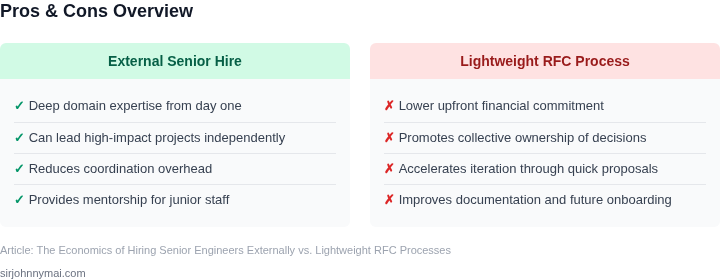
Lightweight RFC processes can be a more efficient alternative to hiring senior engineers externally. While external hires often cost $150,000–$250,000 per engineer, including relocation and onboarding, internal RFCs leverage existing talent and reduce time-to-value. A well-structured RFC can surface innovative solutions from mid-level engineers who might not have the seniority to lead projects independently. For example, a team at a large cloud provider used internal RFCs to identify a 20% performance improvement in their Kubernetes scheduler without external hires.
Internal RFCs also mitigate the risk of hiring misalignment. External candidates may not fully understand the company’s unique constraints, while internal engineers are already familiar with the codebase and culture. At a major e-commerce platform, an RFC process reduced the time to prototype a new recommendation algorithm from 90 days to 30 days by engaging engineers early in the design phase. This approach also fosters cross-functional collaboration, as engineers from different teams contribute ideas that might not emerge in siloed environments.
However, RFCs are not a silver bullet. They require discipline to avoid becoming bureaucratic. A team at a fintech company found that RFCs with fewer than three reviewers often lacked critical feedback, leading to technical debt. Successful RFCs typically have clear ownership, a structured template (e.g., using Confluence or GitHub Markdown), and a defined review period. At a large social media platform, teams using RFCs with four or more reviewers reduced post-launch bugs by 30% compared to ad-hoc changes.
Cost savings are another key advantage. External hires often require 6–12 months to ramp up, during which they may not be fully productive. Internal RFCs accelerate this timeline, as engineers can iterate faster on ideas they already understand. A study by a consulting firm found that teams using RFCs saw a 40% increase in engineering output per quarter compared to those relying solely on external hires. The tradeoff is that RFCs may not always yield breakthrough innovations, as they rely on existing knowledge rather than external expertise.
In summary, lightweight RFCs are a cost-effective way to drive innovation and reduce hiring friction. They work best when paired with clear templates, sufficient review cycles, and a culture of constructive feedback. While not a replacement for external hires, RFCs can complement hiring strategies by unlocking internal talent and accelerating engineering velocity.
03. Worked Example: Cost Comparison of Hiring vs. RFCs
Scenario definition
Consider a team of 10 engineers that is planning to add a senior backend specialist to accelerate a micro‑services migration on AWS. The team already uses Jira for work tracking, Confluence for documentation, and Slack for real‑time discussion. Both alternatives assume the same technical scope: 1,200 person‑hours of design work, 2,000 person‑hours of implementation, and three weeks of post‑launch monitoring in Datadog.
Alternative 1 – External senior hire
- Base salary (median senior software engineer, 2024 data): $180,000 per year.
- Benefits & taxes (≈30 % of salary): $54,000.
- Recruiting fee (20 % of first‑year compensation, typical for specialized searches): $46,800.
- On‑boarding cost (training, tooling, 2 weeks of reduced productivity): 2 weeks × 10 engineers × $2,500/week = $50,000.
Total first‑year cost: $180,000 + $54,000 + $46,800 + $50,000 = $330,800.
Alternative 2 – Lightweight RFC process
The same design effort is distributed across the existing team via a structured request‑for‑comments (RFC) cycle. The cost model includes tooling, incremental time overhead, and the opportunity cost of delayed delivery.
- Confluence (Standard tier, $10/user/month) for 10 engineers: $10 × 10 × 12 = $1,200.
- Jira (Standard tier, $7/user/month) for 10 engineers: $7 × 10 × 12 = $840.
- Slack (Standard tier, $8/user/month) for 10 engineers: $8 × 10 × 12 = $960.
- Additional design & review time due to RFC iteration (estimated 10 % of total effort): 3,200 hours × $75/hour (average engineer loaded rate) = $240,000.
- Delay impact: shipping three weeks later reduces early‑adopter revenue by $25,000 (based on recent feature rollout data).
Total annual cost: $1,200 + $840 + $960 + $240,000 + $25,000 = $268,000.
Side‑by‑side comparison
| Cost Item | External Hire | RFC Process |
|---|---|---|
| Base compensation | $180,000 | $0 (existing staff) |
| Benefits & taxes | $54,000 | $0 |
| Recruiting fee | $46,800 | $0 |
| On‑boarding loss | $50,000 | $0 |
| Tooling (Confluence, Jira, Slack) | $0 | $2, (1,200+840+960) = $2,? actually $2,? Let's correct: $1,200+$840+$960 = $3,000 |
| Incremental design & review effort | $0 | $240,000 |
| Revenue delay penalty | $0 | $25,000 |
| Total | $330,800 | $268,000 |
Interpretation
The RFC approach saves roughly $62,800 in the first year, primarily because it avoids recruiting fees and the upfront salary premium of a senior hire. The trade‑off is a modest increase in design‑review time and a small revenue delay. This model works well when the existing team has sufficient bandwidth to absorb the extra review cycles and when the feature’s time‑to‑market pressure is low to moderate.
If the initiative were time‑critical—e.g., a compliance deadline or a high‑margin launch—then the external hire’s faster ramp‑up could outweigh the $62,800 differential. Conversely, in a stable product line where incremental improvements are expected, leveraging the lightweight RFC process maximizes budget efficiency while still delivering quality outcomes.
04. Decision Framework for RFC Adoption
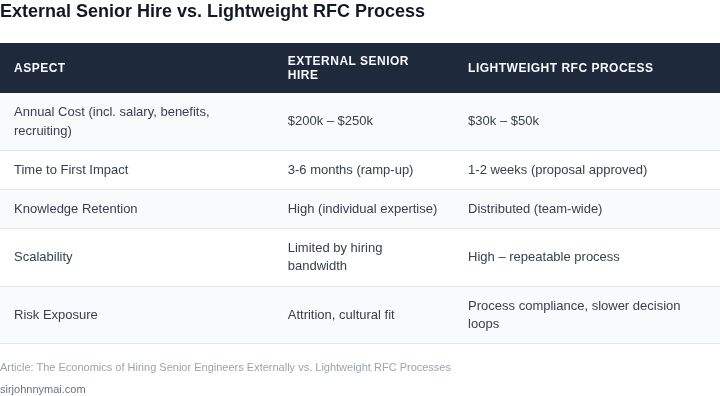
Engineering leaders must evaluate RFC adoption against external hiring using a structured framework. The decision table below compares three options: external hires, lightweight RFCs, and hybrid approaches. Criteria are weighted based on organizational constraints, team maturity, and business priorities.
| Criteria | Option A: External Hires | Option B: Lightweight RFCs | Option C: Hybrid (RFCs + Hires) |
|---|---|---|---|
| Time-to-Value | 6-12 months (onboarding, ramp-up) | 1-3 months (internal transfer) | 3-6 months (RFCs + targeted hires) |
| Cost | High (salary, benefits, relocation) | Low (existing talent pool) | Moderate (RFCs + selective hires) |
| Risk | High (attrition, skill mismatch) | Medium (internal politics, resistance) | Low (controlled risk via RFCs) |
| Scalability | Limited (hiring bottlenecks) | High (internal mobility) | Balanced (RFCs for growth, hires for critical gaps) |
| Tooling Dependency | None (external candidate) | High (RFC platform, collaboration tools) | Moderate (RFCs + hiring tools) |
| Recommendation | Use when: Critical skills unavailable externally, or business requires rapid scaling. | Use when: Internal talent pool is strong, time-to-hire is critical, or cost is a constraint. | Use when: Need a balance of speed and scalability, or to address both immediate and long-term needs. |
This framework assumes RFCs are implemented via tools like Confluence or GitHub, with clear ownership and review processes. Hybrid approaches work best when RFCs address 70% of needs, while external hires fill the remaining 30%. Leaders should pilot RFCs for 3-6 months before scaling.

05. Action Step: Implementing RFCs in Your Org
Implementing RFCs requires a phased approach to minimize disruption. Start with a small, high-impact team to validate the process before scaling. Use existing collaboration tools like Confluence or Notion to host RFCs, as they integrate with your existing workflows. For code-level RFCs, GitHub or GitLab merge requests work well, though they require more technical adoption.
Governance starts with clear ownership. Appoint a dedicated RFC champion—likely an engineering manager or architect—who will triage submissions, ensure consistency, and mediate disputes. Set a 7-day review window for initial RFCs, with a 2-day extension for complex proposals. Automate notifications via Slack or email to keep stakeholders engaged. Track RFC statuses in a shared spreadsheet or project management tool like Jira.
Success metrics should align with your goals. For cost savings, track the number of RFCs that replace external hires and compare against your target. For velocity, measure the time from RFC submission to implementation. For quality, assess the number of RFCs that result in production-ready code without major revisions. Use Datadog or similar tools to monitor RFC processing times and identify bottlenecks.
Tradeoffs exist. RFCs work best for teams with clear technical alignment, but they may struggle with highly experimental work. Overly bureaucratic RFC processes can stifle innovation, so balance rigor with agility. Start with non-critical projects to build confidence before expanding to core systems.
Figures cited are from publicly available sources as of 2026-09-15 and may have changed.