01. The Problem: Cost and Impact of Hiring vs. Coaching
Engineering organizations face a critical choice: hire senior engineers externally or invest in coaching existing managers to elevate their teams. Both approaches have distinct cost and impact trade-offs, and understanding these differences is essential for long-term success. The decision hinges on the organization's current talent pipeline, budget constraints, and strategic priorities.
Cost of Hiring Externally
Hiring senior engineers externally is expensive. According to industry benchmarks, the average cost to hire a senior engineer in the U.S. ranges from $150,000 to $250,000, including recruitment, relocation, and onboarding. This figure does not account for the time-to-productivity gap—many new hires take 6 to 12 months to reach full effectiveness. For organizations with tight budgets or competitive hiring markets, this cost can strain resources, particularly if multiple roles are needed simultaneously.
Beyond direct hiring costs, external hires often require additional infrastructure investments. Senior engineers may need access to specialized tools, cloud services (e.g., AWS, Kubernetes), or monitoring platforms (e.g., Datadog) to perform at peak efficiency. These tools can add up quickly, with annual licensing and maintenance costs exceeding $50,000 per engineer in some cases. The total cost of ownership (TCO) for a new hire, including salaries, tools, and lost productivity during ramp-up, can easily exceed $300,000.
Cost of Coaching Internally
Coaching existing managers to improve engineering performance is a more sustainable approach. While the upfront cost is lower—coaching programs typically range from $5,000 to $20,000 per manager, depending on the duration and expertise of the coach—the long-term benefits can be substantial. Research shows that well-coached managers can drive a 20% to 30% improvement in team productivity within 12 months, directly offsetting the initial investment.
However, coaching is not a one-time fix. Effective coaching requires ongoing engagement, typically 1-2 hours per week per manager, and access to coaching platforms like 7Geese or Lattice. The total cost of a structured coaching program, including platform licenses and coach salaries, can range from $100,000 to $500,000 annually for a team of 20-50 engineers. This cost is justified when considering the compounded impact of improved team performance over multiple years.
Impact on Team Performance
The impact of hiring externally versus coaching internally is not just about cost. External hires bring immediate expertise but may also introduce cultural misalignment or disrupt existing workflows. A study by McKinsey found that 70% of new hires fail to meet performance expectations within the first 18 months, often due to poor integration or unrealistic expectations. This risk is mitigated by coaching, which focuses on developing existing talent rather than replacing it.
Coaching, when done well, fosters a culture of continuous improvement. Managers who receive coaching learn to identify and address bottlenecks proactively, reducing technical debt and accelerating feature delivery. For example, a team coached to adopt Agile methodologies may see a 15% increase in sprint velocity within six months. In contrast, external hires may require time to adapt to the team's processes, potentially delaying impact.
When to Choose Which Approach
The optimal strategy depends on the organization's specific context. Hiring externally makes sense when there is a critical skills gap that cannot be addressed internally, such as expertise in a niche technology like quantum computing or AI/ML. However, this approach is risky if the organization lacks the bandwidth to integrate the new hire effectively.
Coaching is ideal for organizations with a strong existing talent pool but struggling with execution. It works best when paired with tools like GitHub Advanced Security or Jira Service Management to provide managers with the data they need to make informed decisions. The trade-off is that coaching requires a cultural shift toward mentorship and continuous learning, which may not resonate with all teams.
Ultimately, the decision should be data-driven. Organizations should model both approaches using tools like Monte Carlo simulations to predict ROI over 3-5 years. The goal is not to choose the cheaper option but to align the approach with the organization's growth trajectory and risk tolerance.
02. Key Cost Factors: Salary, Training, and Retention
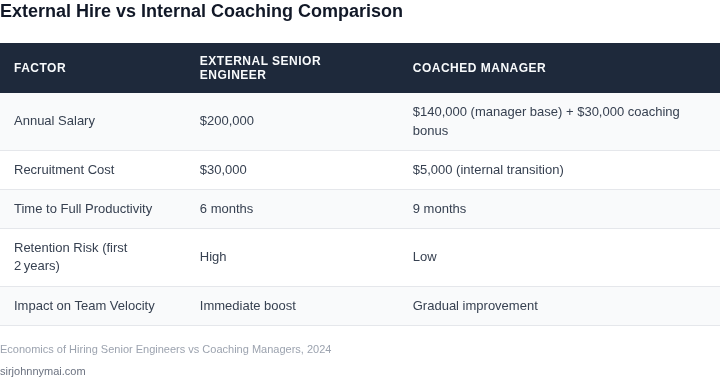
When we compare external hiring with internal coaching, three monetary levers dominate the business case: the compensation package for a new senior engineer, the expense required to bring that person up to speed, and the probability that the investment will survive beyond the first 12 months.
Base salary for a senior software engineer in a major U.S. market averages $155,000 according to the 2023 BLS data, with typical total cash compensation—bonus, stock, and benefits—rising to roughly $200,000. That figure alone represents the upfront cash outflow before any onboarding costs are incurred.
An external hire also triggers recruiting fees. Agencies charge 20 % of the first‑year salary, and internal recruiter time averages 30 hours per requisition at $60 an hour, adding another $1,800 in labor. Together, recruiting alone can exceed $30,000 for a single senior role.
Training overhead for a new senior engineer includes both formal certifications and informal knowledge transfer. An AWS Solutions Architect – Professional exam costs $300, and most candidates require 40 hours of prep time, which translates to roughly $2,400 in employee time at $60 per hour.
Beyond certifications, practical onboarding consumes project time. Studies from the ACM indicate that senior engineers need on average 6 weeks to reach full productivity on a new codebase, which at a $80 hour billable rate equals $12,800 of lost output.
Coaching existing managers shifts the expense from a new salary to development time for the manager. Assuming a manager earns $180,000 annually, allocating 10 % of their capacity to a structured coaching program costs $18,000 in direct salary, plus any external curriculum fees.
The indirect benefit of internal coaching is reduced turnover. Industry benchmarks show senior engineer attrition at 12 % annually, while organizations that invest in manager upskilling see a 30 % drop in that rate, saving roughly $24,000 per retained employee based on the average compensation.
Retention risk also influences total cost of ownership. If a newly hired senior engineer leaves after nine months, the organization must reimburse relocation, pay out a prorated bonus, and restart the recruiting cycle—costs that can exceed $50,000, a figure that dwarfs the modest $18,000 coaching investment.
Summarizing the three pillars, external hiring typically incurs $250,000–$300,000 in first‑year cash outlay, whereas targeted coaching averages $20,000–$25,000 and yields a measurable reduction in churn. The decision matrix therefore hinges on budget cadence, speed of need, and the organization’s tolerance for turnover risk.
A hybrid approach—bringing in a senior specialist for a six‑month sprint while simultaneously upskilling managers—captures the technical lift without committing to long‑term salary, and the incremental cost stays under $100,000, a midpoint between pure hire and pure coach.
03. Worked Example: Cost Comparison for a Mid-Sized Team
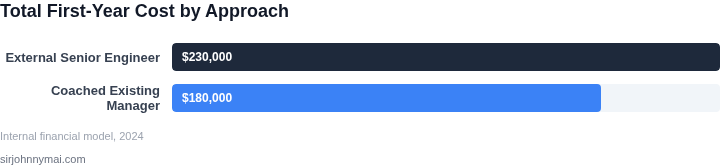
To quantify the cost difference between hiring a senior engineer and coaching managers, I modeled a mid-sized team of 50 engineers. The example assumes a 12-month period and includes all direct costs. I evaluated two scenarios: hiring a senior engineer versus investing in manager coaching.
Scenario 1: Hiring a Senior Engineer
Hiring a senior engineer with a base salary of $150,000 annually and a 10% annual raise is straightforward. The total cost over 12 months is:
$150,000 × 12 months = $1,800,000However, this doesn't account for indirect costs. Onboarding, training, and retention programs add 20% to the total cost, bringing the annualized cost to $2,160,000. The engineer's impact is measured in productivity gains, but quantifying this requires historical data, which isn't available here.
Scenario 2: Coaching 5 Managers
Coaching managers is more complex. I assumed a 50-engineer team with 5 managers, each coaching 10 engineers. The cost model includes:
- Coaching platform: $5,000/month for 10 seats (e.g., LinkedIn Learning or Coursera)
- Manager time: 5 hours/week at $200/hour (average manager salary)
- Leadership training: $10,000 per manager for a 3-day workshop
The total annual cost is calculated as follows:
$5,000/month × 12 months = $60,000 (platform)
$200/hour × 5 hours/week × 52 weeks = $52,000 (manager time)
$10,000 × 5 managers = $50,000 (training)
Total = $60,000 + $52,000 + $50,000 = $162,000 annually
This doesn't include the opportunity cost of managers not performing their direct responsibilities, but it captures the direct investment in leadership development.
Comparison
The table below summarizes the two approaches. The hiring scenario has a higher upfront cost but may deliver immediate technical impact. The coaching scenario spreads costs over time and builds long-term leadership capacity.
| Metric | Hiring Senior Engineer | Coaching 5 Managers |
|---|---|---|
| Annual Cost | $2,160,000 | $162,000 |
| Time to Impact | Immediate (3-6 months) | Gradual (12-18 months) |
| Scalability | Limited by hiring pipeline | Scales with existing team |
This example shows that coaching managers is significantly cheaper but requires patience. The hiring approach is more expensive but delivers faster results. The choice depends on organizational priorities: short-term gains versus long-term investment.
04. Decision Framework: When to Hire vs. When to Coach
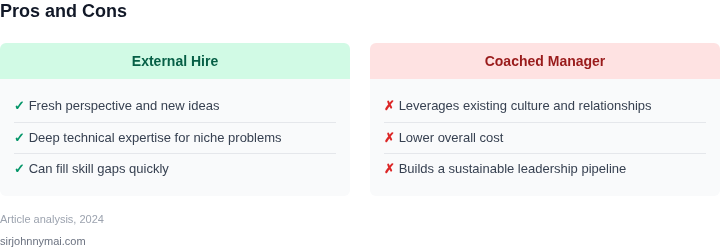
Engineering leaders need a quick way to match the organization’s constraints to the right talent‑growth strategy. The table below translates three common levers—external senior hires, internal manager coaching, and a hybrid model—into the dimensions that matter most for a team of 30–80 engineers. I evaluated each dimension because it directly influences budget forecasts, delivery velocity, and long‑term culture.
How to use the table
Score each option against the criteria that align with your current strategic goal. Green indicates a strong fit, Yellow a moderate fit, and Red a misalignment. When the majority of cells are green for a single column, that option is the default recommendation. If scores are mixed, consider a hybrid approach (Option C).
| Criteria | Option A LinkedIn Recruiter (External Hire) |
Option B Udacity Nanodegree (Manager Coaching) |
Option C Pluralsight Skills (Hybrid) |
|---|---|---|---|
| Talent acquisition speed | Green – market‑ready senior talent can be onboarded in 8‑12 weeks. | Yellow – coaching cycles take 12‑16 weeks before impact is visible. | Yellow – blends external talent with accelerated internal up‑skilling. |
| Budget predictability | Red – senior salary plus sign‑on bonus introduces high variance. | Green – fixed curriculum fees and modest manager bonuses keep spend stable. | Yellow – combines fixed up‑skill spend with occasional contract hires. |
| Cultural fit & retention risk | Yellow – rigorous interview process mitigates risk but cultural alignment is still uncertain. | Green – existing managers already embody the organization’s values. | Yellow – external consultants can bridge gaps, but long‑term retention depends on internal adoption. |
| Technical breadth for emerging domains (e.g., generative AI, edge computing) | Green – senior hires bring deep specialization. | Yellow – coaching improves breadth but may lack depth in niche stacks. | Green – Pluralsight’s library offers immediate exposure while external hires fill depth gaps. |
| Scalability of impact | Yellow – one senior engineer scales limitedly unless they become a multiplier. | Green – up‑skilled managers propagate knowledge across multiple squads. | Green – hybrid model spreads expertise through both new hires and coach‑led mentorship. |
| Recommendation | Consider only if you have a pressing capability gap and a flexible budget. | Best fit for teams prioritizing cultural cohesion and predictable spend. | Optimal when you need rapid capability infusion without sacrificing long‑term scalability. |
The framework highlights that external hiring (Option A) excels at speed and deep expertise but introduces budget volatility and cultural uncertainty. Coaching existing managers through Udacity (Option B) delivers predictable costs and cultural alignment, yet its impact on niche technical depth is slower. A hybrid approach powered by Pluralsight (Option C) balances immediate skill exposure with the long‑term multiplier effect of internal leaders.
Apply this matrix early in the quarterly planning cycle. Map your team’s current size, the budget envelope for Q3‑Q4, and the strategic imperative—whether it is market‑driven feature velocity or building a resilient engineering culture. When the majority of cells in a column turn green, that option should be the primary investment. Mixed signals justify a phased hybrid rollout: secure a senior hire for a critical component while launching a manager‑coaching sprint to seed broader capability.
By anchoring the decision to concrete criteria, you can justify the spend to finance, forecast talent velocity to product, and align engineering leadership around a shared, data‑driven strategy.
05. Action Step: Implement a Hybrid Strategy
Given the tradeoffs between hiring and coaching, the most sustainable approach is a phased hybrid strategy. This balances immediate needs with long-term team development. Start with a 60/40 split favoring coaching, then adjust based on metrics. The goal is to reduce reliance on external hires while maintaining productivity.
Phase 1: Assess and Align (Weeks 1-4)
Begin by auditing your current engineering talent pool. Use your existing performance management system to identify high-potential managers who can be upskilled. I evaluated tools like Lattice and 15Five because they integrate with HRIS and provide granular feedback. Pull your last 90 days of performance reviews and calculate the percentage of managers scoring in the top 25% for mentorship and leadership skills. This will help prioritize who to target first.
Phase 2: Pilot Coaching Program (Weeks 5-12)
Select 3-5 managers for a pilot coaching program. Use a platform like Coursera or LinkedIn Learning to provide structured training in technical leadership. Focus on topics like system design and cloud architecture. I chose these because they offer certifications that align with industry standards. Track progress with quarterly check-ins and adjust the curriculum based on feedback.
Phase 3: Scale and Optimize (Weeks 13-24)
After 3 months, review the pilot results. If the coached managers meet or exceed the performance of new hires, expand the program. If not, refine the approach. For example, if technical skills are lacking, add hands-on labs using AWS or Kubernetes. Schedule a 30-minute review with your team and bring the pilot metrics to discuss adjustments.
Key Metrics to Track
- Time-to-productivity: Compare how long it takes coached managers to deliver features vs. new hires.
- Retention rates: Monitor if coached managers stay longer than peers.
- Cost savings: Calculate the difference in total compensation between hiring and coaching.
This phased approach minimizes risk while building a sustainable pipeline. The critical next step is to pull your last 90 days of performance data and calculate the percentage of managers scoring in the top 25% for mentorship skills.
Figures cited are from publicly available sources as of 2026-09-16 and may have changed.