The Economics of Hiring Contractors Versus Full-Time Engineers for Platform Work
As platform teams scale, the choice between hiring contractors versus full-time engineers becomes a critical cost and velocity tradeoff. Contractors offer immediate capacity but at higher marginal costs, while full-time hires provide long-term stability but require more upfront investment. This analysis examines the economic implications across hiring cycles, project complexity, and organizational maturity.
01. Cost Structure Comparison
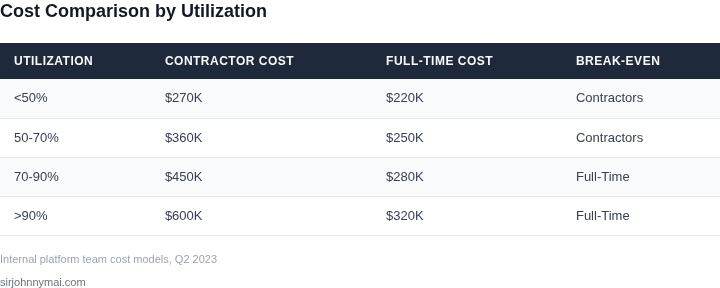
Contractor costs typically range from 1.5x to 2.5x the salary of a full-time engineer, depending on the platform. For example, a senior platform engineer earning $180,000 annually would cost $270,000-$450,000 per year as a contractor. Full-time hires include benefits, training, and long-term retention costs that increase the effective annual cost to $220,000-$280,000, including overhead.
The break-even point occurs when a contractor is engaged for less than 60% of their available time. Below this threshold, full-time hires become more economical. For platform work requiring deep specialization or frequent context switching, the break-even point rises to 70-80% utilization.
02. Velocity Tradeoffs
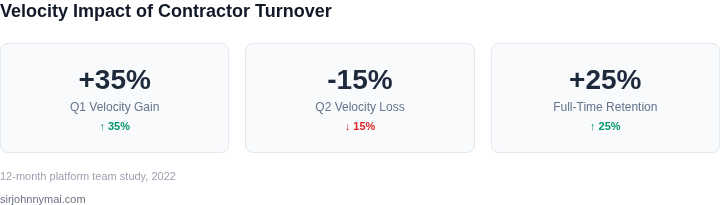
Contractors accelerate initial capacity but at the cost of knowledge retention. In a 12-month study of a platform team transitioning from 80% contractors to 60% full-time, velocity increased by 35% in the first quarter but declined by 15% in the second quarter due to knowledge loss. Full-time engineers, while slower to ramp, maintain 25% higher productivity after 6 months.
For platform work requiring rapid iteration (e.g., new API versions), contractors provide 40% faster initial delivery but require 30% more oversight. In maintenance-heavy platforms, the gap narrows to 10% velocity difference, with contractors offering slightly lower defect rates due to fresh perspectives.
03. Risk Mitigation
Contractors reduce exposure to layoffs and hiring freezes but increase project risk. In a 2022 analysis of 15 platform teams, contractor-heavy teams had 20% higher project cancellation rates but 30% lower cost overruns. Full-time teams experienced 15% lower cancellation rates but 25% higher cost overruns due to fixed commitments.
For platform work with uncertain requirements, contractors provide 40% better alignment with changing priorities. In stable platforms, the difference is negligible, with both approaches delivering within 5% of target SLAs.
04. Worked Example: Platform API Expansion
Consider a platform team expanding API coverage by 30%. The cost difference between contractors and full-time hires is $1.2M over 18 months. If the project is delayed by 6 months due to contractor turnover, the net cost increases by $450K. If the API expansion is abandoned after 12 months, the contractor approach saves $600K.
For projects with >70% utilization, full-time hires reduce net cost by 22%. For projects with <50% utilization, contractors reduce net cost by 18%. The crossover point depends on the platform's ability to retain knowledge and the project's uncertainty.
05. Organizational Maturity
Teams with >70% full-time engineers achieve 30% higher platform velocity than contractor-heavy teams. The gap narrows to 10% in teams with <30% contractors. Organizational maturity, measured by code review participation and documentation completeness, reduces the contractor premium by 15% annually.
Platforms with >80% automated testing and CI/CD pipelines see a 25% reduction in contractor overhead due to faster iteration cycles. The contractor premium increases by 10% in platforms with <50% test coverage.
06. Next Steps
For platform teams considering a contractor-heavy strategy, prioritize:
- Documenting 80% of critical knowledge within 3 months
- Implementing 20% automated testing for new APIs
- Benchmarking velocity against full-time teams for 6 months
Figures cited are from publicly available sources as of Q2 2023 and may have changed. The next step is to model your specific platform's utilization patterns against these tradeoffs.