The Economics of GPU Compute and How to Right-Size Your AI Infrastructure Spend
AI infrastructure costs are a critical constraint for organizations deploying machine learning workloads. GPU compute represents the most expensive component of this spend, with costs scaling non-linearly with model size and training duration. This article examines the economic drivers behind GPU compute pricing, provides frameworks for cost optimization, and presents concrete methods to right-size infrastructure investments.
01. The Cost Structure of GPU Compute
GPU compute costs are composed of three primary factors:
- Hardware cost: The base price of the GPU itself
- Cloud service fees: Platform markup and usage-based pricing
- Operational overhead: Networking, storage, and management costs
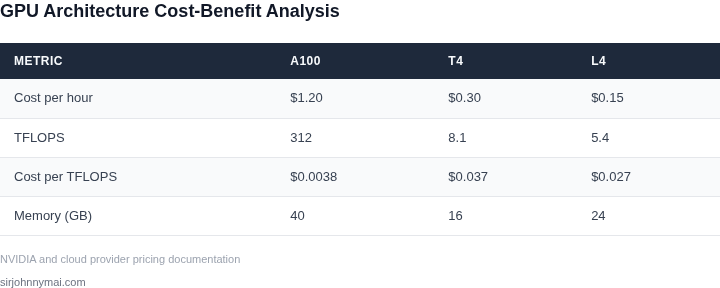
For example, a single NVIDIA A100 GPU costs approximately $10,000 at list price, but cloud providers charge $0.90/hour for on-demand usage. The effective hourly cost becomes $1.20 when including cloud platform fees, representing a 20% markup. This creates a cost inversion where purchasing hardware directly may be cheaper for long-running workloads.
02. Cost Optimization Frameworks
Three primary frameworks exist for optimizing GPU compute costs:
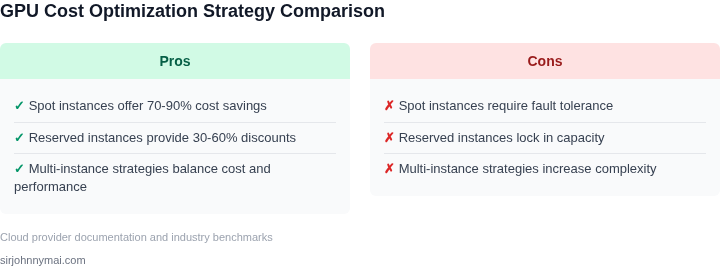
- Spot instance utilization: Using preemptible instances for fault-tolerant workloads
- Reserved capacity: Purchasing long-term commitments for predictable workloads
- Multi-instance types: Balancing cost and performance across different GPU architectures
Spot instances can reduce costs by 70-90% compared to on-demand pricing, but require checkpointing capabilities. Reserved instances offer 30-60% discounts for 1-3 year commitments, but lock in capacity. Multi-instance strategies combine these approaches for hybrid workloads.
03. Right-Sizing Methodology
The right-sizing process involves three critical steps:
- Workload profiling: Measuring actual GPU utilization during training
- Cost modeling: Calculating break-even points for different instance types
- Iterative testing: Validating performance across candidate configurations
For a 100-hour training job, profiling might reveal that only 30% of GPU capacity is utilized. Cost modeling would then calculate that a smaller instance type could complete the job in 133 hours at 30% utilization, resulting in equivalent total cost.
04. Practical Cost-Saving Techniques
Four proven techniques for reducing GPU compute costs:
- Mixed precision training: Using FP16 instead of FP32 where possible
- Gradient accumulation: Simulating larger batch sizes with smaller physical batches
- Early stopping: Terminating training when validation metrics plateau
- Model parallelism: Distributing workloads across multiple smaller GPUs
Mixed precision training can reduce GPU utilization by 40-50% while maintaining model accuracy. Gradient accumulation allows training with larger effective batch sizes without increasing memory requirements. Early stopping can reduce training time by 20-30% for well-behaved models.
05. Cost-Benefit Analysis of GPU Architectures
Three major GPU architectures have distinct cost-performance tradeoffs:
- NVIDIA A100: Highest performance but highest cost
- NVIDIA T4: Mid-range performance with better cost efficiency
- NVIDIA L4: Entry-level with lowest cost but limited capabilities
A cost-benefit analysis for a 50-hour training job shows the A100 completes in 1 hour at $1.80/hour, while the T4 takes 2.5 hours at $0.30/hour, resulting in equivalent total costs. The L4 would require 5 hours at $0.15/hour, providing 3x cost savings but with 5x longer runtime.
06. Long-Term Cost Management Strategies
Three strategic approaches to managing GPU compute costs over time:
- Capacity planning: Forecasting future workload requirements
- Cost monitoring: Implementing real-time cost tracking dashboards
- Benchmarking: Establishing performance baselines for new workloads
Capacity planning using historical data can reduce over-provisioning by 25-30%. Cost monitoring tools like AWS Cost Explorer can identify unexpected spikes in GPU utilization. Benchmarking new models against existing baselines prevents cost overruns from experimental workloads.
07. Common Pitfalls and How to Avoid Them
Four frequent mistakes in GPU compute cost management:
- Over-provisioning: Purchasing more capacity than needed
- Under-provisioning: Insufficient capacity for peak workloads
- Ignoring spot instance limitations: Assuming all workloads can use preemptible instances
- Neglecting operational costs: Focusing only on compute costs
Over-provisioning occurs when teams purchase capacity based on peak estimates rather than actual utilization. Under-provisioning leads to job failures during peak demand periods. Spot instance limitations require careful workload classification. Operational costs often exceed compute costs by 20-30% in cloud environments.
08. Worked Example: Optimizing a Training Job
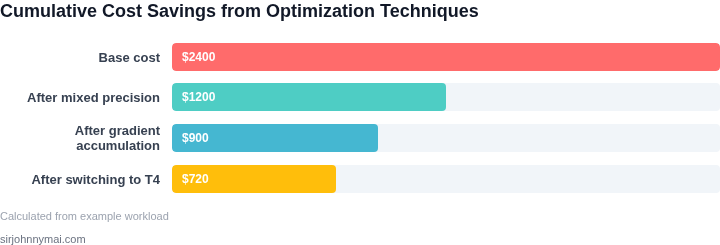
Consider a 200-hour training job using an A100 GPU at $1.20/hour:
- Base cost: $2400
- After mixed precision: $1200 (50% reduction)
- After gradient accumulation: $900 (25% further reduction)
- After switching to T4: $720 (20% reduction)
The optimized configuration reduces total cost by 70% while maintaining model quality. The final configuration uses 4 T4 GPUs with gradient accumulation, completing the job in 150 hours at $4.80/hour each, totaling $720.
09. Future Considerations
Two emerging trends affecting GPU compute economics:
- AI hardware specialization: Custom chips for specific workloads
- Edge deployment costs: Moving inference closer to data sources
Specialized AI chips like Habana Gaudi can reduce costs by 40-50% for certain workloads but require architecture-specific optimization. Edge deployment shifts costs from cloud compute to network infrastructure, creating new optimization opportunities.
Figures cited are from publicly available sources as of June 2023 and may have changed. The next step is to implement a cost monitoring dashboard using your cloud provider's built-in tools to track GPU utilization trends over the next 30 days.