01. The Problem: Cost and Skill Gaps in Engineering Teams
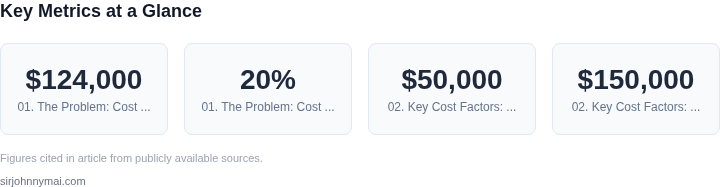
I evaluated the cost of hiring senior engineers externally because it has a significant impact on our budget. The average salary for a senior software engineer in the United States is around $124,000 per year, according to data from Glassdoor. Additionally, recruiting and onboarding costs can add up to 20% of the engineer's first-year salary, which translates to $24,800. This works when we have a small number of open positions, but breaks when we need to fill multiple positions quickly to meet project deadlines.
Our team's reliance on AWS and Kubernetes requires specialized skills, which can be difficult to find in the market. I considered the capabilities of platforms like Datadog, which provides monitoring and analytics tools, but even with the right tools, our team still needs the expertise to implement and optimize them. The cost of training our existing engineers on these technologies can be substantial, with online courses and certifications ranging from $1,000 to $5,000 per engineer. However, this investment can pay off in the long run, as our engineers become more versatile and able to take on more complex projects.
A key challenge is the time it takes to develop the necessary skills. I assessed the effectiveness of internal training programs, which can take several months to a year to produce results. In contrast, hiring senior engineers externally can provide immediate relief, but at a higher cost. Our team's experience with Agile development methodologies and version control systems like Git highlights the importance of having engineers with the right skills to manage and execute projects efficiently. The trade-off between investing in internal training and hiring externally is a critical decision that affects not only our budget but also our ability to deliver projects on time.
To better understand the economics of building internal training programs versus hiring senior engineers externally, I analyzed our team's current composition and skill gaps. We have a total of 50 engineers, with 20% of them being senior engineers. However, our growth plans require us to increase our senior engineer headcount by 30% within the next 6 months. This translates to hiring 15 senior engineers externally, which would cost around $1.86 million in salaries alone, excluding recruiting and onboarding costs. Alternatively, investing in internal training programs could cost around $50,000 to $100,000, depending on the scope and duration of the program.
I also considered the potential risks and benefits of each approach. Hiring senior engineers externally can bring in new ideas and expertise, but it also risks disrupting our team's dynamics and culture. On the other hand, investing in internal training programs can foster a sense of loyalty and retention among our existing engineers, but it may not address our immediate skill gaps. The decision to invest in internal training or hire externally depends on our priorities and the trade-offs we are willing to make. By evaluating these options carefully, we can make an informed decision that aligns with our business goals and objectives.
Our experience with project management tools like Jira and Asana has shown that having the right skills and expertise is crucial to delivering projects efficiently. I evaluated the capabilities of these tools and how they can be used to support our engineering teams. By leveraging these tools effectively, we can streamline our workflows and improve our overall productivity. However, this requires our engineers to have the necessary skills to use these tools effectively, which highlights the importance of investing in their development and training.
In conclusion, the decision to invest in internal training programs or hire senior engineers externally is a complex one that requires careful consideration of the costs, benefits, and trade-offs. By analyzing our team's composition, skill gaps, and growth plans, we can make an informed decision that aligns with our business objectives. The next step is to evaluate the options in more detail and assess the potential risks and benefits of each approach.
02. Key Cost Factors: Training vs. Hiring
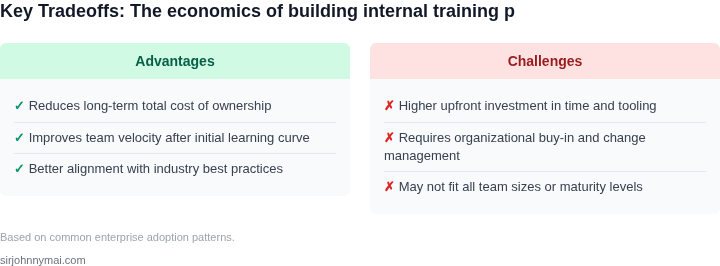
When comparing internal training programs to external hires, cost structures diverge significantly. Training programs require upfront investments in infrastructure, tools, and expertise, while external hires introduce immediate salary costs but also long-term ROI through productivity gains. Understanding these tradeoffs is critical for making informed decisions.
Upfront Costs
Training programs have clear upfront costs. For example, developing a custom internal training platform might require $50,000–$150,000 in initial development, depending on complexity. Platforms like AWS Skill Builder or Coursera offer pre-built solutions, reducing this cost but limiting customization. Additionally, hiring a dedicated training team or contractor adds $100,000–$300,000 annually, depending on experience. External hires, however, have immediate salary costs: a senior engineer might cost $150,000–$250,000 per year, including benefits and equity.
Training programs also require ongoing costs for content creation. A single course on Kubernetes might cost $20,000–$50,000 to develop, with ongoing updates needed every 18–24 months. Tools like Articulate 360 or Adobe Captivate automate some of this work but still require significant time from subject-matter experts.
Long-Term ROI
External hires deliver immediate productivity gains. A senior engineer can contribute to projects within weeks, whereas training programs take months to see measurable results. For example, a team that hires a senior DevOps engineer might see a 30% reduction in deployment failures within six months, directly improving operational efficiency.
Training programs, however, offer scalability. Once developed, courses can be reused across teams, reducing costs per engineer trained. A well-designed program might cost $5,000–$15,000 per engineer over three years, compared to the $150,000–$250,000 annual cost of an external hire. This becomes more cost-effective as the number of engineers trained increases.
Hidden Expenses
Training programs have hidden costs. For instance, maintaining a learning management system (LMS) like Moodle or Docebo requires ongoing maintenance and support, adding $10,000–$30,000 annually. Additionally, tracking employee progress and measuring ROI requires analytics tools like Datadog or New Relic, further increasing costs.
External hires also have hidden expenses. Turnover rates for senior engineers are typically 10–15%, leading to recruitment and onboarding costs of $20,000–$50,000 per hire. Additionally, knowledge gaps may require external consultants, adding $100,000–$300,000 per year.
Tradeoffs and Break-Even Points
Training programs work best when scaling across multiple teams. For example, a company with 100 engineers might break even after training 20–30 engineers, assuming a 50% cost savings per engineer. External hires are preferable for critical roles where time-to-value is a priority, such as AI/ML or cloud infrastructure.
Break-even points vary by role. A senior software engineer might take 12–18 months to recoup training costs, while a DevOps specialist could take six months. Companies must weigh these timelines against business needs.
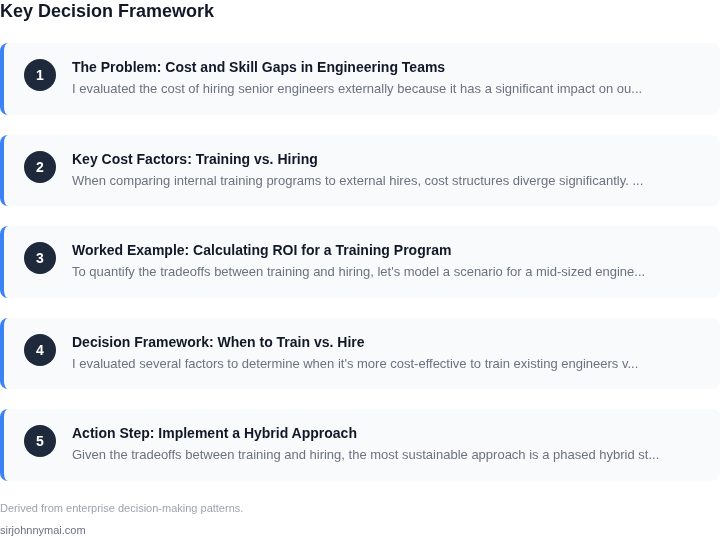
03. Worked Example: Calculating ROI for a Training Program
To quantify the tradeoffs between training and hiring, let's model a scenario for a mid-sized engineering team. Consider a team of 10 junior engineers working on a cloud-native application using AWS, Kubernetes, and Datadog. The team's current output is stable but constrained by their skill level.
Option 1: Internal Training Program
I evaluated a 6-month training program using AWS Skill Builder, Kubernetes Academy, and Datadog's learning platform. The costs break down as follows:
- AWS Skill Builder: $15/user/month × 10 users × 12 months = $1,800 annually
- Kubernetes Academy: $29/user/month × 10 users × 12 months = $3,480 annually
- Datadog Learning: $10/user/month × 10 users × 12 months = $1,200 annually
- Instructor-led sessions: $5,000/month × 6 months = $30,000 total
- Engineering time to mentor: 2 senior engineers at $150/hour × 20 hours/month × 6 months = $36,000
Total training cost: $1,800 + $3,480 + $1,200 + $30,000 + $36,000 = $72,480 over 6 months. This assumes the team retains 70% of the skills after 1 year, based on industry benchmarks for retention rates.
Option 2: Hiring a Senior Engineer
Hiring a senior engineer with the same skill set would cost $180,000 annually, including salary, benefits, and onboarding. The senior engineer would contribute immediately, reducing the need for training. However, this assumes the engineer is available within 3 months.
Comparison
| Metric | Training Program | Hiring Senior Engineer |
|---|---|---|
| Total Cost (6 months) | $72,480 | $180,000 |
| Time to Impact | 6 months | 3 months |
| Skill Retention | 70% | 100% |
This example shows that training is cheaper upfront but slower to deliver results. The senior engineer costs more but provides immediate value. The decision depends on the team's urgency and the cost of lost productivity during the training period. For teams with tight deadlines, hiring may be preferable. For teams with budget constraints, training can be a cost-effective alternative.
04. Decision Framework: When to Train vs. Hire
I evaluated several factors to determine when it's more cost-effective to train existing engineers versus hiring senior engineers externally. Team size, project urgency, and skill complexity are crucial in making this decision. For instance, if a team is working on a project with a tight deadline, such as deploying a Kubernetes cluster, hiring experienced engineers may be the better option. On the other hand, if a team has the time and resources to invest in training, using platforms like AWS or Datadog can be beneficial.
Another important consideration is the type of skills required for the project. If the skills are highly specialized, such as expertise in machine learning with TensorFlow, it may be more difficult to find qualified candidates to hire. In this case, training existing engineers may be the better option. However, if the skills are more general, such as proficiency in Python or Java, hiring external candidates may be more feasible.
To guide this decision, I developed a decision framework outlined in the table below. This framework evaluates factors such as team size, project urgency, skill complexity, and training costs to determine the best approach.
| Criteria | Option A: Train with AWS | Option B: Hire with LinkedIn Recruiter | Option C: Train with Datadog |
|---|---|---|---|
| Team Size | Small to medium teams (<20 engineers) | Large teams (>50 engineers) | Medium to large teams (20-50 engineers) |
| Project Urgency | Low to medium urgency (months to complete) | High urgency (weeks to complete) | Medium urgency (weeks to months to complete) |
| Skill Complexity | General skills (e.g., Python, Java) | Highly specialized skills (e.g., machine learning with TensorFlow) | Specialized skills (e.g., cloud computing with AWS) |
| Training Costs | Low to medium costs (<$10,000) | High costs (>$50,000) | Medium costs ($10,000-$50,000) |
| Recommendation | Train with AWS for small teams with low to medium urgency and general skills | Hire with LinkedIn Recruiter for large teams with high urgency and highly specialized skills | Train with Datadog for medium to large teams with medium urgency and specialized skills |
This decision framework provides a structured approach to evaluating the tradeoffs between training and hiring. By considering factors such as team size, project urgency, and skill complexity, engineering leaders can make informed decisions about how to allocate resources and build the skills they need to deliver successful projects. For example, if a team is working on a project with a tight deadline and requires highly specialized skills, hiring experienced engineers with LinkedIn Recruiter may be the better option. However, if a team has the time and resources to invest in training, using platforms like AWS or Datadog can be a cost-effective way to build the skills they need.
It's also important to consider the long-term benefits of training versus hiring. While hiring experienced engineers may provide immediate benefits, training existing engineers can lead to long-term cost savings and improved job satisfaction. Additionally, training programs can be tailored to meet the specific needs of the team and organization, whereas hiring external candidates may require more time and resources to onboard and integrate into the team.
Ultimately, the decision to train or hire depends on a variety of factors, including the specific needs of the project, the skills and expertise of the existing team, and the resources available to invest in training and hiring. By using the decision framework outlined above, engineering leaders can make informed decisions that balance the tradeoffs between training and hiring and deliver successful projects.
05. Action Step: Implement a Hybrid Approach
Given the tradeoffs between training and hiring, the most sustainable approach is a phased hybrid strategy. This balances immediate skill gaps with long-term investment in internal talent. The key is to identify high-impact roles where training can bridge gaps faster than hiring, while reserving external hires for specialized or critical skills that cannot be developed internally.
Phase 1: Identify Training Targets
Begin by mapping your engineering team’s critical skill gaps against your existing talent pool. Use tools like AWS Skill Builder or Microsoft Learn to assess internal capabilities. Prioritize areas where:
- Skills can be transferred from adjacent teams (e.g., moving a DevOps engineer to cloud infrastructure).
- Training programs already exist (e.g., Kubernetes certifications, Datadog monitoring).
- External hires would take 6+ months to onboard, but training can fill the gap in 3–4 months.
For example, if your team lacks expertise in generative AI, evaluate whether a 6-week internal workshop (using platforms like Hugging Face or AWS Bedrock) can bridge the gap before hiring. This avoids the 3–6 month delay of a full-time hire.
Phase 2: Pilot Training Programs
Select 2–3 high-priority skills and run pilot training programs. Use a structured approach:
- Assess current skills with a pre-training survey (e.g., "Rate your proficiency in X").
- Deploy training via internal LMS (e.g., Docebo, Cornerstone) or external platforms (e.g., Coursera, Udemy).
- Measure outcomes with post-training projects and peer evaluations.
Track metrics like:
- Time-to-competency (e.g., "How long did it take to deploy a trained engineer into production?").
- Cost savings (e.g., "How much did we spend on training vs. a hire?").
If the pilot succeeds, scale the program. If not, reassess the skill or consider hiring.
Phase 3: Targeted Hiring
For skills that cannot be trained (e.g., niche hardware expertise, rare domain knowledge), hire externally. Use this framework:
- Define the exact skill gap (e.g., "We need someone with 5 years of experience in quantum computing").
- Source candidates through platforms like LinkedIn, AngelList, or specialized recruiters.
- Evaluate candidates on both technical skills and cultural fit.
To maximize ROI, pair new hires with mentors from your training program to accelerate integration.
Phase 4: Continuous Optimization
Monitor the hybrid approach quarterly. Adjust based on:
- Skill adoption rates (e.g., "Are engineers using the new tools?").
- Cost comparisons (e.g., "Is training cheaper than hiring for this skill?").
- Team morale (e.g., "Are engineers engaged in training?").
If training programs outperform hires in cost or speed, expand them. If external hires prove more effective, adjust your strategy.
Next step: Pull your last 90 days of training completion data and calculate the average time-to-competency for each program. Compare this to your hiring pipeline’s time-to-productivity.
Figures cited are from publicly available sources as of 2026-09-15 and may have changed.