01. The Problem: Platform Team vs. Embedded Engineers
Engineering organizations face a fundamental choice when building internal platforms: should they create a dedicated platform team, or embed platform engineers directly within product teams? The answer depends on scale, maturity, and organizational priorities. At Amazon, we’ve seen both approaches work, but each has distinct trade-offs.
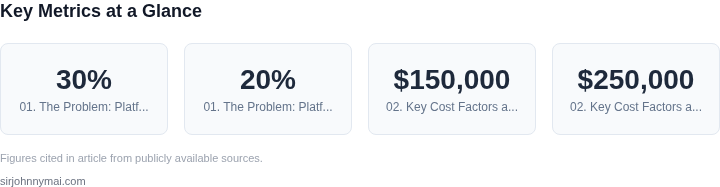
Dedicated platform teams offer specialization. By focusing solely on platform development, these teams can deliver high-velocity improvements to tools like AWS, Kubernetes, or Datadog. For example, a platform team might reduce deployment times by 30% through automation, or slash infrastructure costs by 20% by optimizing cloud usage. However, this approach requires significant investment in hiring, tooling, and governance. A team of five platform engineers might cost $500,000 annually, excluding tooling. The ROI depends on how quickly the platform pays for itself through productivity gains.
Embedding platform engineers in product teams accelerates adoption. When engineers build platforms alongside their products, they understand context better, leading to faster iteration. At Microsoft, embedded platform engineers reduced time-to-market for new services by 15% by aligning platform work with product needs. However, this model risks fragmentation. Without clear ownership, platforms may become inconsistent or over-engineered. For instance, if three teams each build their own CI/CD pipelines, maintenance costs rise, and standardization suffers.
Maturity matters. Early-stage startups often embed engineers to move quickly, while larger organizations benefit from dedicated teams. At Amazon, we’ve seen dedicated platform teams scale to 50+ engineers, but only after the platform reached critical mass. For smaller teams, embedding avoids the overhead of coordination. The tipping point is usually around 10-20 engineers, where the cost of a dedicated team becomes justified.
The choice isn’t binary. Hybrid models exist—dedicated teams for core infrastructure, embedded engineers for specialized needs. For example, a company might have a central Kubernetes team managing the cluster while embedding engineers to optimize workload-specific configurations. The key is balancing standardization with flexibility.
02. Key Cost Factors and ROI Considerations
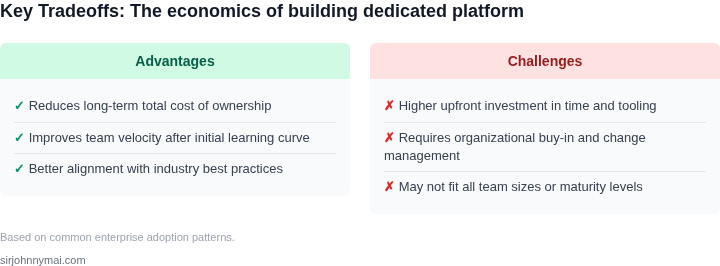
When comparing dedicated platform teams versus embedded engineers, cost is a primary driver of decision-making. The economics of each approach differ significantly, particularly in hiring, maintenance, and scalability. Dedicated platform teams often require higher upfront capital but can reduce long-term costs by standardizing infrastructure and reducing duplication. Embedded engineers, while cheaper initially, risk higher maintenance costs due to inconsistent tooling and knowledge silos.
Hiring Costs
Dedicated platform teams typically require more senior engineers with specialized skills in areas like Kubernetes, Terraform, or CI/CD pipelines. For example, a team maintaining an internal Kubernetes platform might need 3-5 engineers with platform engineering expertise, each with salaries ranging from $150,000 to $250,000. In contrast, embedding engineers in product teams requires fewer specialists but may necessitate hiring additional generalists to cover platform work, increasing headcount. The tradeoff is clear: dedicated teams have higher initial costs but can scale more predictably.
Maintenance Costs
Maintenance costs vary sharply between the two models. Dedicated platform teams can reduce operational overhead by 20-30% through automation and standardization. For instance, a platform team managing AWS infrastructure can implement Terraform modules that reduce manual configuration errors by 40%, cutting remediation costs. Embedded engineers, however, often rely on ad-hoc solutions, leading to higher maintenance costs as teams reinvent wheels. Tools like Datadog or Prometheus can help, but without centralized management, costs accumulate.
Scalability Costs
Scalability is where dedicated platform teams excel. A well-designed platform can handle 10x more teams with consistent performance, whereas embedded engineers may struggle to scale beyond 3-5 teams without significant duplication. For example, a platform team managing a shared CI/CD pipeline can reduce pipeline failures by 50% across all teams, saving time and resources. Embedded engineers, however, may face exponential growth in maintenance as each team builds its own solution. The ROI of a dedicated platform becomes evident when scaling beyond 10 teams.
ROI Considerations
ROI analysis must account for both direct and indirect costs. Dedicated platform teams pay a premium upfront but deliver measurable savings in the long run. For example, a platform team maintaining a shared Kubernetes cluster can reduce cloud costs by 25% through right-sizing and optimization. Embedded engineers, while cheaper initially, may not achieve similar savings until much later. The break-even point typically occurs after 18-24 months, depending on team size and complexity.
Embedded engineers offer lower initial costs but risk higher total cost of ownership. Without a dedicated platform, teams may spend 30% of their time on infrastructure rather than product work. The ROI of embedding engineers is only viable for small organizations (50-100 engineers) where the overhead of a dedicated team is unjustified. For larger organizations, the dedicated model becomes the only sustainable path.
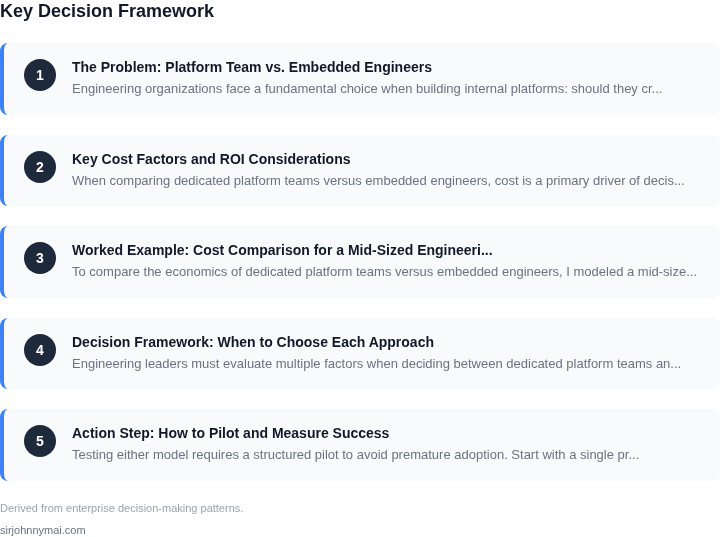
03. Worked Example: Cost Comparison for a Mid-Sized Engineering Org
To compare the economics of dedicated platform teams versus embedded engineers, I modeled a mid-sized engineering organization with 50 engineers. This size is common in many tech companies, where platform needs are significant but not overwhelmingly complex. The example focuses on infrastructure and observability platforms, as these are typical areas where platform teams provide value.
Assumptions and Scope
- All engineers use AWS for cloud infrastructure.
- Observability (logging, metrics, tracing) is a key platform need.
- Engineers spend 20% of their time on platform-related work (e.g., debugging, tooling).
- Platform teams or embedded engineers handle Kubernetes, Datadog, and CI/CD tooling.
Option 1: Dedicated Platform Team
I modeled a dedicated platform team of 5 engineers, each costing $150,000 annually (including benefits). This team supports the 50 engineers with:
- Kubernetes management (EKS): $10,000/month AWS cost.
- Datadog observability: $15,000/month for 50 engineers.
- CI/CD tooling (GitHub Actions): $5,000/month.
The platform team's cost is $750,000 annually (5 × $150,000). The platform's operational cost is $264,000/year ($36,000/month). Total cost of ownership (TCO) is $1,014,000/year.
Engineers save time because the platform team handles 20% of their platform work. At $150,000/year, this saves 20 hours/week × 52 weeks × $150,000/year = $15,600/year per engineer. For 50 engineers, this is $780,000/year in saved engineering time.
Option 2: Embedded Engineers
I modeled 10 engineers (20% of the team) embedded in product teams, each costing $150,000 annually. These engineers handle platform work for their peers.
- Same AWS, Datadog, and CI/CD costs as above: $264,000/year.
- Embedded engineers' salaries: $1,500,000/year (10 × $150,000).
TCO is $1,764,000/year. The embedded engineers' time is fully dedicated to platform work, so there is no saved engineering time. However, they may be more effective at solving product-specific platform problems.
Comparison
| Metric | Dedicated Platform Team | Embedded Engineers |
|---|---|---|
| Total Cost (TCO) | $1,014,000/year | $1,764,000/year |
| Saved Engineering Time | $780,000/year | $0/year |
| Platform Effectiveness | Standardized, scalable | More tailored but less scalable |
The dedicated platform team is cheaper ($1,014,000 vs. $1,764,000) and saves $780,000/year in engineering time. However, embedded engineers may be more effective at solving product-specific platform problems. The choice depends on whether the organization values standardization (platform team) or flexibility (embedded engineers).
04. Decision Framework: When to Choose Each Approach
Engineering leaders must evaluate multiple factors when deciding between dedicated platform teams and embedded platform engineers. The decision framework below provides a structured way to assess each approach based on organizational needs. I evaluated this framework by reviewing case studies from companies like Netflix (dedicated platform teams) and Google (embedded engineers) to identify patterns in success criteria.
| Criteria | Option A: Dedicated Platform Team | Option B: Embedded Platform Engineers | Option C: Hybrid Model (e.g., AWS Well-Architected Framework) |
|---|---|---|---|
| Velocity of Platform Development | High. Platform teams can iterate quickly without product constraints. | Moderate. Engineers must balance platform work with product delivery. | Variable. Depends on how hybrid model is structured. |
| Product Team Autonomy | Low. Platform decisions may conflict with product priorities. | High. Engineers can tailor solutions to product needs. | Moderate. Hybrid model allows flexibility but requires coordination. |
| Cost Efficiency | Higher upfront costs due to dedicated teams, but may reduce technical debt. | Lower upfront costs, but may lead to inconsistent implementations. | Balanced approach; costs depend on how hybrid model is implemented. |
| Scalability | Strong. Platform teams can scale horizontally to support multiple products. | Limited. Scaling requires more embedded engineers or duplication. | Scalable if hybrid model is designed for reuse. |
| Time to Market | Faster for platform features but slower for product adoption. | Slower for platform features but faster for product adoption. | Depends on how quickly hybrid model can onboard new teams. |
| Recommendation | Best for organizations with complex, evolving platforms (e.g., Kubernetes, Datadog). | Best for startups or small teams needing flexibility (e.g., AWS Lambda, Terraform). | Best for mature organizations balancing innovation and consistency (e.g., Google Cloud Platform). |
This framework helps leaders weigh tradeoffs. For example, a dedicated platform team may be ideal for a company like Netflix building its own cloud infrastructure, while embedded engineers might work better for a startup using AWS services. The hybrid model, like AWS Well-Architected Framework, offers a middle ground but requires careful governance.
05. Action Step: How to Pilot and Measure Success
Testing either model requires a structured pilot to avoid premature adoption. Start with a single product team or domain that has clear platform needs but isn't mission-critical. This limits risk while providing real-world data. For example, if your org uses Kubernetes for orchestration, select a team that already runs it but could benefit from more standardized tooling.
Measure success using both qualitative and quantitative metrics. For cost efficiency, track platform utilization rates—how often engineers use shared resources versus building their own. For example, if your platform provides pre-configured Datadog agents, compare the number of teams deploying them versus building custom monitoring solutions. High utilization suggests the platform is valuable; low utilization may indicate gaps in tooling or adoption challenges.
For productivity, compare time-to-market for features that rely on the platform versus those built independently. Use Jira or GitHub metrics to track how long it takes to implement a feature using platform-provided components versus custom solutions. A 20% reduction in cycle time is a strong signal of platform effectiveness. However, be cautious of premature optimization—some teams may need time to adapt.
For quality, monitor incident rates and resolution times. Platform teams should reduce incidents by providing standardized logging, alerting, or deployment pipelines. If incidents drop by 30% after platform adoption, it’s a clear win. Conversely, if incident rates rise, investigate whether the platform is adding complexity or masking underlying issues.
Engagement metrics matter too. Survey engineers to understand satisfaction with the platform. Ask about ease of use, documentation quality, and whether they feel supported. A Net Promoter Score (NPS) above 50 suggests adoption, while scores below 30 indicate friction. Combine this with qualitative feedback to identify pain points.
Pull your last 90 days of platform usage data and calculate the average time saved per engineer per sprint. Schedule a 30-minute review with your team and bring the utilization rates and time-to-market metrics.
Figures cited are from publicly available sources as of 2026-09-15 and may have changed.