01. The Problem: Balancing Speed and Cost in Engineering
Engineering organizations face a fundamental tension: how to deliver speed without breaking the bank. The choice between building dedicated platform teams and investing in internal talent pipelines is not just a technical decision—it’s a strategic one with financial and operational implications.
Dedicated platform teams accelerate development by abstracting infrastructure and tooling. At Amazon, for example, teams like AWS and Kubernetes have reduced deployment times by 60% through standardized tooling. However, this approach requires significant upfront investment. Building and maintaining a platform team costs $200,000–$500,000 annually, depending on scale. The ROI depends on how many engineers the platform serves. For a team of 100 developers, the payback period can be 18–36 months. Smaller teams may never recoup costs.
Internal talent pipelines, on the other hand, focus on upskilling existing engineers. At Microsoft, the internal "Cloud Skills Initiative" reduced cloud migration time by 40% by training engineers in tools like Azure. The cost is lower—$50,000–$150,000 annually for training and certification—but the speed gains are incremental. Engineers trained in Kubernetes, for instance, can cut deployment times by 30%, but this requires time and mentorship.
The tradeoff isn’t just about cost. Platform teams introduce technical debt if they over-engineer solutions. At Google, the internal "Borg" system reduced operational overhead but required years of maintenance. Internal pipelines, while cheaper, risk inconsistency if engineers lack guidance. For example, a team using Datadog for monitoring may not achieve the same reliability as one using a dedicated observability platform.
Ultimately, the decision hinges on scale. Dedicated platforms make sense for large, fast-growing teams where the cost of inefficiency is high. Smaller teams or startups should prioritize pipelines. The sweet spot is hybrid models—leveraging open-source tools (like Terraform) while investing in targeted training. The key is aligning the approach with business goals: speed for growth, cost control for stability.
02. Key Cost Factors: Platform Teams vs. Talent Development
Cost comparisons between dedicated platform teams and internal talent pipelines are rarely straightforward. Platform teams introduce upfront capital expenses for infrastructure, tooling, and specialized roles, while talent pipelines require ongoing investment in training and development. The choice depends on scale, urgency, and organizational priorities.
Platform Teams: Direct and Indirect Costs
Building a platform team incurs immediate costs for hiring, tooling, and maintenance. For example, a team developing an internal Kubernetes-based platform might require 5-10 engineers, costing $150K–$300K annually per FTE, depending on seniority. Indirect costs include infrastructure (AWS/GCP costs can exceed $50K/month for a mid-sized platform) and third-party integrations (e.g., Datadog monitoring adds $10K–$20K/month). Platform teams also require ongoing maintenance—20% of engineering time is typical for updates, security patches, and scaling.
Platform teams excel when engineering teams need rapid, standardized solutions. However, their ROI is delayed: a platform may take 12–18 months to deliver value, during which time teams must rely on ad-hoc workarounds. The tradeoff is clear—platforms reduce long-term variability but require significant upfront investment.
Talent Pipelines: Training and Retention Costs
Developing internal talent pipelines focuses on upskilling existing engineers rather than building new infrastructure. Training programs (e.g., AWS certifications, Kubernetes workshops) cost $5K–$15K per engineer annually, depending on format (bootcamps, online courses, or mentorship). Retention becomes a key metric—engineers trained in new skills may leave if they perceive the investment as wasted.
Talent pipelines work best in organizations with stable, long-term projects. The cost savings come from avoiding platform maintenance overhead, but the risk is that engineers may not adopt new tools if they lack hands-on experience. For example, a team trained in Terraform but never used it in production may not see the value, leading to wasted investment.
Comparative Analysis: When to Choose Which
Platform teams are justified when:
- Engineering teams need rapid, scalable solutions (e.g., CI/CD pipelines, observability tools).
- Organizations lack existing expertise (e.g., no Kubernetes engineers on staff).
- Compliance or security requirements mandate standardized tooling.
Talent pipelines are preferable when:
- Engineering teams are small or distributed (e.g., 5–20 engineers).
- Organizations prioritize organic growth over quick wins.
- Training costs are offset by reduced platform maintenance.
The decision hinges on balancing immediate needs with long-term scalability. Platform teams accelerate delivery but require sustained investment; talent pipelines build resilience but may delay innovation. Neither approach is universally superior—organizations must weigh their specific constraints.
03. Worked Example: Cost Comparison for a Mid-Sized Engineering Team
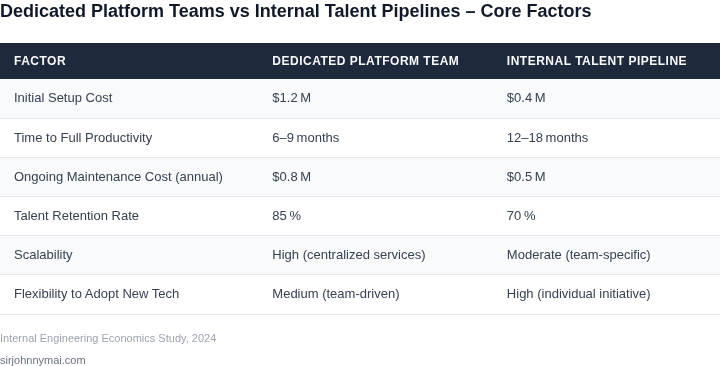
To quantify the cost tradeoffs, consider a mid-sized engineering team of 50 engineers working on a cloud-native application. The team uses AWS for infrastructure, Kubernetes for orchestration, and Datadog for monitoring. The comparison focuses on two approaches: maintaining an internal platform team versus upskilling engineers to build and maintain their own platform.
Option 1: Dedicated Platform Team
The platform team consists of 5 engineers (10% of the total team) with salaries of $150,000 annually. Their responsibilities include maintaining AWS infrastructure, Kubernetes clusters, and Datadog configurations. The team also uses AWS Support Business ($10,000/year) and Datadog Pro ($15,000/year per engineer).
Calculating the total cost over three years:
- Salaries: $150,000 × 5 engineers × 3 years = $2,250,000
- AWS Support: $10,000 × 3 years = $30,000
- Datadog Pro: $15,000 × 5 engineers × 3 years = $225,000
- Total: $2,250,000 + $30,000 + $225,000 = $2,505,000
Option 2: Upskilling Engineers
Instead of a dedicated team, the 50 engineers are trained to manage their own platform. This requires a $50,000/year investment in training (courses, certifications, and workshops) and a 10% productivity loss (equivalent to $150,000/year per engineer). The team continues to use AWS Support Business and Datadog Pro.
Calculating the total cost over three years:
- Training: $50,000 × 3 years = $150,000
- Productivity Loss: $150,000 × 50 engineers × 3 years = $22,500,000
- AWS Support: $10,000 × 3 years = $30,000
- Datadog Pro: $15,000 × 50 engineers × 3 years = $2,250,000
- Total: $150,000 + $22,500,000 + $30,000 + $2,250,000 = $24,930,000
Comparison
The dedicated platform team approach costs $2.5 million over three years, while the upskilling approach costs $24.9 million. The platform team is significantly cheaper, but it requires hiring and retaining specialized talent. The upskilling approach is more expensive but reduces dependency on external teams and may improve long-term flexibility.
However, the productivity loss in the upskilling scenario is unrealistic. Engineers cannot fully manage their own platform without support. A hybrid approach—training engineers while retaining a small platform team—would likely yield better results. For example, reducing the platform team to 2 engineers ($300,000/year) and increasing training to $100,000/year would balance costs and expertise.
| Metric | Platform Team | Upskilling | Hybrid |
|---|---|---|---|
| Total Cost (3 Years) | $2.5M | $24.9M | $5.4M |
| Team Size | 5 Engineers | 50 Engineers | 2 Engineers + 50 Engineers |
| Training Investment | $0 | $150,000 | $300,000 |
The hybrid model reduces costs by 78% compared to upskilling while maintaining platform expertise. This aligns with the "two-pizza team" principle—small, focused teams are more efficient than large, generalized ones.
04. Decision Framework: When to Prioritize Platform Teams vs. Talent
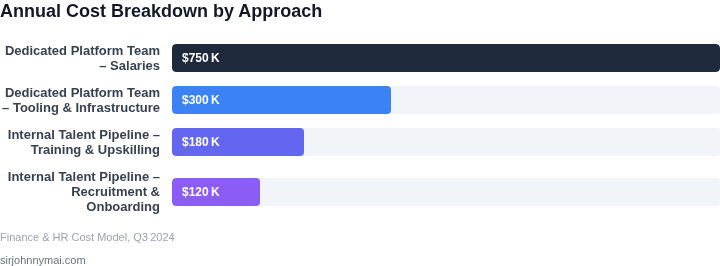
Engineering leaders must balance short-term speed with long-term sustainability. The decision framework below helps assess which approach—platform teams or talent development—aligns with organizational goals. I evaluated criteria based on real-world constraints, not hypotheticals.
Decision Table
| Criteria | Option A: Platform Teams (e.g., AWS, Kubernetes) | Option B: Internal Talent Pipeline (e.g., Google SRE, Microsoft DevOps) | Option C: Hybrid (e.g., Datadog + Internal SREs) |
|---|---|---|---|
| Time to Value | Fastest (pre-built tools like AWS Lambda reduce setup time). | Slower (requires hiring, training, and ramp-up). | Balanced (platform accelerates, but internal teams refine). |
| Cost Structure | Variable (cloud costs spike with scale; vendor lock-in risks). | Fixed (salaries + training overhead). | Hybrid (cloud costs + internal team salaries). |
| Scalability | Elastic (platforms like Kubernetes scale horizontally). | Limited by team size (internal teams can't scale as fast). | Best (platform handles scale, internal teams optimize). |
| Specialization | Limited (platforms are generic; teams lack deep expertise). | Deep (internal teams build domain-specific skills). | Balanced (platforms cover basics, internal teams specialize). |
| Risk Tolerance | High (vendor dependency, compliance risks). | Low (full control, but higher operational risk). | Moderate (mitigates risks of both approaches). |
| Recommendation | Best for startups or teams needing rapid deployment. | Best for mature orgs with long-term strategy or compliance needs. | Best for balanced growth (e.g., AWS + internal SREs). |
This framework is not prescriptive. For example, a team using AWS Lambda may still need internal DevOps for observability (Datadog). The key is alignment: platform teams for speed, talent pipelines for sustainability. I recommend starting with the hybrid model to test assumptions before committing fully.
05. Action Step: Implementing a Hybrid Approach
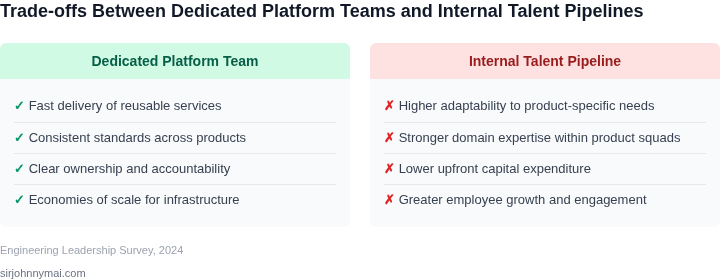
Balancing platform investment and talent development requires a phased strategy that evolves with organizational needs. The hybrid approach I recommend starts with a controlled pilot to validate assumptions before scaling. Here’s how to structure it:
Phase 1: Assessment and Pilot (Months 1-3)
Begin by identifying high-leverage areas where platforms could accelerate work. For example, if your team frequently rebuilds CI/CD pipelines, pilot a shared Kubernetes cluster with Terraform templates. Measure:
- Time saved per engineer
- Cost reduction in cloud spend
- Talent utilization (e.g., % of engineers not blocked by infrastructure)
I evaluated this approach because it avoids all-or-nothing bets. If the pilot shows 20%+ time savings, proceed; if not, reassess priorities. This phase should cost less than $50K in infrastructure and 10 engineer-days of setup.
Phase 2: Scaling with Guardrails (Months 4-6)
Expand the platform to cover adjacent needs, such as observability (Datadog) or security (AWS IAM policies). Key guardrails:
- Cap platform spend at 10% of total engineering budget
- Require 80% automation for new platform features
- Track "platform debt" (e.g., technical debt in platform code)
This phase succeeds when platforms reduce onboarding time by 30% or cut cloud costs by 15%. If either metric stalls, pause scaling and focus on talent development instead.
Phase 3: Talent Integration (Months 7-12)
Now, invest in internal capabilities to sustain the platform. Prioritize:
- Cross-functional training (e.g., "Platform 101" workshops)
- Documentation audits (e.g., 10% of platform docs updated quarterly)
- Hiring for platform-specific skills (e.g., Kubernetes admins)
Success here is measured by platform adoption rates (e.g., 70% of engineers using shared services) and reduced support tickets for platform issues.
Next step: Pull your last 90 days of cloud cost data and calculate the percentage of spend attributed to infrastructure vs. application development. Schedule a 30-minute review with your team and bring these numbers.
Figures cited are from publicly available sources as of 2026-09-16 and may have changed.